


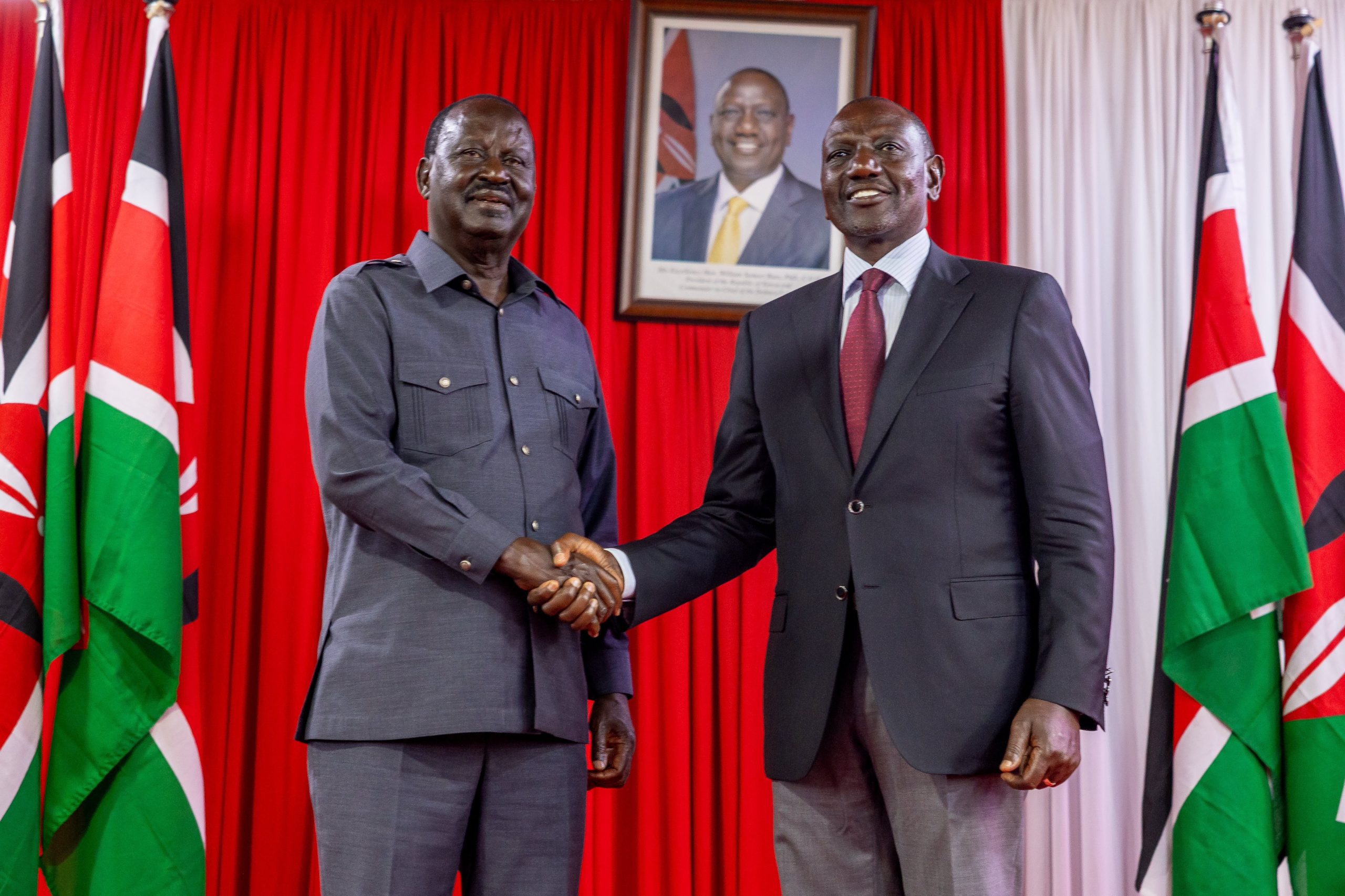
A new report by TIFA Research has revealed that more than half of Kenyans—54 percent—do not support the idea of a Broad-Based Government (BBG). Only 22 percent of those surveyed are in favour of the political arrangement, while 25 percent said they had no opinion.
According to the report, 28 percent of respondents want Azimio leader Raila Odinga to return to the opposition and run for the presidency in the 2027 General Election.
“It is unclear whether the remaining one-fifth who declined to express an opinion (22%) did so because they have mixed feelings about the BBG, have a negative view but were too uncomfortable to express it, or because they felt they did not have enough information to have a firm opinion one way or the other,” the report stated.
Support for the Broad-Based Government varies widely across the country. It is strongest in the Central Rift region, President William Ruto’s home area, where 37 percent of residents support the idea. In contrast, support is lowest in the Mt. Kenya and Lower Eastern regions—home areas of former Deputy President Rigathi Gachagua and Wiper leader Kalonzo Musyoka—where only 13 percent and 12 percent, respectively, back the BBG.
Interestingly, Nyanza region, which is traditionally associated with Raila Odinga, gives the third-highest level of support for the BBG. This could reflect the recent warm relations between Odinga and the Kenya Kwanza government, including the participation of several senior ODM leaders in government activities.
The TIFA report also shows that public opinion about the BBG is closely tied to how people feel about the direction the country is taking and their personal economic situations. Among BBG supporters, the country’s direction is viewed almost evenly between positive and negative (42% vs. 44%). However, among opponents of the BBG, a staggering 88 percent believe the country is headed in the wrong direction, compared to just 4 percent who think otherwise.
Even among those who had no opinion on the BBG, 74 percent believe Kenya is on the wrong path, while only 11 percent think the country is on the right track.
The report also highlights how economic hardship may be shaping political views. Among those who oppose the BBG, 85 percent say their financial situation has worsened since the 2022 elections, compared to only 4 percent who say it has improved. In contrast, BBG supporters are more divided: 52 percent say their economic situation has worsened, while 26 percent say it has improved.
This suggests that while economic challenges play a major role in shaping public opinion, they are not the only factor. Notably, 52 percent of BBG supporters still report a worsened economic situation, while just 4 percent of those whose finances have improved say they oppose the BBG.
The latest political developments also come after the ODM and UDA parties came together following the nationwide Gen Z-led protests. The two parties met at the Kenyatta International Convention Centre (KICC) and signed a Memorandum of Understanding to address several concerns raised during the demonstrations.
Email your news TIPS to Editor@Kahawatungu.com — this is our only official communication channel
