


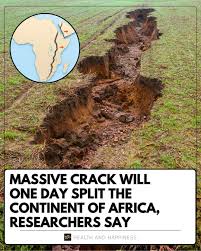
The African continent will one day break in two, with a new ocean filling the void between the separation, scientists say.
Researchers have determined that Eastern Africa will likely split from the rest of the continent along the Turkana Rift, a 310-mile-long region spanning Kenya and Ethiopia, because it exhibits characteristics of late-stage continental rifting, according to a paper published in Nature Communications.
Continental rifting is what happens when the Earth’s crust — the outermost layer that is rocky and hard — begins to extend, Christian Rowan, a Ph.D candidate at Columba University’s Department of Earth and Environmental Sciences, told ABC News. The crust then starts to break, fracture and subside as it extends, which then creates the rift system.
Turkana is the only active rift on Earth that is exhibiting “necking” — a geological phase in which new ocean basins are formed. All of the processes of deformation, faulting and sedimentation are localized in one area, causing the Earth’s crust to thin dramatically, according to Rowan, the study’s lead author.
When the crust completely breaks through the continued extension, new oceanic crust can form.
“All of Eastern Africa, from Mozambique in the south all the way up to the north to the Afar, which is up in Ethiopia, is undergoing this process of continental rifting,” he said.
Turkana is nearing its critical breakup stage, the researchers said. The Afar region in the north, near the Red Sea and Gulf of Aden, is showing early versions of oceanic crust, Rowan said.
“It’s basically almost breaking up there,” he said.
One of the most famous cases of continental rifting is the idea of Pangea, the supercontinent that broke up and formed the Atlantic Ocean hundreds of millions of years ago.
Turkana began pulling apart about 45 million years ago, the researchers said. The necking is estimated to have begun about 4 million years ago as a result of widespread volcanic eruptions.
Researchers have previously recognized the East African Rift, where Turkana is located, but there is debate over whether it would eventually break, Rowan said. The new research indicates an actual breakup of the continent in a few million years, according to the researchers.
The team studied seismic reflection data — essentially an ultrasound of the shallow subsurface of the upper 6 miles of the Earth’s crust — to form acoustic waves that travel through the sediments and create an image of the subsurface.
The data indicates that the region is further along in continental rifting than previously thought, the researchers said.
The geography of Eastern Africa is extremely important for residents, Rowan said. On the western branch of the Eastern Africa rift system are Lake Tanganyika and Lake Malawi, which have significant economic value in the form of food and human settlement, he added.
Turkana, which has produced more than 1,200 fossils of hominins — or early humans — is the site of the Cradle of Humankind that has long fascinated scientists.
The rift system at the same site offers another layer of interest for researchers to explore. The geological conditions there may have aided in preserving the fossil record, Rowan said.
“What our study has done is looked actually at the rift itself, the structure of the rift there, and the processes that are ongoing — and have tied that to the fossil record, to understand how this world-famous fossil record has come to be,” Rowan said.
By ABC News

Email your news TIPS to Editor@Kahawatungu.com — this is our only official communication channel
