


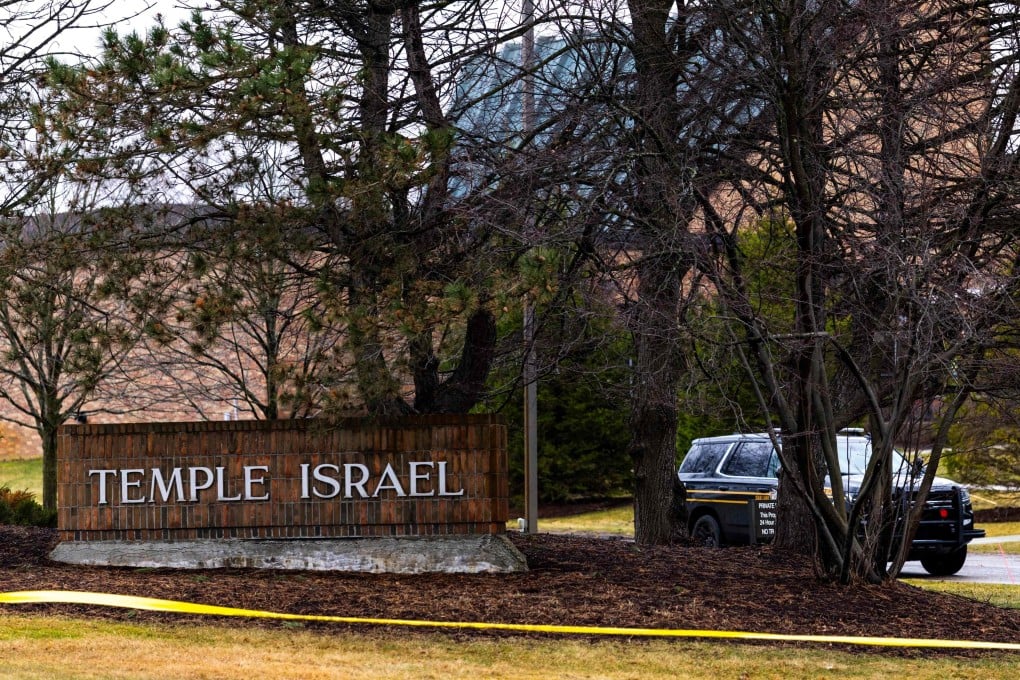
The attack on a Michigan synagogue earlier this month was a “Hezbollah-inspired act of terrorism”, federal officials have said.
The FBI on Monday said the accused assailant, Ayman Muhammad Ghazali, “purposely [targeted] the Jewish community and the largest Jewish temple in Michigan” and was “inspired by Hezbollah’s militant ideology”.
Ghazali, a naturalised US citizen from Lebanon, rammed his truck into Temple Israel in West Bloomfield on 12 March. Dozens of children were inside the synagogue at the time.
His recovered online activity showed repeated searches for pro-Hezbollah news channels and for queries on large gatherings of Israelis in Michigan, the FBI said in a news conference.
Ghazali died of a self-inflicted gunshot wound to the head during the attack, authorities said. No others were killed but a security guard was injured and multiple officers were treated for smoke inhalation.
His online history over the past months included searches for videos about shootouts and bullets and for “news coverage of an Iranian fatwa for total jihad against the US military”, FBI Special Agent Jennifer Runyan said on Monday.
Authorities noted that he also consumed live coverage about Naim Qassem, the secretary-general for Hezbollah, an Iranian-backed militia and a political party designated by the US as a foreign terrorist organisation.
In the days before the attack, Ghazali purchased an AR-style rifle along with 10 rifle magazines and about 300 rounds of ammunition, Runyan said. He also bought fireworks, torch lighters and gallons of gasoline.
The day before the incident, he started adding photos to a Facebook album he entitled “vengeance”, including with images of Iran’s Supreme Leader, Ayatollah Ali Khamenei, who was killed during the first wave of strikes by the US and Israel in the war with Iran.
On 12 March, while parked at the temple, Ghazali sent his sister overseas videos, photos and messages that “reiterated his intent to commit a mass terrorist attack”, Runyan said.
In a video sent just before the attack, Ghazali said in Arabic that he had booby-trapped his car. He then said: “I will forcefully enter and start shooting at them. God willing, I will kill as many of them as I possibly can,” according to the FBI.
He also exchanged five short phone calls with his ex-wife, who called police and asked then to do a welfare check on him.
Ghazali then drove his vehicle into the temple doors twice, the first time unsuccessfully, officials said. He exchanged gunfire with security guards before appearing to set off fireworks from inside his truck, according to the FBI. The vehicle caught fire and the hallway filled with smoke.
Authorities have not found any evidence that Ghazali had co-conspirators.
Ghazali was not the subject of or referenced in any prior FBI investigation, nor was he on its terrorist watch list, authorities said.
If Ghazali had lived, he would have been charged with providing material support to Hezbollah, said Jerome Gorgon, US attorney for the Eastern District of Michigan.
In days after the attack, the Israel Defense Forces (IDF) said Ghazali’s brother was a Hezbollah commander who was recently killed in an airstrike. The BBC has not independently confirmed the brother’s identity.
By BBC News

Email your news TIPS to Editor@Kahawatungu.com — this is our only official communication channel
