


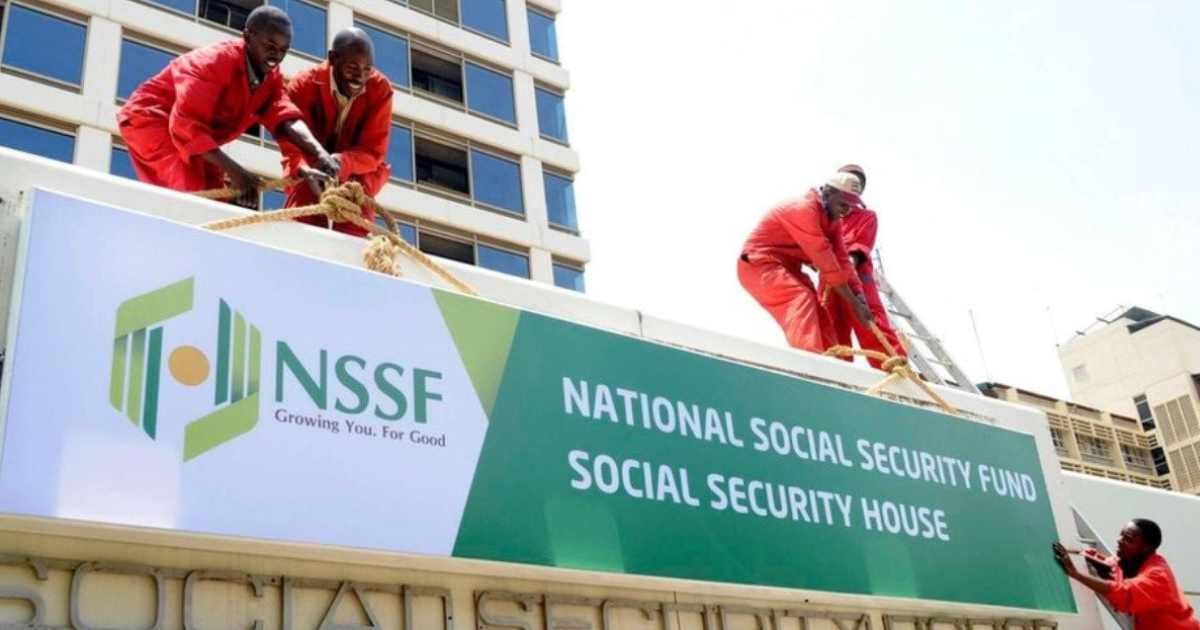
Members of Parliament have questioned top officials from the National Social Security Fund (NSSF) over idle funds, poor planning, and procurement irregularities flagged in recent audit reports.
The National Assembly’s Public Investments Committee on Social Services, Administration, and Agriculture (PIC-SSAA) summoned NSSF leadership on Tuesday to respond to concerns raised by the Auditor-General for the financial years 2021/2022 to 2023/2024.
The meeting was led by the committee’s Vice-Chairperson, Saboti MP Caleb Amisi.
The audit revealed that NSSF collected Sh105.3 billion in revenue—Sh26.3 billion more than the budgeted Sh78.9 billion. The extra income came mainly from increased member contributions under the revised NSSF Act and the inclusion of public servants from August 2023.
But MPs were not impressed, questioning why such a big jump wasn’t predicted in the budget.
“The purpose of a budget is to guide an organisation,” said Ndhiwa MP Martin Peters Owino. “Overshooting by that much shows poor planning.”
NSSF CEO David Koros said the unexpected growth was due to new contribution rates and improved investment returns. “We collected Sh26 billion in 2022/2023 and projected Sh38 billion in 2023/2024, showing a 46% increase. Investment income was also Sh6 billion above budget thanks to strong markets,” he said.
Despite the large revenue, MPs were concerned that only Sh206 million of the Sh4.06 billion capital budget was used—an absorption rate of just 5%.
Othaya MP Michael Wambugu warned that failing to invest these funds lowers returns for contributors.
Koros blamed the low spending on delayed project approvals and a freeze on capital projects issued by the National Treasury in March 2024. “We got approvals in January 2024, leaving little time for implementation,” he explained.
The Auditor-General also questioned a Sh940 million tax refund the Fund is yet to receive—mostly from the Kenya Revenue Authority (KRA) and dating back to 1996–1997. This was after NSSF had already been declared tax-exempt.
“This money is just sitting there, earning nothing,” said the report.
Koros said the matter is still being followed up with KRA, despite a 2016 High Court ruling and a six-month deadline given by Parliament years ago. “This is a legacy issue and we continue to pursue it,” he added.
MPs also raised concerns over a Sh115 million land purchase in Upper Hill that later turned out to be public land. The title deed was revoked in 2010 and the land was taken back by the government and given to the Judiciary.
“How could such a major purchase be made without proper checks?” asked MP Bishop Kosgei.
Amisi echoed the concern, asking whether any due diligence had been done before buying the land.
Koros said the matter is in court, with a hearing scheduled for June 11, 2025, and that the Ethics and Anti-Corruption Commission (EACC) is investigating.
Auditors also found that NSSF spent Sh317 million on meetings and travel, including Sh11.3 million on conference services bought from suppliers who were not registered, which goes against procurement rules.
In one shocking case, a hotel was paid Sh3.3 million for services that were only approved for Sh1 million—an overpayment of Sh2.3 million.
Kaiti MP Joshua Kimilu didn’t hold back. “Don’t try to explain mistakes. If it was wrong, say so,” he said.
Koros admitted the mistake but said changes had been made to avoid repeat issues. “The extra spending came from an extra day of preparation. We got retrospective approval,” he said.
Wajir County MP Fatuma Jehow questioned whether the Fund’s investments in Treasury bonds were giving members good returns.
Koros assured MPs that the Fund’s money was being invested wisely. “The money is safe, and we continue to invest it to earn returns,” he said.
Email your news TIPS to Editor@Kahawatungu.com — this is our only official communication channel
