


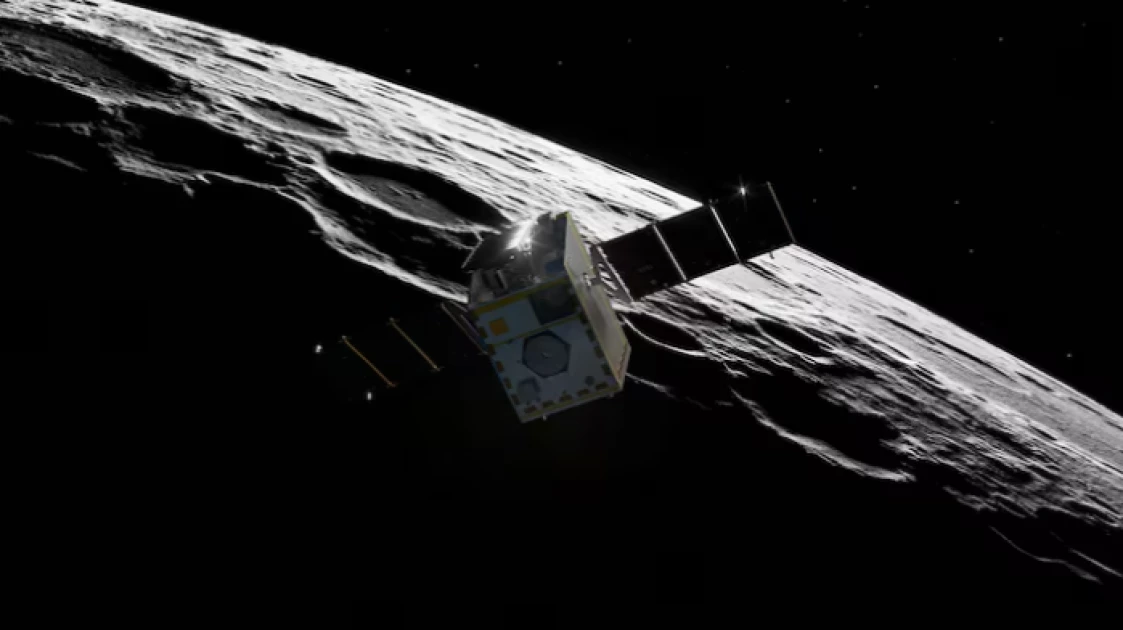
A dishwasher-sized NASA satellite was launched into space from Florida on Wednesday to identify where water – a precious resource for lunar missions – resides on the moon’s surface in places such as the permanently shadowed craters at its poles.
A SpaceX Falcon 9 rocket lifted off from the Kennedy Space Center in Cape Canaveral, carrying NASA’s Lunar Trailblazer orbiter.
The Lunar Trailblazer spacecraft was built by Lockheed Martin’s space division. The satellite was a secondary payload onboard the rocket, with the primary payload being a lunar lander mission led by Intuitive Machines.
The lunar surface is often thought of as arid, but previous measurements have found the presence of some water, even in warmer sun-lit locations. In cold and permanently shadowed places at the lunar poles, it has long been hypothesized that there could be significant amounts of water ice.
Lunar Trailblazer, which weighs about 440 pounds (200 kg) and measures about 11.5 feet (3.5 meters) wide when its solar panels are fully deployed, is being sent to find and map this water on the moon’s surface.
For future moon exploration, including potential long-term lunar bases staffed by astronauts, lunar water would be of vital importance because it could be processed not only as a drinking supply but also into breathable oxygen and hydrogen fuel for rockets.
The bottoms of hundreds of craters at the moon’s South Pole, for instance, are permanently shadowed and may hold ice patches. Some water may also be locked inside broken rock and dust on the lunar surface.
Lunar Trailblazer is scheduled to perform a series of moon flybys and looping orbits over a span of several months to position itself to map the surface in detail. It eventually will orbit at an altitude of roughly 60 miles (100 km) and collect high-resolution images of targeted areas to determine the form, distribution and abundance of water and to better understand the lunar water cycle.
“We see tiny amounts of water on sunlit portions of the moon, which is mysterious,” said planetary scientist Bethany Ehlmann, the mission’s principal investigator and director of Caltech’s Keck Institute for Space Studies.
But, Ehlmann added, “The most interesting (aspect) for many is the potentially large amounts of ice in the permanently shadowed regions of the lunar poles. Lunar Trailblazer will peer inside to see how much is at the surface.”
Such locations could serve as a resource for lunar explorers in the future.
“Understanding where a rover would drive or an astronaut would walk to examine deposits for science and future resource use will benefit all future landed missions,” Ehlmann said.
Two Lunar Trailblazer instruments will take measurements from orbit together. The Lunar Thermal Mapper, or LTM, will map and measure the lunar surface temperature. The High-resolution Volatiles and Minerals Moon Mapper, or HVM3, will look at the moon’s surface for a telltale pattern of light given off by water.
“We believe that the movement of water on the moon is likely driven by the surface temperature. So by measuring the presence and amount of water via the HVM3 instrument and the surface temperature via the LTM instrument, we can better understand this relationship,” said University of Oxford planetary scientist Tristram Warren, who worked on developing the LTM instrument.
Lunar water is thought to come from several potential sources. One possibility is that solar wind – charged particles from the sun – could react with lunar minerals to create water. Another source might be comets or meteorites, which may have delivered water to the moon over billions of years. The exact amount of lunar water remains uncertain, but it is potentially hundreds of millions of tons.
“Other than for human exploration, lunar water is also scientifically very exciting. The moon has been orbiting near the Earth almost since the formation of Earth itself. So, understanding the origin of the lunar water might help us to understand the origin of water on Earth,” Warren said.
By Agencies

Email your news TIPS to Editor@Kahawatungu.com — this is our only official communication channel
