


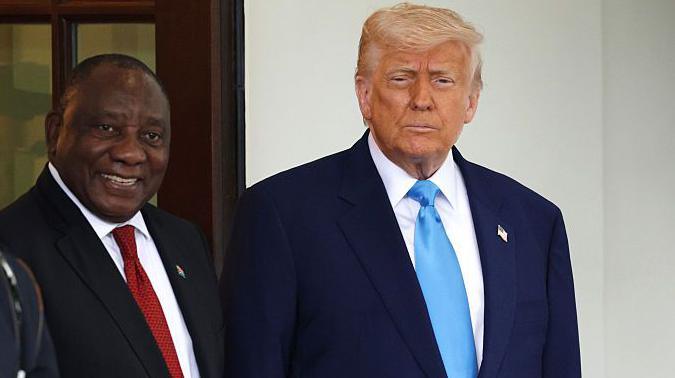
South African products exported to the US will be hit by a 30% tariff from 7 August, President Donald Trump has announced.
South Africa faces the highest rate in sub-Saharan Africa, reflecting Trump’s strained relationship with the government of President Cyril Ramaphosa.
Other African nations, including Nigeria, Ghana, Lesotho and Zimbabwe have been hit with a 15% tariff, which will also come into effect in seven days.
The decision is a huge blow to South Africa, as the US is its second-biggest trading partner.
Looking across the whole continent, including North Africa, exports from Algeria and Libya will now also incur a 30% tariff at the US border.
Tunisian goods are facing a 25% rate. Goods from Kenya and Ethiopia, on the other hand, will be charged at the lower 10% rate.
Tariffs are taxes charged on goods bought from other countries – typically, they are a percentage of a product’s value.
Trump argues that introducing tariffs will protect American businesses from foreign competition and also boost domestic manufacturing and jobs.
South Africa’s automobile, farming and textile sectors had enjoyed duty-free access to the US market under the African Growth and Opportunity Act (Agoa), which was enacted in 2000 to help countries on the continent create jobs and grow their economies.
Trump’s announcement effectively spells the end of Agoa, even though it is officially up for review in September.
Ahead of Trump’s 1 August deadline, South Africa had been trying to agree a trade deal with the US, which included buying US liquefied natural gas, simplifying rules for US poultry imports and investing $3.3bn (£2.5bn) in US industries like mining, according to the Reuters news agency.
Reacting to the news of the 30% tariff, Ramaphosa said his administration would “continue negotiating with the US” and had “submitted a framework deal” to its US counterpart.
“In the meantime, government is finalising a package to support companies that are vulnerable to the reciprocal tariffs.”
The government also noted that there were exceptions for certain goods, such as copper, pharmaceuticals, semiconductors, some critical minerals, stainless steel scrap and energy products.
US-South Africa relations have hit rock-bottom since Trump took office in January.
The US president has stopped all aid to South Africa, accusing it of discriminating against its white minority. South Africa has repeatedly denied this.
Ramaphosa held talks with Trump in May in a bid to mend relations but this failed to make any headway.
Earlier this week, Trump indicated he would “maybe send someone else” to the G20 Leaders Summit taking place later this year in Johannesburg.
“I’ve had a lot of problems with South Africa. They have some very bad policies,” he told reporters.
Other African nations have also reacted to the tariffs announcement.
Kenya said it welcomed having the “lowest rate among nations with comparable export interests”.
The east African country’s trade and industry department also said it remained “committed to deepening its longstanding trade and investment” with the US and would continue engaging with its counterpart to “safeguard and grow the historical trade ties that have benefited both our countries”.
In Lesotho, Trade Minister Mokhethi Shelile lamented the announcement of the 15% tariff, telling the BBC that the country’s textile and garment industry “will not be able to compete at all” with other markets.
Lesotho is one of the African nations that have benefited most from Agoa, exporting jeans for iconic American brands such as Levi’s and Wrangler among others. It had initially been threatened with a rate of 50% – higher than any other country.
The textile industry, the country’s largest private employer, has already been affected by the uncertainty around Agoa and the tariffs, leading to some factories cutting staff or shutting down altogether.
By BBC News

Email your news TIPS to Editor@Kahawatungu.com — this is our only official communication channel
