


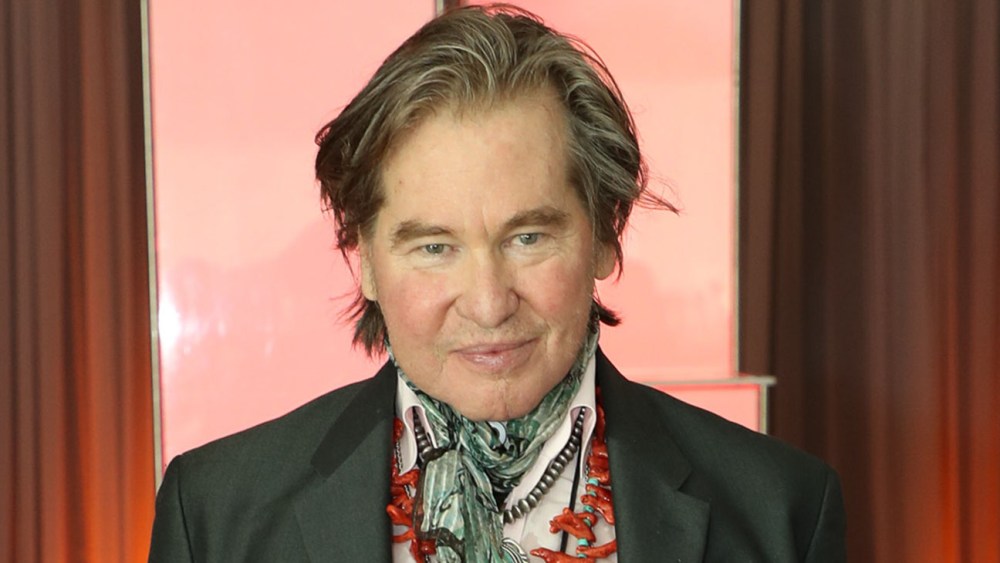
Val Edward Kilmer was an acclaimed American actor renowned for his performances across a wide array of genres.
Born on December 31, 1959, in Los Angeles, California, Kilmer emerged as a leading man in Hollywood during the 1980s and 1990s, captivating audiences with his intense charisma, sharp wit, and chameleon-like ability to embody complex characters.
His career spanned over four decades, amassing a global box office haul exceeding $3.85 billion, and he left an indelible mark on cinema with roles that ranged from the cocky fighter pilot Iceman in Top Gun to the enigmatic rock icon Jim Morrison in The Doors.
Kilmer’s personal life was equally compelling, marked by triumphs and tragedies, including a profound battle with throat cancer diagnosed in 2015 that altered his voice and health, yet never dimmed his passion for storytelling.
He chronicled his journey in the 2020 memoir I’m Your Huckleberry and the 2021 documentary Val, which offered intimate glimpses into his artistic evolution and resilience.
Kilmer passed away on April 1, 2025, at the age of 65 from pneumonia in Los Angeles.
Siblings
Val was the middle child in a family of three brothers, born to parents Gladys Swanette Ekstadt, of Swedish descent, and Eugene Dorris Kilmer, an industrialist with Irish, German, and Cherokee ancestry.
His older brother, Mark Kilmer, shared a childhood with Val in the sun-soaked sprawl of Los Angeles, though their relationship later grew strained following their father’s death in 1993.
Mark, who maintained a low public profile, became a father to two children, Thomas and Lisa, as noted in their mother’s obituary.
The youngest sibling, Wesley Thomas Kilmer, formed an especially close bond with Val, who often described him as a prodigious talent with a flair for stop-motion animation that rivaled the ingenuity of directors like Steven Spielberg or George Lucas.
Tragedy struck the family in 1977 when Wesley, just 15 years old, drowned in their father’s hot tub during an epileptic seizure—a devastating loss that occurred mere days before Val was set to depart for the Juilliard School in New York.
Career
Kilmer’s odyssey into acting began not on the silver screen but on the stage, where his precocious talent shone brightly from a young age.
After honing his craft at Hollywood Professional School and earning a spot at the prestigious Juilliard School at just 17, Kilmer made his Broadway debut in 1983 with the working-class drama The Slab Boys, showcasing a raw intensity that foreshadowed his future stardom.
Transitioning to film, he burst onto the scene with the zany spy spoof Top Secret! in 1984, lampooning espionage tropes with deadpan hilarity, followed by the cult-favorite college comedy Real Genius in 1985, where his portrayal of a brilliant, laser-wielding inventor cemented his knack for blending intellect with irreverence.
Also Read: Wille Crafoord Siblings: Meet the Siblings Squad Behind the Swedish Actor

The pivotal breakthrough arrived in 1986 with Top Gun, directed by Tony Scott, in which Kilmer’s turn as the arrogant yet magnetic Lt. Tom “Iceman” Kazansky opposite Tom Cruise’s Maverick propelled him into A-list territory and turned the film into a blockbuster phenomenon.
This high-flying success paved the way for more daring roles, including the mischievous swordsman Madmartigan in Ron Howard’s fantasy epic Willow in 1988, where his chemistry with co-stars like Warwick Davis infused the tale with warmth and whimsy.
The 1990s marked Kilmer’s zenith as a shape-shifting leading man, delving into biographical profundity with his mesmerizing embodiment of The Doors’ frontman Jim Morrison in Oliver Stone’s 1991 rock opus The Doors.
Kilmer didn’t just act the part; he lived it, performing all the band’s concert songs live on set with uncanny vocal precision, earning widespread acclaim for capturing Morrison’s poetic volatility and tragic allure.
That same year, he dazzled in Tombstone as the consumptive gunslinger Doc Holliday, delivering iconic lines like “I’m your huckleberry” with a tubercular drawl that blended fragility and ferocity, turning the Western into a box-office darling.
Kilmer’s caped crusade came in 1995’s Batman Forever, where he succeeded Michael Keaton as Bruce Wayne, infusing the Dark Knight with a brooding physicality amid Joel Schumacher’s neon-drenched spectacle.
He navigated further genre terrain in Heat (1995) as a cunning thief clashing with Al Pacino’s detective, The Ghost and the Darkness (1996) as a big-game hunter battling killer lions, and The Saint (1997) as the suave master of disguise Simon Templar, showcasing his effortless adaptability.
As the millennium turned, Kilmer’s career embraced edgier, more eclectic fare, from the psychological thriller The Salton Sea (2002), where he portrayed a tormented jazz musician, to the meta-noir romp Kiss Kiss Bang Bang (2005) alongside Robert Downey Jr., which the Phoenix Film Critics Society hailed as the Overlooked Film of the Year.
He revisited familiar skies in Top Gun: Maverick (2022), reprising Iceman in a poignant, voice-altered cameo that bookended his legacy with emotional resonance.
Accolades
Kilmer’s portrayal of the fractured informant in The Salton Sea earned him the 2003 Prism Award, celebrating depictions of mental health and addiction with sensitivity and grit.
The 2005 neo-noir Kiss Kiss Bang Bang further burnished his credentials, clinching the Phoenix Film Critics Society’s prize for Overlooked Film of the Year, a testament to its sharp script and Kilmer’s sly interplay with Downey.
Later in his career, the introspective documentary Val (2021), co-produced by his children and narrated in part by his son Jack, premiered to rapturous reviews at the Cannes Film Festival and secured two Critics’ Choice Documentary Awards: one for Best Archival Documentary and another for Best Editing, honoring its raw excavation of Kilmer’s highs, lows, and health odyssey.
Kilmer’s stage roots also yielded acclaim, including a Drama Desk nomination for his one-man show Citizen Twain in 2012, where he channeled Mark Twain’s wry humanism.
Beyond formal honors, his influence echoed in cultural touchstones—a Bowling for Soup track titled after him in 2006—and in the heartfelt tributes from peers like Josh Brolin and Tom Cruise upon his passing, affirming a legacy etched not just in gold statues, but in the collective memory of cinema’s golden eras.
Email your news TIPS to Editor@Kahawatungu.com — this is our only official communication channel
