


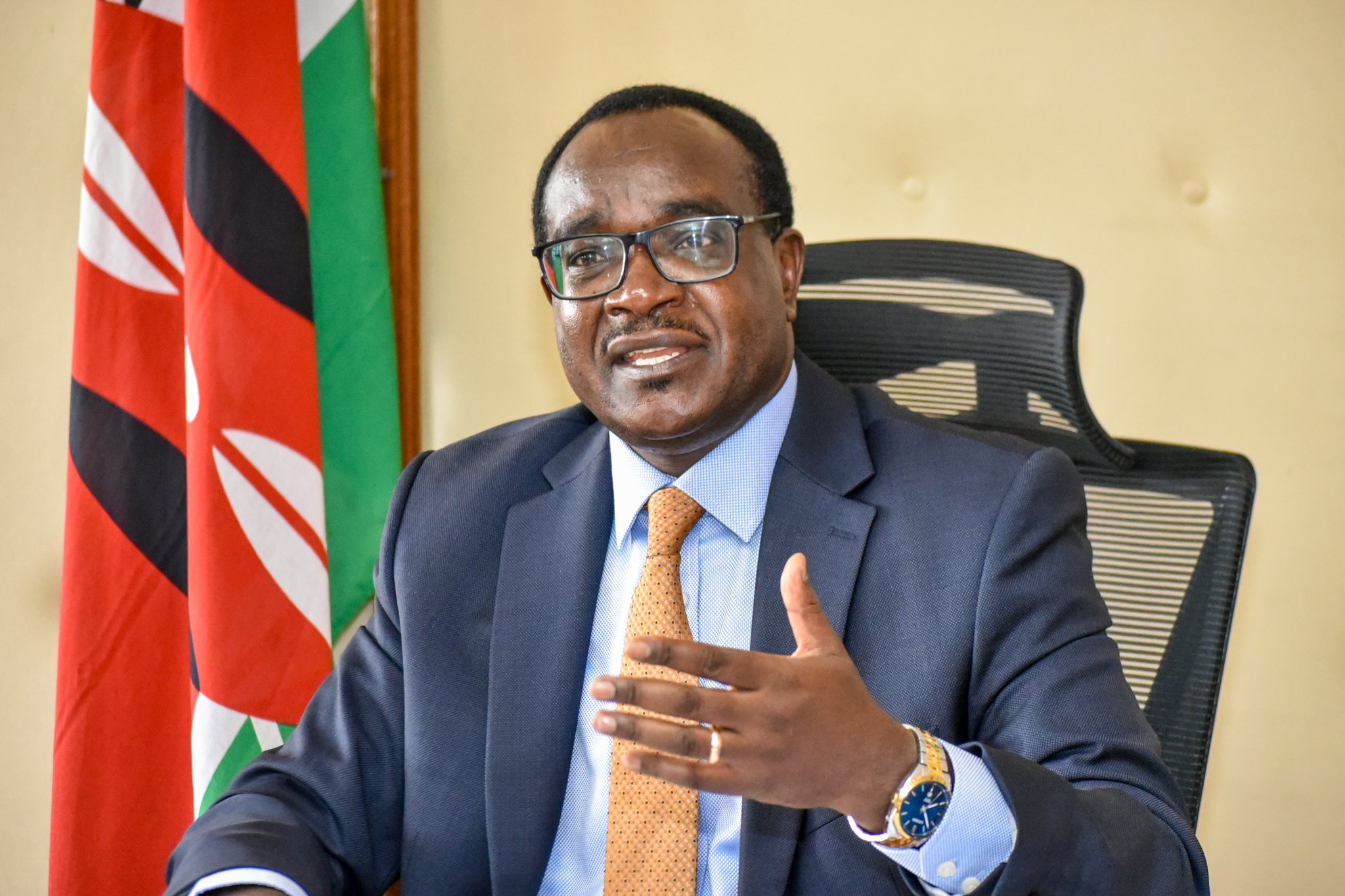
Education Cabinet Secretary Julius Migos has defended the government’s decision to switch capitation disbursements from the National Education Management Information System (NEMIS) to a new platform, Kenya Education Management Information System (KEMIS), amid growing concerns over delayed funding to schools.
Speaking before the National Assembly’s Committee on Education, CS Migos was taken to task by MPs who warned that the delays were threatening the delivery of free and compulsory education across the country.
The meeting came after Kathiani MP Robert Mbui raised concerns about serious underfunding in public schools. He said that during the first term of 2025, schools only received Sh14 billion of the expected Sh28 billion, which had created financial pressure and left many institutions struggling with unpaid bills.
Mbui further revealed that capitation arrears had grown to Sh64 billion over the last five years, making it difficult for schools to operate smoothly.
“How free is education in Kenya if schools are forced to run on half their budgets?” asked Hon. Rebecca Tonkei. “The government must explain how schools are expected to function with such uncertainty.”
In his response, CS Migos admitted there was a shortfall in funding, noting that although Sh28.8 billion was disbursed to secondary schools in two instalments—January and March 2025—it was still Sh7.5 billion less than the required Sh36.3 billion for the term.
“We disbursed 50% of the budgeted amount, but the printed estimates already had a deficit. This reflects the financial pressure the country is facing,” he said.
Committee Chair Julius Melly added that Kenya’s growing population—rising at nearly 5% per year—was placing more pressure on the education budget.
“Free education must be meaningful. We need sustainable funding solutions,” said Melly.
CS Migos explained that while NEMIS was previously used for budgeting, disbursement had now shifted to KEMIS to resolve data issues. “We had to move to KEMIS because of persistent challenges with data accuracy in NEMIS,” he said.
However, MPs were not fully satisfied. Clive Gesairo questioned how the Ministry could be unaware of the pending bills schools were facing. “This shows a serious gap in planning. The Ministry must know exactly how much it owes,” he said.
The Committee also heard that in 2025, each primary school learner was allocated Sh1,420, junior secondary school learners Sh15,043, and secondary school learners Sh22,244. However, not all funds go directly to schools.
For example, Sh75 per primary pupil is deducted for textbooks and sent to the Kenya Institute of Curriculum Development (KICD), while Sh20 supports co-curricular activities.
On exam funding, the CS clarified that national exams are funded separately through allocations to the Kenya National Examinations Council (KNEC), not through capitation. Internal school exams receive Sh36 per learner in primary, Sh647 in junior secondary, and 11% of tuition funds in secondary schools.
To improve efficiency, Migos said capitation is now disbursed in three phases: 50% in Term 1, 30% in Term 2, and 20% in Term 3. He blamed delays in exchequer releases and errors in data submissions by schools as major causes of the funding delays.
The CS appealed to Parliament for support in securing full budget allocations in the next financial year. “We urge this Committee to support the Ministry so that all schools receive what they are entitled to. No child should be left behind,” Migos said.
Email your news TIPS to Editor@Kahawatungu.com — this is our only official communication channel
