


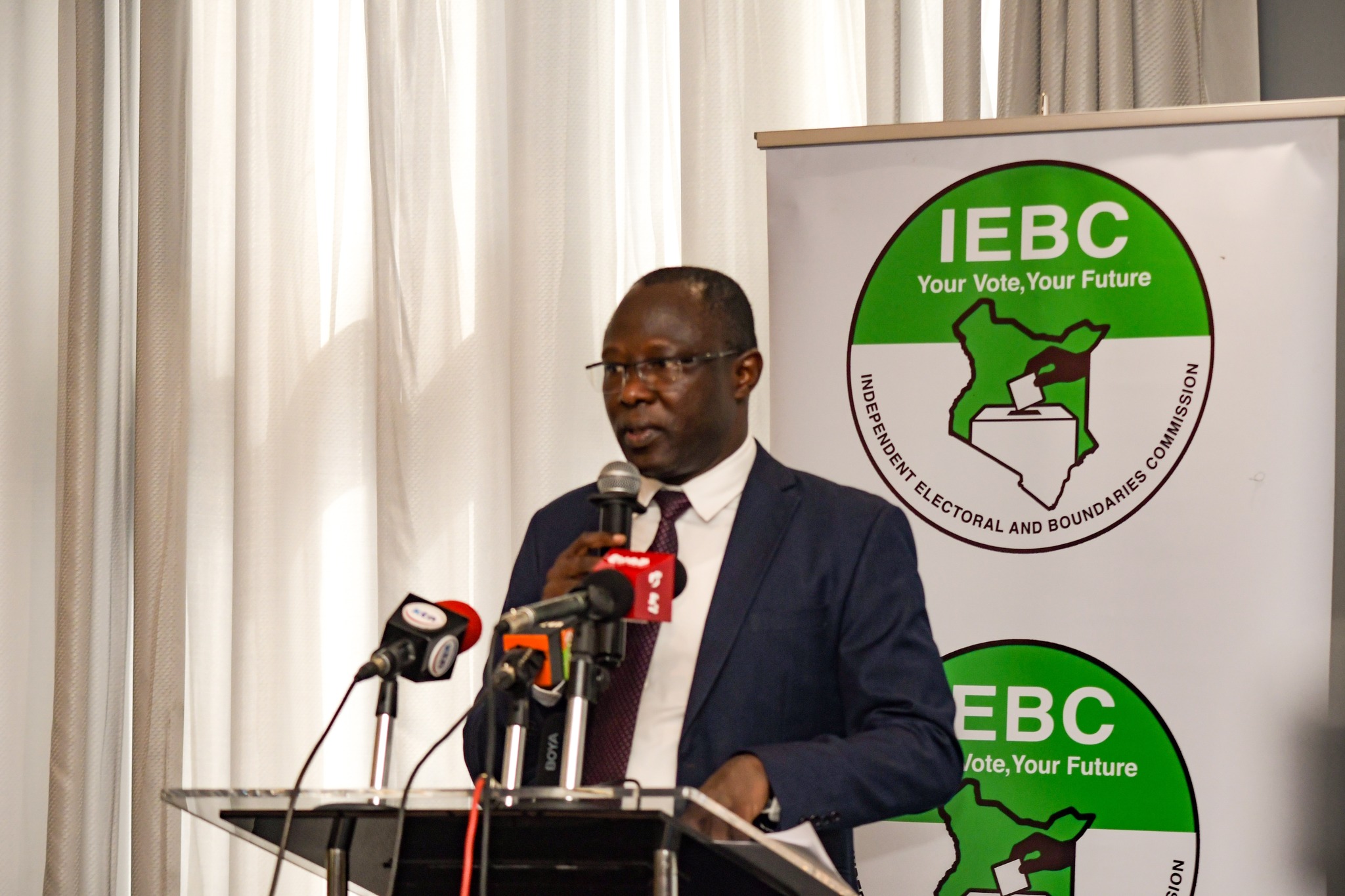
The Independent Electoral and Boundaries Commission (IEBC) has announced that it will review constituency and ward boundaries using a phased approach, citing constitutional requirements, court rulings, limited resources and preparations for the 2027 General Election.
In a statement issued on Tuesday, IEBC Chairperson Erastus Edung Ethekon said the decision was reached after a detailed assessment of the law, past judicial guidance and the country’s electoral calendar.
“This decision reflects the Commission’s commitment to upholding constitutionalism while safeguarding the integrity and preparedness of the electoral process,” Ethekon said.
Boundary delimitation is a key constitutional role of the IEBC and is meant to uphold the principle of “one person, one vote, one value” by ensuring fair representation based on population changes and geographic realities. The Constitution requires the Commission to periodically review electoral boundaries to prevent voter dilution and promote equity.
IEBC last conducted a full boundary review in 2012. In preparation for the second review cycle, the Commission developed the Boundaries Review Operations Plan (BROP) 2019–2024, which guided planning, data collection, public participation and capacity building. According to the Commission, significant preparatory work was carried out from 2019, including pilot studies, staff training and acquisition of mapping and geolocation systems.
However, the process faced major setbacks that made it impossible to complete a full review within the constitutional timeline.
One of the key challenges was the absence of commissioners between January 17, 2023 and July 11, 2025, after the previous commission’s term ended. During this period, the Secretariat could not make policy decisions that required commissioners’ approval, including endorsing a new boundaries review plan.
The process was further complicated by court cases that invalidated the 2019 Kenya Population and Housing Census data for Garissa, Wajir and Mandera counties. In January 2025, the High Court ruled that the census process in the three counties did not meet legal standards. The Court of Appeal later ordered that the matter remain unresolved until a pending appeal is determined, making the data unusable for official purposes.
“The Commission needs a valid and legally binding Kenya Housing and Population census report for use in determining the population quota and to publish the Preliminary Report and the Notice of Intention to Delimit electoral boundaries,” the notice stated. “Until the courts resolve the issues and litigation around national population census report for use in the discharge of our mandate, the work will be hindered.”
IEBC also cited exposure to legal risks, noting that it has faced lawsuits from individuals seeking to compel the Commission to carry out boundary reviews before the August 2027 General Election. The Commission warned that continued litigation could disrupt election preparations depending on court outcomes.
In addition, the Commission sought an advisory opinion from the Supreme Court on whether the Secretariat could proceed with boundary delimitation in the absence of commissioners. The court advised that the Secretariat alone could not undertake the exercise, a decision that further delayed progress.
The Commission also pointed to competing priorities, including by-elections, legal and institutional reforms, continuous voter registration and preparations for the 2027 General Election. IEBC said running a full boundary review alongside these activities would strain resources and compromise election readiness.
Time constraints were another major factor. A full boundary review takes at least two years, while the Constitution requires any changes intended to apply to a general election to be completed at least 12 months before polling day. With the 2027 election scheduled for August, IEBC said the remaining time is insufficient to complete the process and handle disputes.
Following legal advice from the Attorney General and an advisory opinion from the Supreme Court delivered on September 5, 2025, the Commission resolved to adopt a phased approach.
Under this approach, IEBC will immediately scale up preparatory and technical work such as data collection, validation and capacity building. However, no constituency or ward boundaries will be reviewed before the 2027 General Election. Full boundary delimitation will be carried out after the election, using legally validated population data.
The Commission also addressed public expectations around increasing the number of constituencies.
“The Commission further notes that there have been enormous interests by politicians and citizens on the delimitation of boundaries with the legitimate expectation that the number of constituencies will be increased,” IEBC said.
However, it clarified that Article 89 of the Constitution caps the number of constituencies at 290.
“Any review, especially in the absence of constitutional changes, will not increase or decrease the 290 constituencies but will focus on reviewing their names and boundaries only,” the Commission stated.
IEBC said it will share detailed work plans and timelines with stakeholders, engage Parliament and the National Treasury on funding, continue public participation, and closely follow up on pending court cases affecting the use of census data.
Email your news TIPS to Editor@Kahawatungu.com — this is our only official communication channel
