


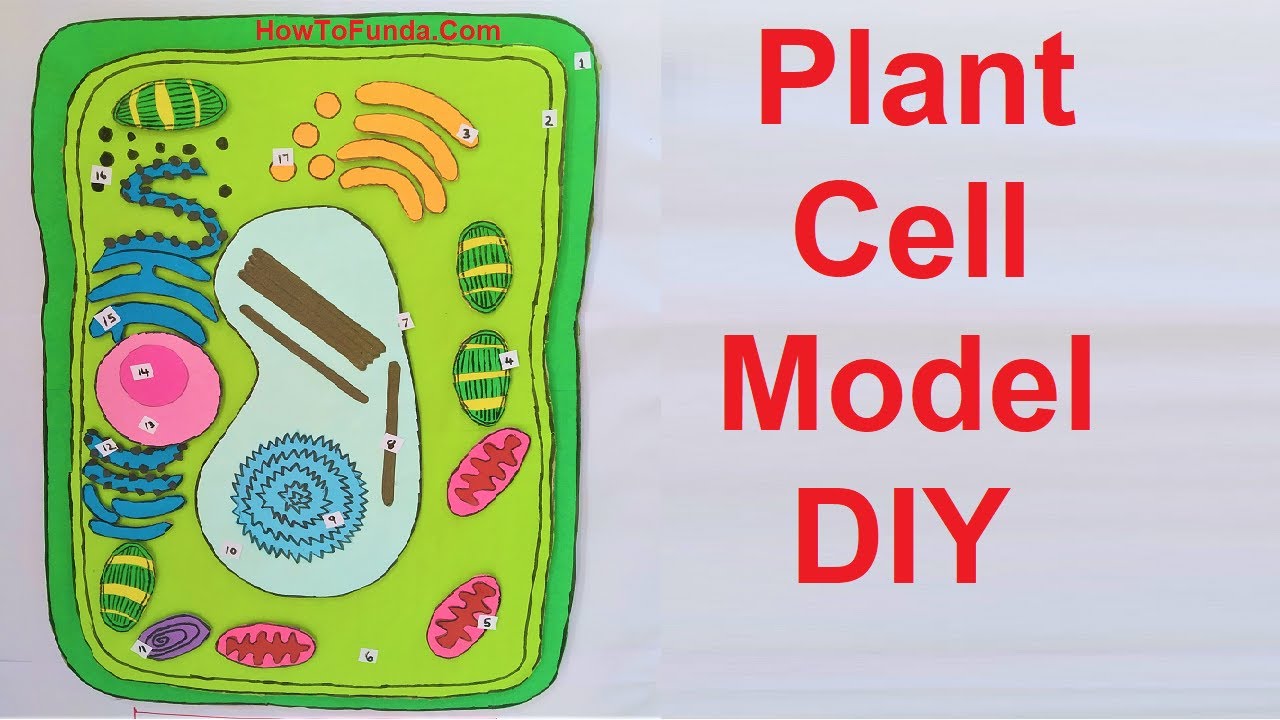
Making a plant cell model is a fun and educational way to learn about cell biology. Whether it’s for a school project or personal study, building a plant cell helps you understand its structure and the role each part plays. You can create a model using paper, clay, cardboard, or even food, depending on what materials you have available. Here is how to make a plant cell.
- Gather Your Materials
To begin, decide whether you want to make your plant cell flat (on paper or cardboard) or three-dimensional (using clay, dough, or sponge). For a simple 3D version, you’ll need different colours of clay or playdough, a plastic container or box to act as the cell wall, and labels. You can also use household items like beads, yarn, or buttons to represent various parts. - Create the Cell Shape
Start with the cell wall, which gives plant cells their rectangular or box-like shape. If you’re using a container, that will serve as the outer wall. If you’re using paper or clay, shape a rectangle or square to form the boundary. Inside the cell wall, create a slightly smaller layer to represent the cell membrane. - Add the Organelles
Fill in the rest of the cell with its internal parts, known as organelles. Use different colours or shapes for each one to make it easy to tell them apart. The nucleus can be a ball of clay or a round bead placed near the centre. Inside the nucleus, add a smaller dot for the nucleolus.
Next, create a large central vacuole—a key feature of plant cells. This can be a clear plastic bag or a flattened piece of blue clay. Place it in the centre, taking up much of the space.
Add chloroplasts, which are small, green ovals. These are responsible for photosynthesis and should be placed near the edges. Include mitochondria, shaped like small beans, and endoplasmic reticulum by laying down thin lines or strings near the nucleus. Also include ribosomes (tiny dots) and the Golgi apparatus, which can be small stacked layers or flattened discs.
- Label Each Part
Use small pieces of paper and toothpicks to label each organelle, or write names directly onto the surface if you’re using paper or cardboard. Make sure your labels are neat and placed clearly so someone else can understand the model. - Final Touches
Double-check that you’ve included all the major parts of the plant cell: cell wall, cell membrane, cytoplasm, nucleus, nucleolus, vacuole, chloroplasts, mitochondria, Golgi apparatus, endoplasmic reticulum, and ribosomes. Add colour and tidy up your model to make it visually appealing and accurate.
Also Read: How To Make A Cheese Board
Email your news TIPS to Editor@Kahawatungu.com — this is our only official communication channel
