


Modern networks bear little resemblance to the environments that traditional security architectures were designed to protect. Workloads span multiple cloud providers and on-premises data centers simultaneously. Users access applications from locations that no corporate perimeter can encompass. Devices range from fully managed endpoints to personal mobile devices operating on uncontrolled networks. In this environment, security models built around network location and static perimeters do not just underperform they create structural vulnerabilities that adversaries have learned to exploit systematically.
Zero trust network access addresses this reality at the architectural level. Understanding how does ZTNA work securely in modern network environments requires examining both the principles that guide it and the specific mechanisms through which those principles produce better security outcomes than the models they replace.
The Security Problem ZTNA Is Designed to Solve
The core problem with perimeter-based network security in modern environments is the assumption of trust it extends to connected users and devices. VPN architectures authenticate users at connection time and then grant broad access to internal network segments, maintaining that access until the session ends. This model was workable when enterprise applications were centralized, users worked from predictable locations, and the network perimeter was a coherent boundary.
None of those conditions are consistent in modern enterprise networks. Applications live in SaaS platforms, public cloud environments, and distributed data centers. Users connect from wherever they are working, on devices that span corporate laptops to personal smartphones. The implicit trust that VPN architectures extend to connected users becomes a systemic vulnerability the moment any credential in that system is compromised and credential compromise is now among the most common initial access vectors in enterprise breaches.
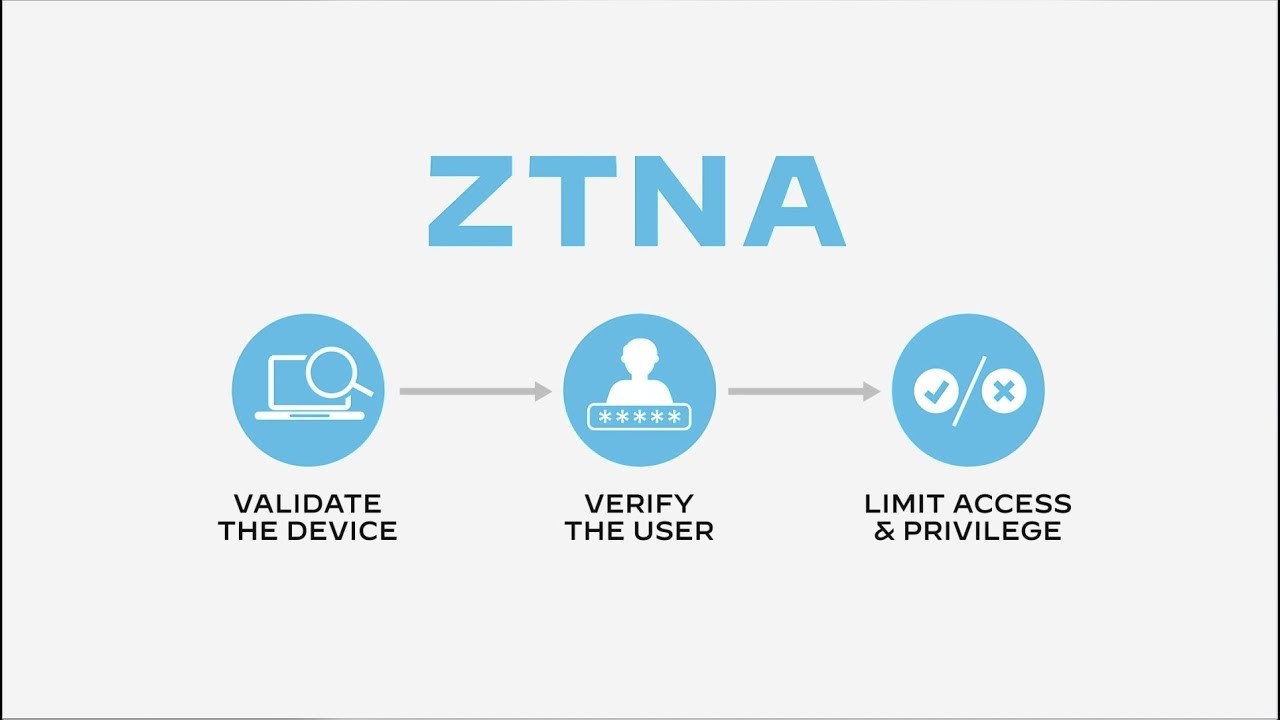
ZTNA removes the implicit trust assumption entirely. Every access request regardless of who is making it, where they are connecting from, or what device they are using is evaluated against defined policy before any access is granted.
The Principle of Continuous Verification
The foundational operating principle of ZTNA is continuous verification. Where VPN verifies once at connection time and maintains that trust, ZTNA verifies at every access request and monitors session behavior throughout its active period. This distinction has significant practical implications for how security is enforced across modern networks.
Continuous verification means that access cannot be pre-granted in ways that persist beyond the conditions that justified the original grant. A user who authenticated successfully under normal conditions does not retain that access if their device falls out of compliance, if their session moves to an untrusted network, or if their behavioral patterns shift in ways that indicate potential compromise. The enforcement layer evaluates these signals in real time and can restrict or terminate access automatically when risk conditions change.
This approach aligns with the security philosophy reflected in federal zero trust guidance from CISA, which defines zero trust as a collection of concepts designed to minimize uncertainty in enforcing accurate, least-privilege access decisions in systems where the underlying network is treated as already compromised. The practical implication of this posture is that security controls cannot rely on network location as a trust signal every request must be verified on its own merits, every time.
How ZTNA Applies Least-Privilege Access to Network Security
Least-privilege access is the structural mechanism through which ZTNA improves security across modern networks. Rather than granting users access to network segments that may contain dozens or hundreds of resources, ZTNA grants access to individual applications and only the applications that the requesting user’s policy explicitly permits.
This application-level granularity changes the security calculus for modern networks in a fundamental way. The attack surface accessible through any single compromised credential is reduced from a network segment to a specific set of applications. An adversary who obtains a user’s credentials in a ZTNA environment cannot use those credentials to traverse the internal network, reach adjacent systems, or access the infrastructure in which applications reside. The underlying network remains invisible and inaccessible the user interacts only with the application surface that policy permits.
For modern networks where applications are distributed across cloud environments, private infrastructure, and SaaS platforms, this application-level access model scales naturally. Policy is defined once and enforced consistently across all environments, regardless of where the application is hosted. There is no need for separate access controls per cloud provider or per infrastructure tier ZTNA’s policy enforcement layer applies uniform controls regardless of the application’s physical or logical location.
Network Segmentation Without Network Complexity
One of the persistent challenges of securing modern networks through traditional means is the operational complexity of maintaining network segmentation at scale. Firewall rules must be defined, maintained, and updated as networks evolve. Segmentation that was accurate at the time it was configured may drift from actual access requirements as application architectures change and user populations shift.
ZTNA produces effective network segmentation without that operational overhead. Because access to each application is governed by its own identity-based policy, the segmentation emerges from the access control architecture rather than from explicit firewall rules that must be manually maintained. Applications are isolated from one another not by firewall policies but by the access model itself a user cannot reach Application B through their authorized connection to Application A, because there is no network pathway between the two available through the ZTNA architecture.
The security implications for modern networks are significant. Understanding what modern network security requirements look like in practice including the need for business-centric segmentation, centralized policy management, and consistent enforcement across distributed environments highlights how closely ZTNA’s design aligns with what enterprise network security actually demands. The shift from perimeter-based controls to identity-driven, application-level enforcement addresses the segmentation requirement more effectively than rule-based approaches in networks that change as continuously as modern enterprise environments do.
How ZTNA Secures Modern Networks Across Cloud and Hybrid Environments
Modern enterprise networks are defined by their distribution across on-premises infrastructure, public cloud environments, and SaaS platforms simultaneously. Security tools that enforce controls in one of these environments but not others create the blind spots and policy gaps that adversaries exploit to move between environments undetected.
ZTNA addresses this challenge through its policy enforcement architecture. The policy enforcement point evaluates access requests regardless of where the requested application is hosted applying the same identity verification, device posture assessment, and contextual evaluation whether the application runs on-premises, in a public cloud, or is delivered as a SaaS platform. Users receive consistent access controls and consistent visibility across all environments, without the need for separate security tools per infrastructure tier.
This consistency is particularly important for modern networks undergoing cloud migration. As workloads are progressively moved from on-premises infrastructure to cloud environments, the ZTNA policy framework moves with them applications migrated to cloud hosting remain governed by the same access policies, with no gap in enforcement during or after the migration.
Protecting Against Lateral Movement in Modern Networks
Lateral movement the technique through which adversaries who gain an initial foothold in a network explore and reach additional systems is among the most consequential threats in enterprise network security. It is the phase that transforms a single compromised credential or endpoint into an enterprise-wide incident, and it depends on the broad network access that traditional architectures extend to connected users.
ZTNA structurally prevents lateral movement by eliminating the network-level access that makes it possible. An adversary who compromises a user’s credentials in a ZTNA environment can reach only the applications that user’s policy permits they cannot reach the underlying network, cannot enumerate adjacent systems, and cannot traverse from one application to another unless their credentials were authorized to access both. Each application is independently protected, and compromise of one does not create a pathway to any other.
For modern networks where lateral movement risk is compounded by the distribution of applications across multiple cloud environments and on-premises infrastructure, this structural containment is particularly valuable. The adversary’s ability to expand their foothold is limited by policy enforcement, not by their ability to bypass additional detection controls after they have gained network access.
Visibility and Audit Across Modern Networks
ZTNA generates a complete log of every access request, every policy evaluation, and every access grant or denial across all protected applications. For modern networks where visibility across cloud, hybrid, and on-premises environments is often fragmented across multiple logging systems, ZTNA’s centralized access log provides a consistent audit trail regardless of where applications reside.
This visibility supports two distinct operational functions. For compliance purposes, the access log provides the granular record of who accessed what, when, and under what policy conditions that regulated industries must be able to demonstrate. For security operations, it provides the behavioral baseline that analysts need to detect anomalous access patterns that may indicate account compromise, insider threat activity, or reconnaissance ahead of a more significant attack.
Frequently Asked Questions
Why is ZTNA better suited to modern networks than traditional VPN architectures?
Modern networks are defined by distributed applications, mobile users, and cloud infrastructure, which perimeter-based VPN architectures were not designed to protect. ZTNA grants access at the application level based on continuous identity verification rather than extending network access after a single authentication, which aligns the security model with how modern networks actually operate rather than with the centralized, perimeter-bounded environments that VPN was designed for.
How does ZTNA enforce consistent security across cloud and on-premises applications simultaneously?
ZTNA applies the same identity-based access policy regardless of where an application is hosted. Whether the application runs on-premises, in a public cloud environment, or is delivered as a SaaS platform, the policy enforcement layer evaluates the same user identity, device posture, and contextual signals before granting access. This consistent enforcement across all environments eliminates the policy gaps that arise when separate tools govern access to different infrastructure tiers.
Does ZTNA require significant changes to existing network infrastructure?
ZTNA deployments typically integrate with existing identity providers, endpoint management systems, and security monitoring platforms without requiring wholesale replacement of existing network infrastructure. The policy enforcement layer is introduced progressively as applications are onboarded to ZTNA controls, and most organizations run ZTNA alongside existing access controls during a phased transition rather than replacing the entire remote access architecture simultaneously

Email your news TIPS to Editor@Kahawatungu.com — this is our only official communication channel
