


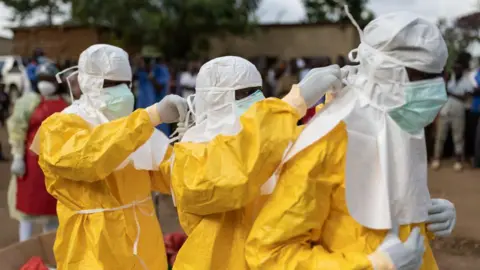
GENEVA — The World Health Organization said Friday that 906 suspected Ebola cases have been recorded in the Democratic Republic of the Congo, including 223 suspected deaths currently under investigation, as an outbreak of the rare Bundibugyo strain continues to expand across eastern DRC and into neighboring Uganda.
The outbreak, first declared by the DRC Ministry of Health on May 15 after reports of eight laboratory‑confirmed cases and 246 suspected infections in Ituri Province, has now been confirmed in three provinces: Ituri, North Kivu and South Kivu. According to WHO data, the DRC has recorded 125 confirmed cases, including 17 confirmed deaths. In Uganda, seven confirmed cases—three of which were imported from the DRC—have been reported, along with one death. No community transmission has been documented in Uganda, WHO noted.
The outbreak is caused by the Bundibugyo virus (BDBV), a rare strain of Ebola first identified in Uganda in 2007. Unlike the more common Zaire ebolavirus, no licensed vaccines or specific treatments currently exist for Bundibugyo virus disease, complicating containment efforts. WHO Technical Officer Anaïs Legand told reporters that the case‑fatality rate among confirmed infections is estimated at between 30 and 50 percent. “It’s huge. It means that up to five out of 10 people are likely to die,” Legand said, adding that early intensive care could lower fatality rates.
The outbreak may have been circulating undetected for weeks before its official declaration. Africa CDC Director General Jean Kaseya said a four‑week detection gap—from the suspected index case’s symptom onset on approximately April 25 to laboratory confirmation on May 13—allowed wider geographic spread before containment measures could be implemented. Kaseya also noted that the number of suspected cases in DRC and Uganda had surpassed 1,000, with 1,077 suspected cases and 246 probable deaths recorded as of May 27.
WHO Director‑General Tedros Adhanom Ghebreyesus arrived in Bunia, the epicenter of the outbreak in Ituri province, on Friday and called for a ceasefire by armed groups operating in the region. “The best way to address this is to provide all the necessary support to fight the disease at its epicenter and to continue offering every assistance needed,” Tedros told reporters.
Response efforts have been hampered by insecurity and community distrust. In Ituri province alone, 1.2 million people require humanitarian assistance, while conflict and food insecurity constrain access to affected areas. Legand said the primary challenge in the field was access to communities rather than lack of resources. Residents have launched at least three attacks against health centers, angered by strict medical protocols for handling victims’ bodies, which clash with local burial customs.
Rebel groups, including the Allied Democratic Force—an affiliate of the Islamic State—and ethnic militias, have further hindered the response. The Rwanda‑backed M23 rebel group, which controls large areas of North and South Kivu, has reported two cases in territory under its control.
Doctors Without Borders (MSF) warned that the response has not kept pace with the outbreak’s rapid expansion. “Never before has an Ebola outbreak recorded so many cases so soon after its declaration,” said Dr. Alan Gonzalez, MSF’s deputy director of operations, in a statement. “Nobody knows the true scale and severity of this outbreak.”
In the absence of approved countermeasures, WHO has prioritized three candidate therapeutics for clinical trials in confirmed cases: the monoclonal antibodies MBP 134 and maftivimab, along with the antiviral remdesivir. For prevention, WHO has prioritized the oral antiviral obeldesivir for post‑exposure prophylaxis in individuals who have been in contact with confirmed cases. Two candidate vaccines are also under evaluation once doses become available.
The United States imposed temporary entry restrictions on travelers who have been in DRC, Uganda or South Sudan within the past 21 days, including green card holders. Uganda and Rwanda have also closed their land borders. Tedros called such measures counterproductive. “Closing borders, as some countries have done, only discourages transparency,” he said, urging countries to reconsider the restrictions.
The WHO has not recommended restrictions on travel or trade with either country. The United Kingdom announced £20 million in new aid funding for the response, while the European Union has delivered medical supplies to Ituri.
The outbreak was declared a Public Health Emergency of International Concern by WHO on May 17 and a Public Health Emergency of Continental Security by Africa CDC on May 18. Kaseya identified 11 other African countries—including South Sudan, Rwanda, Kenya, Zambia and the Central African Republic—as being at high risk of spillover
Email your news TIPS to Editor@Kahawatungu.com — this is our only official communication channel
