


Andrew Carnegie was a Scottish-American industrialist and philanthropist who became one of the wealthiest people in history through his dominance of the American steel industry. At the height of his fortune, Andrew Carnegie had an inflation-adjusted net worth estimated at around $310 billion, making him one of the richest individuals ever to live.
Carnegie built his fortune by transforming steel production in the United States. He embraced the Bessemer process, which made steel production faster and more affordable, while also pursuing vertical integration to control nearly every stage of the manufacturing process.
His wealth reached its peak when he sold Carnegie Steel Company to financier J.P. Morgan for $303 million. Carnegie personally received more than $225 million from the transaction, an amount equivalent to several billion dollars today.
The deal created United States Steel Corporation, which became the first American company to reach a market capitalization of more than $1 billion.
Unlike many wealthy industrialists, Carnegie spent much of his later life giving away his fortune. Before his death, he had donated more than $350 million to libraries, universities, educational institutions, scientific research, peace initiatives, and other charitable causes. His remaining fortune was also distributed after his death.
| Andrew Carnegie Net Worth | $310 Billion |
| Date of Birth | November 25, 1835 |
| Place of Birth | Dunfermline, Scotland |
Early Life
Andrew Carnegie was born on November 25, 1835, in Dunfermline, Scotland, to William Carnegie and Margaret Morrison Carnegie.
His family lived modestly in a small two-room cottage. His father worked as a handloom weaver, while his mother helped support the household by selling prepared foods.
As industrialization changed the textile industry and reduced opportunities for traditional weavers, the Carnegie family struggled financially. In 1848, they borrowed money from Margaret’s brother, George Lauder Sr., and immigrated to the United States.
The family settled in Allegheny, Pennsylvania, near Pittsburgh.
Carnegie began working at a young age as a bobbin boy in a cotton mill. He later became a telegraph messenger for the Ohio Telegraph Company.
His career changed significantly when he joined the Pennsylvania Railroad. His intelligence, determination, and strong work ethic quickly attracted attention, and he eventually became superintendent of the railroad’s Western Division.
His position in the railroad industry also introduced him to influential investors and business leaders. Carnegie used the knowledge and connections he gained during this period to build his own investment portfolio.
Carnegie’s First Investments
Carnegie began generating income from investments while he was still a young man.
In 1866, at the age of 31, he received a dividend payment of $10 from one of his investments. Although the amount was small, the experience had a significant impact on him because it represented income generated from capital rather than direct labor.
Carnegie continued investing his earnings in businesses and securities. Dividend payments and interest from bonds helped him accumulate substantial wealth before he reached the age of 40.
His investments included interests in railroad companies, ironworks, bridge construction, telegraph operations, and other businesses benefiting from America’s industrial expansion.
By the early 1870s, Carnegie had established significant holdings in companies such as Union Iron Mills, Keystone Bridge Company, and the Lucy furnace operation. He also held investments in major railroad companies.
His early success as an investor gave him the financial resources to pursue his most ambitious opportunity in steel.
Carnegie and the Steel Industry
Carnegie’s biggest contribution to American industry came through his development of a highly efficient steel business.
He recognized that steel would become essential to America’s rapidly expanding economy. Railroads required steel rails, while bridges, buildings, factories, and other infrastructure projects created additional demand.
One of Carnegie’s most important decisions was adopting and improving the Bessemer process for mass-producing steel.
The process allowed manufacturers to produce steel more quickly and at lower costs. Carnegie used the technology to dramatically increase production while reducing prices.
He also pursued vertical integration by acquiring or controlling businesses that supplied the raw materials and transportation required by his steel operations.
This strategy allowed Carnegie to control costs and reduce his dependence on outside suppliers.
The result was Carnegie Steel Company, which became one of the most powerful industrial enterprises in the United States.
Sale of Carnegie Steel to J.P. Morgan
Carnegie eventually decided to leave the steel industry as he approached retirement.
In the early 1900s, Carnegie Steel executive Charles M. Schwab secretly negotiated with financier J.P. Morgan over the sale of the company.
A deal was ultimately reached in which Morgan acquired Carnegie Steel for $303 million.
Carnegie personally received more than $225 million from the transaction. Adjusted for inflation and the relative size of the U.S. economy at the time, his fortune would be worth hundreds of billions of dollars today.
Morgan used bonds to finance the acquisition. The resulting company was named United States Steel Corporation, with Schwab becoming its first president.
The new company went on to become the first corporation in American history to reach a market capitalization of more than $1 billion.
The sale transformed Carnegie from a powerful industrialist into one of the wealthiest individuals in modern history.
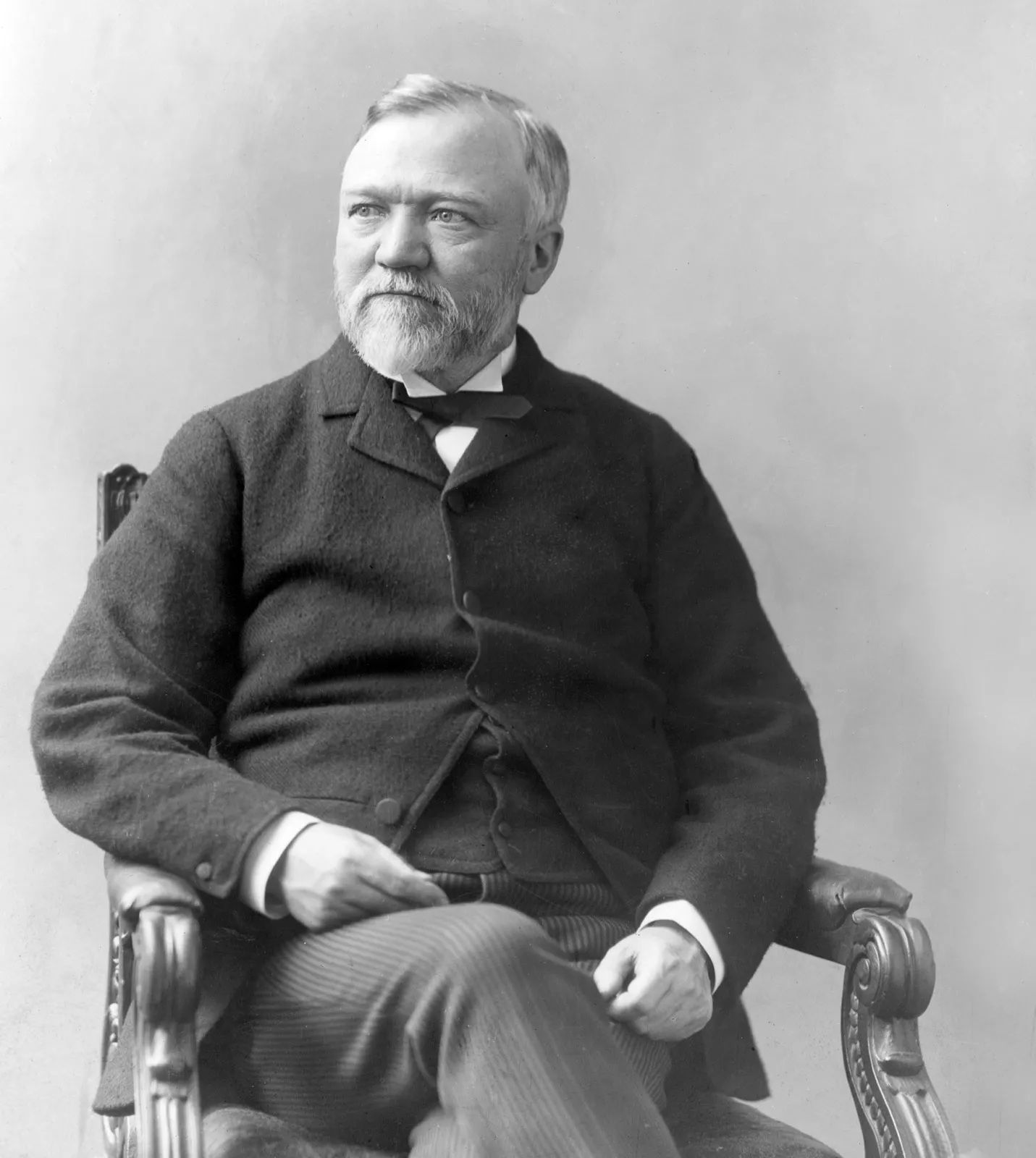
Andrew Carnegie’s Philanthropy
After selling his steel company, Carnegie devoted much of the rest of his life to philanthropy.
He believed wealthy individuals had a responsibility to use their fortunes for the benefit of society. His philosophy was famously outlined in his essay “The Gospel of Wealth,” in which he argued that the wealthy should distribute their fortunes in ways that improved the lives of others.
Carnegie donated enormous sums to education, libraries, scientific research, music, and world peace.
He helped establish or fund thousands of public libraries across the United States, Canada, and other English-speaking countries. More than 3,000 libraries were built with Carnegie funding.
His hometown of Dunfermline, Scotland, also benefited from his generosity, including through the establishment of a public library.
Carnegie and Education
Education was one of Carnegie’s most important philanthropic interests.
He provided financial support to universities, research institutions, and educational organizations in the United States and Britain.
His donations helped establish institutions that later became major centers of education and research.
Carnegie also supported African-American education and contributed to the work of Booker T. Washington.
His legacy in education continues through institutions such as Carnegie Mellon University, which grew from the Carnegie Technical Schools he established in Pittsburgh.
Other organizations associated with his philanthropy include the Carnegie Corporation of New York, the Carnegie Foundation for the Advancement of Teaching, and the Carnegie Endowment for International Peace.
Carnegie Hall and the Arts
Carnegie was also a major supporter of music and the arts.
His most famous contribution was Carnegie Hall in New York City, which opened in 1891 and became one of the world’s most prestigious concert venues.
He also funded the construction of thousands of church organs around the world.
His support for music reflected his belief that the arts and education could improve society and provide opportunities for future generations.
Andrew Carnegie’s Personal Life
Andrew Carnegie married Louise Whitfield in 1887 when he was 51 years old and she was 30.
The couple had one daughter, Margaret Carnegie Miller, who was born in 1897.
Despite his enormous wealth, Carnegie’s lifestyle became increasingly focused on philanthropy after he retired from business.
He continued writing and speaking about wealth, democracy, education, and social responsibility.
Carnegie died on August 11, 1919, in Lenox, Massachusetts, from bronchial pneumonia. He was 83 years old.
Also Read: What Was Nikola Tesla Net Worth?
Email your news TIPS to Editor@Kahawatungu.com — this is our only official communication channel
