


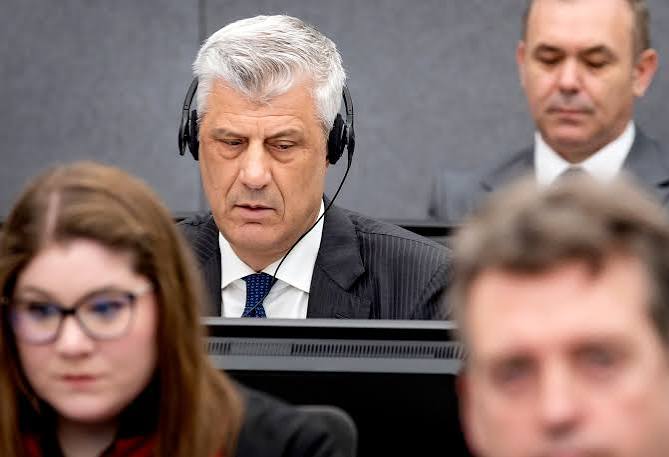
On September 16, 2026, the Kosovo Specialist Chambers in The Hague convicted former Kosovo President Hashim Thaci of four counts of war crimes and sentenced him to 25 years in prison. The ruling marks the conclusion of a three-year trial stemming from the 1998–1999 Kosovo conflict.
The Kosovo Specialist Chambers, a European Union-backed tribunal based in The Hague, delivered the first-instance verdict on Wednesday, September 16, 2026. Presiding Judge Charles Smith read out the sentence as Thaci, 58, stood in silence wearing a suit and tie.
Thaci was convicted of four war crimes: murder, torture, cruel treatment, and arbitrary detention. He was acquitted of six separate charges of crimes against humanity because the judges found that prosecutors failed to prove beyond a reasonable doubt that the crimes were part of a widespread or systematic attack directed against a civilian population.
The Trial Panel found Thaci criminally responsible for the following acts committed by Kosovo Liberation Army (KLA) forces during the conflict:
- Murder of 96 individuals
- Torture of 303 individuals
- Cruel treatment of 49 individuals
- Arbitrary detention of 385 individuals
The court found that the victims were targeted because they were perceived as opponents of the KLA’s political and military goals. This included Kosovo Albanians associated with other political or military forces, individuals alleged to be associated with Serbian authorities, and members of ethnic minorities including Roma and Serbs.
With limited exceptions, the Trial Panel found no evidence that any of the victims had engaged in criminal activity, taken an active part in hostilities, or presented any legitimate security concern for the KLA. The vast majority were innocent civilians, often falsely described as collaborators or spies.
As a member of the KLA General Staff and head of its Political Directorate, Thaci was found to be a key member in formulating and implementing the common criminal purpose. This included setting up detention facilities, identifying individuals perceived as opposing the KLA, arresting and detaining them, and if necessary, killing them.
Presiding Judge Charles Smith stated that Thaci “used his position, leadership, authority and standing” to encourage the crimes, which he then failed to investigate. Smith also said Thaci “showed a ruthless ability to remove and eliminate political impediments” to his and other commanders’ leadership.
The judges stressed that the trial was not about the legitimacy of the Kosovo Liberation Army or its goal of an independent Kosovo, but about the use of criminal means by some of its members to achieve those goals.
Three other senior KLA figures were tried alongside Thaci and received sentences on the same day:
- Jakup Krasniqi: 25 years in prison
- Kadri Veseli: 18 years in prison
- Rexhep Selimi: 13 years in prison
All four men had pleaded not guilty to all charges. Prosecutors had sought 45-year prison sentences for each defendant.The court ordered that all sentences include credit for time already served in detention.
The trial began on April 3, 2023, and lasted more than three years before reaching the first-instance verdict stage. The verdicts were delivered by a panel of judges presided over by Charles Smith from the United States, along with judges from Germany, Switzerland, and Ireland.
The rulings are first-instance decisions and are subject to appeal. Both the defense and the prosecution have the right to appeal the decision. Thaci’s defense team is expected to focus on the appellate stage to challenge the convictions.
The verdict sparked widespread anger and disappointment in Kosovo, where Thaci remains widely regarded as a national hero for his role in the country’s independence struggle. Thousands of citizens gathered in Pristina’s main city square to watch the verdict on large screens, many weeping and chanting support for the KLA and Thaci.
Protest marches followed the verdict reading, with demonstrators carrying KLA, Albanian, and American flags, chanting “KLA” and “Thaci,” and setting off pyrotechnics. Some groups tore down parts of a protective wall around the EULEX headquarters before police prevented further incidents.
Kosovo Foreign Minister Glauk Konjufca, who attended the proceedings in The Hague, called the verdict “unfair” and “undeserved,” describing it as “a heavy blow to the state and the domestic public.”
Acting President Albulena Haxhiu described the convictions as “a heavy blow” to the defendants’ families and “deeply distressing news” for Kosovo, while emphasizing that the legal process is not over and the right to appeal must be fully utilized.
Albanian Prime Minister Edi Rama also criticized the verdict on social media, writing “Marre” (meaning “shame”) and sharing an image of Europe surrounded by barbed wire
France said it took note of the decision and reiterated its support for the Kosovo Specialist Chambers and its commitment to combating impunity. The French Foreign Ministry noted that the decision was subject to appeal.
The court itself emphasized that the trial was not about the legitimacy of the KLA or its goal of independence, and that it did not deal with crimes committed by Serbian forces against Kosovo Albanians. The proceedings were exclusively concerned with whether the crimes alleged in the indictment were committed and whether the accused could be held criminally responsible for them.
Hashim Thaci, 58, was a co-founder and commander of the Kosovo Liberation Army during the 1998–1999 conflict. He served as Kosovo’s first prime minister after it declared independence in 2008, holding that office until 2014. He later served as foreign minister and then as president from 2016 to 2020.
Thaci resigned from the presidency in 2020 after his indictment was confirmed by the Kosovo Specialist Chambers.He had been in detention in The Hague for nearly six years before the verdict was delivered. With credit for time already served, he is expected to serve approximately 19 more years of his 25-year sentence.

Email your news TIPS to Editor@Kahawatungu.com — this is our only official communication channel
