


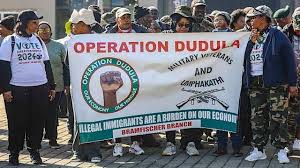
A South African court has ordered an anti-migrant group to stop blocking foreign nationals from accessing public health facilities and schools, saying such actions are illegal.
Operation Dudula has been picketing hospitals and clinics in Gauteng and KwaZulu-Natal provinces, checking identity cards and stopping anyone who is not South African from entering. This has since extended to schools.
But the high court in Johannesburg has ordered the group to stop “intimidating, harassing [or] interfering with access” to these facilities, following a case brought by rights groups.
South Africa is home to about 2.4 million migrants, just less than 4% of the population, according to official figures.
Most come from neighbouring countries such as Lesotho, Zimbabwe and Mozambique, which have a history of providing migrant labour to their wealthy neighbour.
Xenophobia has long been an issue in South Africa, which has been accompanied by occasional outbursts of deadly violence, and anti-migrant sentiment has become a key political talking-point.
Judge Leicester Adams, handing down judgment on Tuesday, also barred Operation Dudula from making statements that can be construed as hate speech, “unlawfully evicting foreign nationals from their homes… [or] from their trading stalls” and instigating others to do so.
“Dudula” means to remove something by force in the Zulu language.
He also barred law enforcement from conducting “warrant-less searches” in foreigners’ private spaces and said they must have “reasonable suspicion” that a person was in the country unlawfully before asking them to identify themselves.
South African police came under scrutiny after human rights organisations accused them of failing to act against Operation Dudula or protect the public from their unlawful conduct.
Several Operation Dudula members were arrested for blocking the entrances of public health facilities in August. They were later released with a warning.
The organisation says it is disappointed by the ruling and intends to appeal against it, according to South African online publication News24.
Kopanang Africa Against Xenophobia, one of the organisations that took the case to court, said the “judgment provides critical protection for those targeted by xenophobic attacks”.
“In a country founded on the rejection of apartheid, we cannot allow ourselves to be subjected to the xenophobic hate promoted by Operation Dudula,” the human rights organisation said in a statement.
Kopanang said there would be proactive monitoring at schools and clinics to ensure compliance with the order and that it would hold the police accountable for enforcing it.
“Should the police fail in their duty to enforce the order… we are prepared to report their inaction to formal oversight bodies,” the organisation told the BBC.
South Africa’s Health Minister Dr Aaron Motsoaledi said the ruling “was to be expected” as it echoed the government’s stance that no-one should be denied access to healthcare, irrespective of their legal status.
Dr Motsoaledi met Operation Dudula leaders in August, at the height of their protests at health facilities, and criticised their methods.
“I told them [at the time] that whatever concerns they have, some of which might be legitimate by the way, they are [using] the wrong method,” he told local broadcaster 702 on Tuesday.
One of the demands the group had for the minister when they met was that anyone without documentation be turned away at healthcare facilities but Dr Motsoaledi said this would be difficult as 11% of South Africans do not have national ID cards.
The minister also criticised South Africa’s neighbours for not doing more to help reduce the pressure on the country’s overburdened healthcare system, suggesting this was being worsened by the influx of migrants.
“It is South Africa which is suffering, not them. In fact, many of them are relieved,” he said.
By BBC News
Email your news TIPS to Editor@Kahawatungu.com — this is our only official communication channel
