


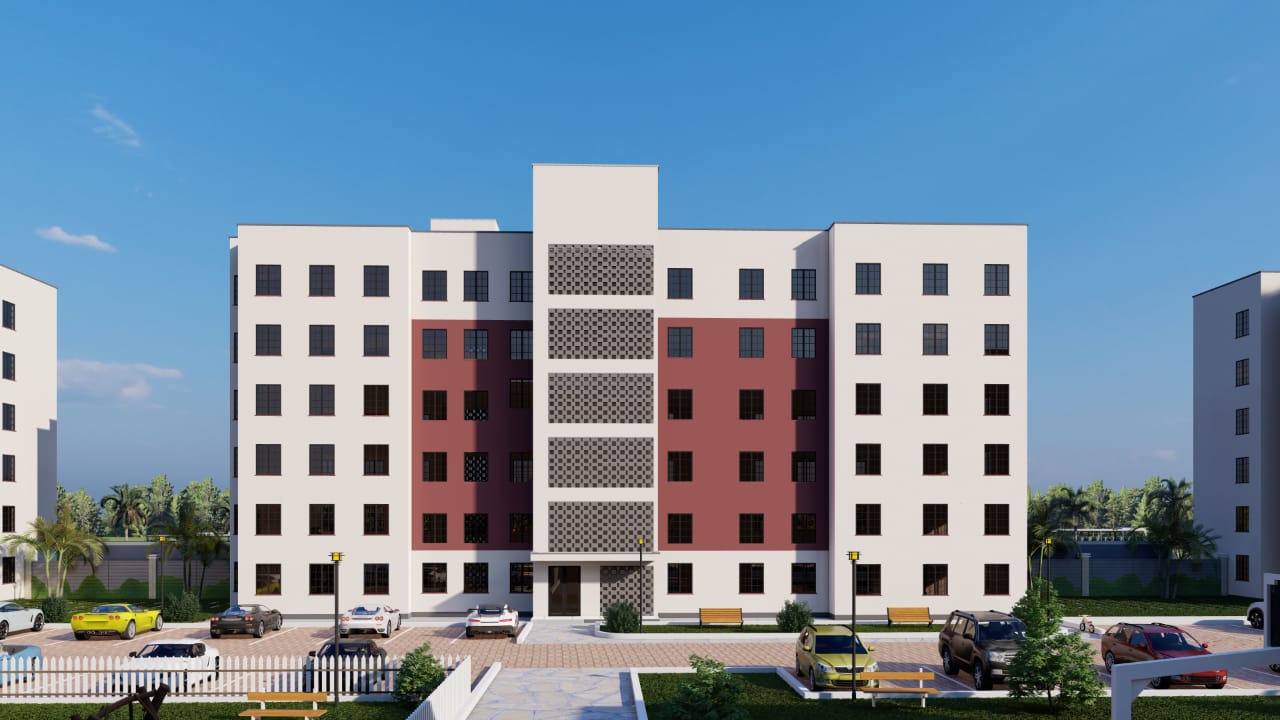
The government Monday, April 28, 2025, announced the sale of 4,888 units under the Affordable Housing Programme.
Kenyans can now apply for the houses, which are priced at Sh640,000 for a studio unit, Sh960,000 for a one-bedroom unit, and Sh1,280,000 for a two-bedroom unit.
Each house will be sold to one individual per ID.
“Kenyans can now apply for affordable housing units. Since September 2022, the Affordable Housing program has created over 250,000 direct jobs,” the announcement read.
Interested applicants can register by dialing *832# or by visiting http://bomayangu.go.ke.
The move comes as part of the government’s plan to make home ownership easier for low-income earners.
According to Dan Ameyo, leader of the National Government Coordination (NGC) Secretariat Multi-agency team, the Affordable Housing Programme is designed to allow Kenyans to own homes through the National Tenant Purchase Scheme or rent-to-own models.
Ameyo said the housing projects have boosted economic recovery by linking Micro, Small and Medium Enterprises (MSMEs) and Jua Kali artisans to supply key building materials like hinges, doors, and windows. He added that the investments were creating a multiplier effect in the economy, resulting in job creation, improved health and safety, and stronger household resilience.
In Nakuru County, the Affordable Housing Programme continues to progress. The Sh504 million Bahati Sub-County project, featuring 220 units, is now 85 percent complete. Launched by President William Ruto on August 22, 2023, it includes 60 studio units, 20 one-bedroom units, 120 two-bedroom units, and 20 three-bedroom units. The project is expected to be completed by June 2025.
The Bahati project is part of a bigger plan to deliver over 50,000 low-cost housing units in Nakuru County within the next 10 years. Ameyo noted that the government is heavily relying on private sector partnerships to fund such projects without straining the national budget or increasing debt.
Kenya’s Rapid Urbanization Sparks Need for Affordable Housing
Kenya is currently experiencing an urbanization rate of 3.4 percent per year, leading to an annual housing demand of about 250,000 units. However, the country only manages to supply approximately 50,000 units each year, creating a shortfall of around 200,000 units annually, and a total backlog of 2 million units.
To address the crisis, the government initiated the Affordable Housing Programme, aiming to deliver 200,000 new units annually. The programme also targets increasing the number of mortgage holders from 30,000 to 1 million by offering payment terms with monthly installments as low as Sh5,000.
Nakuru is among 23 counties that have already provided land for affordable housing projects. According to the 2024 Kenya National Bureau of Statistics (KNBS) report, Nakuru requires at least 10,000 housing units to meet current demand but has only about 3,000 available, leaving a gap of 8,000 units.
Housing Projects Creating Jobs and Boosting Local Economy
The Sh2 billion Bondeni project in Nakuru Town East Constituency, comprising 605 units, is already 100 percent complete. The units are selling at Sh1.55 million for one-bedroom houses, Sh3.25 million for two-bedroom houses, and Sh4.3 million for three-bedroom units. Another 220-unit project in Molo is also nearing completion at 85 percent.
The projects have provided over 1,500 jobs for residents, employing mechanical engineers, plumbers, masons, steel fixers, carpenters, and welders. They have also empowered local businesses, as tenders for construction materials have largely been awarded to local SMEs rather than relying on imports.
In Naivasha, 2,000 more units are under construction on a 55-acre plot near the GK Prisons along the Nairobi-Nakuru Highway, targeting workers earning between Sh15,000 and Sh150,000.
Despite the growing demand for affordable housing—estimated at 170,000 units annually—only about 1,000 units are currently being built each year. Factors such as outdated building codes, policy misalignments, and low mortgage penetration have slowed progress.
Support for Industrialization and Digital Economy
During the visit to Nakuru, the NGC team also inspected the ongoing construction of the Nakuru County Aggregation and Industrial Park (CAIP) at Ngongongeri Farm in Njoro Sub-County. Ms. Ann Olubendi from the NGC Secretariat encouraged investors to take advantage of new manufacturing facilities being set up across counties.
Ms. Olubendi said industrialization is key to achieving Kenya’s economic independence, noting that manufacturing currently accounts for just 7.6 percent of the country’s GDP. The Nakuru CAIP, costing Sh500 million, aims to host a range of industries including ICT hubs, construction firms, and chemical companies.
She emphasized that fully implemented CAIPs would boost Kenya’s economy by creating thousands of jobs, reducing dependence on imports, and enhancing global competitiveness.
Youth Empowerment Through Digital Skills
The NGC team also praised the “Jitume” program being run at Rift Valley National Polytechnic (RVNP), which is training young Kenyans in digital skills. The program, a collaboration between the government, Pathways Technologies Ltd, and Konza Technopolis, targets training 10,000 youth over five years in areas like data science, data analytics, and software development.
RVNP Principal Sammy Chemoiwa said over 300 young people have already completed training and are earning between Sh9,000 and Sh20,000 weekly by working remotely for international firms, especially in the field of Artificial Intelligence (AI).
Email your news TIPS to Editor@Kahawatungu.com — this is our only official communication channel
