


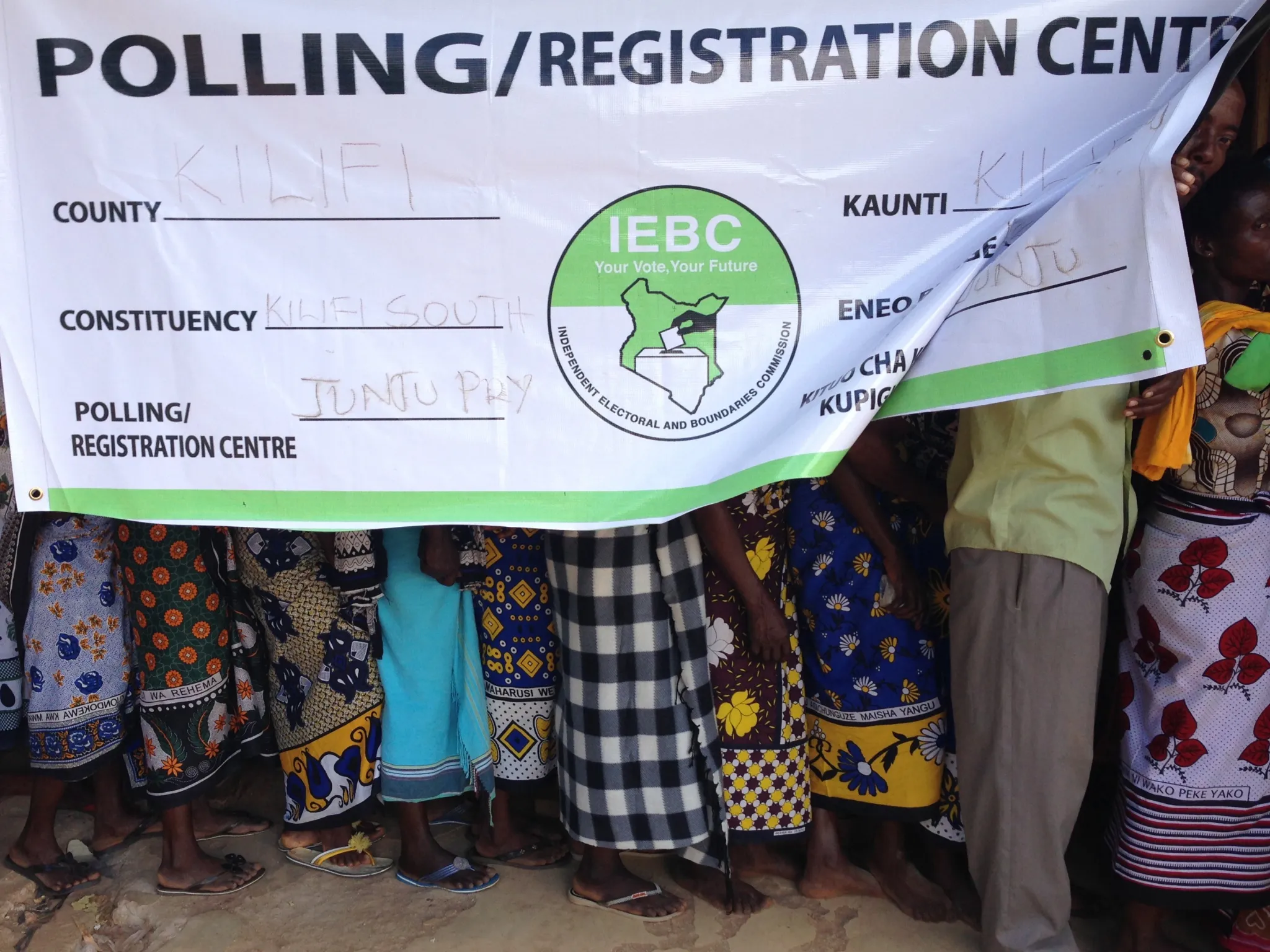
The High Court in Malindi has ruled that Kenya’s next presidential election ought to be held on August 11, 2026, declaring that the Constitution requires the poll to be conducted on the second Tuesday of August in the fifth year following the previous general election.
In a judgment delivered on Friday, Lady Justice Mugure Thande found that the Independent Electoral and Boundaries Commission’s (IEBC) plan to conduct the next General Election in August 2027 is inconsistent with Article 136(2)(a) of the Constitution.
Despite declaring the intended 2027 presidential election date unconstitutional, the judge suspended the declaration of invalidity until after the next General Election, saying an immediate implementation of the decision would create logistical challenges and disrupt preparations already underway.
“Such an order would no doubt plunge the country into chaos,” the judge ruled.
The judge held that the fifth year following the August 9, 2022 presidential election commenced on August 9, 2026, making August 11, 2026 the second Tuesday of that month, the constitutionally prescribed date for the next presidential election.
“The election of the President shall be held on the second Tuesday in August in the fifth year following the immediately preceding presidential election,” the court ruled.
Justice Thande declared that conducting the presidential election on any date other than the second Tuesday of August 2026 would violate the Constitution and would therefore be null and void.
The court further held that the Constitution does not guarantee the President a fixed five-year term in office, finding that Article 142 only provides that the President’s term begins upon taking the oath of office and ends once the next duly elected President is sworn in.
The judge rejected the argument that the President is constitutionally entitled to serve a full five years, ruling that the Constitution ties the end of a presidential term to the swearing-in of the next President elected in accordance with Article 136(2)(a).
In interpreting the Constitution, the court relied on Article 259(5)(c), which provides that where time is expressed in years, the period ends at the beginning of the corresponding date in the relevant year. Applying that provision, the court concluded that the fifth year after the 2022 election began on August 9, 2026.
The court also ruled that the IEBC’s Election Operation Plan 2025–2027 indicated that the next General Election would be held on August 10, 2027, a position also reflected in the foreword by IEBC Chairperson Erastus Edung Ethekon.
Justice Thande rejected preliminary objections by the Attorney General and the IEBC that the petition was speculative and premature, holding that Article 258 of the Constitution allows any person to institute proceedings where there is a threatened violation of the Constitution.
The court held that the petitioners had raised legitimate constitutional questions regarding the intended election date and the alleged threat of violating Article 136(2)(a).
Justice Thande traced the history of Kenya’s electoral framework, holding that the 2010 Constitution deliberately introduced fixed election dates to eliminate uncertainty that existed under the former Constitution, where the President had discretion to dissolve Parliament and determine election dates.
The judge also cited the period served by former President Uhuru Kenyatta following the 2013 elections, noting that he remained in office for about four years and five months before the next election, demonstrating that the Constitution does not guarantee a President a full five-year tenure.
The petition had been filed by Dr. Owiso Owiso, Khelef Khalifa and Ashioya Biko, who argued that postponing the presidential election to August 2027 would violate several provisions of the Constitution, including Articles 2, 3, 10, 136, 142, 249 and 259.
“A Declaration is hereby made that holding the next presidential election on any date other than the second Tuesday in August 2026 will violate and contravene Articles 2, 3, 10, 136(1) & (2)(a), 142(1), 24, 25(1) & (5) of the Constitution, and will consequently be null and void,” Justice Mugure Thande said.

Email your news TIPS to Editor@Kahawatungu.com — this is our only official communication channel
