


It may have been drowned out this week as US President Donald Trump walked back tariffs on his closest neighbours – and biggest trading partners – almost as soon as they were in place.
But despite the dizzying back-and-forth with Canada and Mexico, the White House made clear that it is serious about its economic vision. And it is willing to pay the price of some short-term economic harm to pursue it.
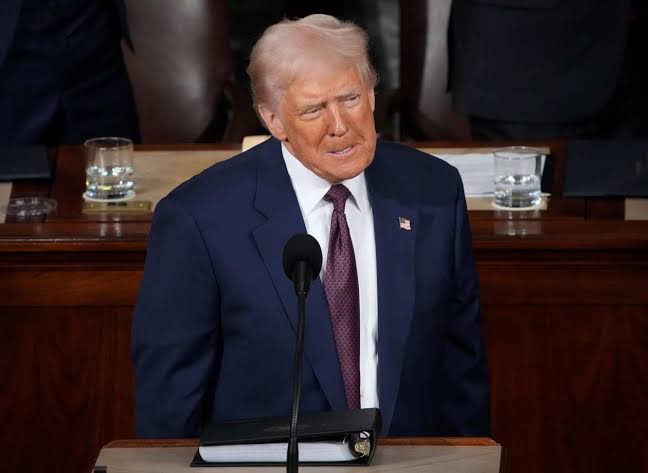
“There’ll be a little disturbance,” Trump warned in his address to Congress on Tuesday. “But we’re okay with that.”
Some scepticism about that comfort might be understandable, given the abrupt policy turns on tariffs Trump has made, as financial markets dropped and the outcry from US businesses intensified.
Those who see Trump’s tariff threats as economic bluster might be tempted to conclude that he wants to talk tough, but flinches at the first signs of economic damage.
But that view is to some extent undermined by the trade war against China he started in his first term which has seriously intensified.
In just a few weeks, Trump has raised taxes to at least 20% on all Chinese imports.
It means the average effective tariff rate on imports from China now stands at roughly 34%, because taxes on some sectors – like electric vehicles and steel – stand at much higher rates.
The 25% tariff on Mexican and Canadian goods hasn’t completely gone away either. The levy still stands on goods that aren’t compliant with a trade deal that Trump negotiated in his first term – and so some goods coming from both neighbours will still be subject to it.
The White House also says its much-touted reciprocal tariffs targeting nearly all US trade partners are still in the pipeline. The details, they say, will be unveiled on 2 April, with rates tailor-made to address whatever policies other countries impose that officials consider unfair – whether in the form of taxes on US tech firms, Value-Added Taxes, or other import rules.
“It’s a certainty – reciprocal tariffs are coming,” Trump’s senior adviser on trade and manufacturing Peter Navarro told business broadcaster CNBC on Friday.
He said the White House had seen signs that its threats alone were prompting car companies to start taking action and bolster their supply chains in the US – exactly the kind of investment that Donald Trump says his tariffs will spur.
“They’re getting the picture,” Navarro said.
Navarro and others say the nitty-gritty of tariff rates is not their focus. Rather, they are using trade levies as a means to create a new version of America, where the country has a different relationship with its global partners.
That America has more local manufacturing, a smaller government and pays less for the military defence of its allies.
Treasury Secretary Scott Bessent – a former Wall Street hedge fund boss not known as a tariff hawk – this week pointed to political discussions in Germany about boosting its military spending as an “early, big win”.
“The international trading system consists of a web of relationships – military economic, political. One cannot take a single aspect in isolation,” he said, as he tried to sell the administration’s strategy to a tariff-sceptical audience at the Economic Club of New York.
“This is how President Trump sees the world – not as a zero-sum game but as inter-linkages that can be re-ordered to advance the interests of American people.”
For Trump, tariffs are a key tool for re-ordering that web. And the treasury secretary made clear that the likely short-term harm – higher prices – is an acceptable trade-off.
“Access to cheap goods is not the essence of the American dream,” Bessent said.
For now, polls indicate Trump’s voter base remains behind him. But how the next months unfold – and what happens in particular with consumer prices – could prove a real test of that message.
By BBC News
Email your news TIPS to Editor@Kahawatungu.com — this is our only official communication channel
