


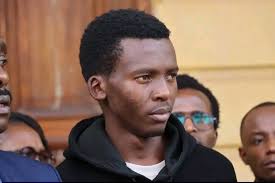
A Moi University student who was acquitted last week in a cybercrime case involving false information about President William Ruto has now sued telecommunications giant Safaricom for Sh200 million alleging a “blatant violation of is privacy rights.”
In a petition filed under certificate of urgency, David Ooga Mokaya through his lawyer Danstan Omari, claimed that his rights were violated after his mobile phone data was allegedly released to the Directorate of Criminal Investigations (DCI) without his consent.
Mokaya was previously charged with publishing false information linked to President William Samoei Ruto.
He had been arrested and arraigned at Milimani Law Courts in November 2024 over allegations that he published a post on the social media platform X suggesting that the President’s body had left Lee Funeral Home.
He denied the charges and was later acquitted under Section 215 of the Criminal Procedure Code after the trial court found that the prosecution had failed to establish a prima facie case against him.
In his application, Mokaya contended that during the criminal proceedings it emerged that information linking him to the alleged X account had been supplied to investigators by Safaricom.
He argued that the disclosure of his call data records, subscriber information, location data and other metadata was carried out without his knowledge or consent, and without a lawful court order, in violation of his constitutional right to privacy.
He is seeking certification of the matter as extremely urgent and wants the court to issue interim conservatory orders restraining Safaricom, its agents or servants from transferring, sharing or disseminating his personal data without his consent, a valid court order, or strict compliance with the Constitution and applicable statutory framework.
In the judgment delivered on February 19, 2026 Magistrate Carolyne Nyaguthii Mugo acquitted Mokaya under Section 215 of the Criminal Procedure Code, ruling that investigators had acted illegally.
They acted without any court order
Evidence emerged during the trial about how police tracked down Mokaya.
Daniel Hamisi, a Safaricom security department employee who testified as a Prosecution Witness, confirmed that he received a formal letter from the Directorate of Criminal Investigations (DCI) requesting records for Mokaya’s mobile number.
Under cross-examination, Hamisi conceded that he had not been served with any court order authorizing the disclosure .
Magistrate Mugo in her judgement said she “not only were the accused person’s gadgets seized unlawfully, they were subjected to forensic examination without any judicial authorization” .
The court also heard that the arresting officer admitted he had no court order to carry out the search or seize Mokaya’s phone and laptop .
‘This trend must stop’
Omari described the case as a landmark moment for digital rights in Kenya.
“This is a violation of the fundamental human right of Mokaya.”
However, In a letter dated February 24, 2026 Safaricom rejected the demand, describing it as “unequivocally rejected.”
Legal services head of Department Wangechi Gichuki, said; “Having reviewed the Judgment made on 19th February 2026, Safaricom does not admit, and expressly denies, any liability as alleged. We draw your attention to the fact that the trial court made no binding determination of civil liability against Safaricom”.
The company argued that observations in the judgment concerning investigative practices “cannot be construed as imposing strict constitutional liability on a telecommunications provider acting in compliance with formal requests from law enforcement agencies.”
Safaricom further warned that “any litigation will be vigorously and robustly defended.”
In his supporting affidavit, Mokaya describes constant travel between Eldoret and Nairobi for court appearances, funded by well-wishers and family members who also struggled to pay his tuition fees.
“I used to travel all the way from Eldoret where I stay and study to come attend mentions and hearings and travel back to Eldoret on the same day due to financial difficulties,” he said.
Omari alleges that Mokaya “can’t even talk due to mental trauma and shock that gripped him since he was charged”
His lawyers had previously written to the Office of the Director of Public Prosecutions seeking review and withdrawal of the charges, arguing that the X account had not been authenticated and that no Mutual Legal Assistance agreement had been established with the United States to unravel account ownership.
Email your news TIPS to Editor@Kahawatungu.com — this is our only official communication channel
