


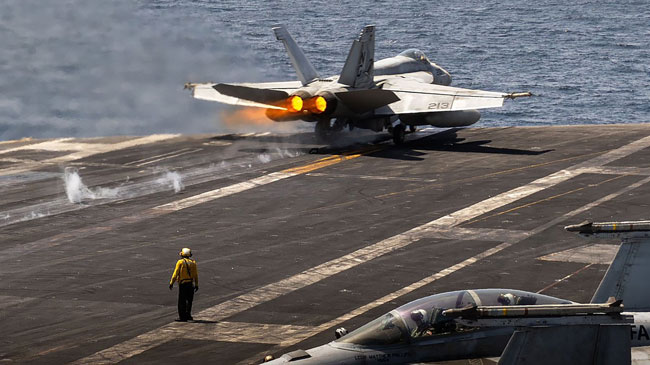
The US military says it has launched new strikes on southern Iran, targeting Iranian missile sites and boats attempting to place mines. US Central Command said in a statement the strikes were taken in “self-defense”, and were designed “to protect our troops from threats posed by Iranian forces”.
Central Command spokesperson Capt Tim Hawkins said the US military “continues to defend our forces while using restraint during the ongoing ceasefire”.
The strikes come as Iranian foreign ministry spokesman Esmail Baqai said some progress has been made in talks with the US, but a deal to end the conflict “is not imminent”.
Capt Hawkins said the strikes targeted an area near Bandar Abbas, a southern port city and home of an Iranian naval base that sits on the Strait of Hormuz, according to the New York Times.
Iranian state media had earlier reported that local officials in Bandar Abbas were investigating after explosions were heard.
Iran is yet to respond to the latest US strikes. It is unclear what impact they will have on any potential peace agreement between the US and Iran.
At the weekend, President Donald Trump had suggested the sides were close to a deal, but later said he had instructed negotiators “not to rush into” one.
US Secretary of State Marco Rubio also said an agreement could possibly be reached on Monday.
But Baqai responded: “It is correct to say that we have reached a conclusion on a large portion of the issues under discussion… But to say that this means the signing of an agreement is imminent – no-one can make such a claim.”
The memorandum of understanding being discussed reportedly involves a 60-day ceasefire extension, the reopening of the Strait of Hormuz and a plan for further negotiations over Iran’s nuclear programme.
CBS News, the BBC’s US partner, has reported that US intelligence believes Iran’s Supreme Leader Mojtaba Khamenei – who was injured in an Israeli strike on the first day of the war which killed his father and predecessor – is holed up in an undisclosed location, making communication with his envoys difficult and therefore delaying pace of talks with the US.
According to US media, the discussions will not immediately lead to a final settlement. Contentious issues will likely be negotiated later, including details of Iranian sanctions relief, the release of frozen Iranian funds, and US demands for Iran to curb its nuclear ambitions.
At the start of the war, Iran is thought to have had about 440kg (970 lbs) of uranium that was enriched up to 60% purity – a short process away from being enriched further to the weapons-grade 90%, which theoretically could allow it to create a nuclear bomb.
On Monday night, Trump said the enriched uranium would either be “immediately” turned over to the US, or “preferably, in conjunction and co-ordination with the Islamic Republic of Iran, destroyed in place”.
Despite the downplaying of any breakthrough from senior officials, Iran’s top negotiator and foreign minister were in Doha for talks with Qatar’s prime minister on a potential deal with the US, Reuters reported.
US and Iranian forces have observed a ceasefire since 8 April. Iran has maintained controls on Gulf shipping through the Strait of Hormuz and the US Navy has sought to blockade Iran’s ports.
The US and Israel launched wide-ranging strikes on Iran on 28 February, sparking conflict across the Middle East. Iran responded by attacking Israel and US-allied states in the Gulf, and effectively closed the Strait of Hormuz. The move sent oil prices soaring globally.
By BBC News

Email your news TIPS to Editor@Kahawatungu.com — this is our only official communication channel
