


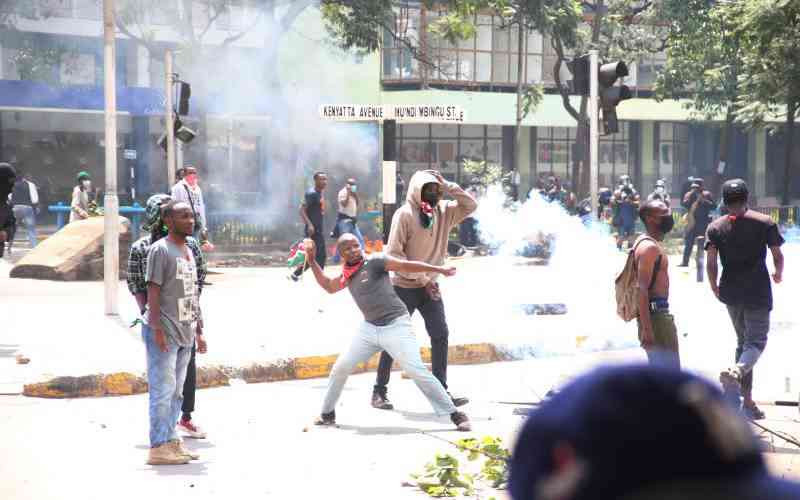
The Kenya National Commission on Human Rights (KNCHR) announced the proposed compensation packages for protest victims in its Reparations Guidelines, 2026.
The Commission said all eligible victims should be awarded appropriate monetary compensation and other medical packages as individuals injured during protests, as well as families who lost loved ones, were expected to come forward before the April 3, 2026, deadline.
KNCHR sought public participation and memoranda on the proposed reparations guidelines by April 27, 2026. It recommended that victims of fatal shootings, death in custody or during demonstrations should receive a minimum of Sh3,000,000 plus Medical and Funeral Expenses, and a public apology.
Victims of enforced disappearances and abductions should receive a minimum of Sh2,000,000 and psychosocial support under the Social Health Authority (SHA) cover.
Victims who suffered Sexual and Gender-Based Violence (SGBV) are recommended to receive Sh4,000,000 plus medical expenses, a public apology and psychosocial support under SHA.
KNCHR added that victims of unlawful arrest and detention should receive a minimum Sh200,000 accompanied by a public apology; those who suffered severe physical injury (bullet wounds, amputation) should receive Sh1 million with medical expenses, disability benefits and a public apology.
Those who suffered moderate physical injuries (dislocation, fractures) are proposed to get a minimum of Sh500,000, medical expenses, disability benefits, and an apology while those who sustained minor injuries will receive a minimum of Sh100,000 with similar benefits.
Victims of psychological trauma will receive a minimum of Sh250,000, psychosocial support under SHA and an apology.
Those whose property was damaged or looted are to receive Sh100,000, depending on valuation, as well as an apology.
Victims with extreme medical conditions and vulnerable individuals or groups will be prioritised, as the monetary compensation shall be paid to the victims or their representatives.
In the compensation framework for human rights violations, eligible persons have the right to lodge a reparations claim to any relevant State Agency.
The claims may be instituted by a person acting on behalf of another person who cannot act in their own name, a person acting as a member of a group or class of persons, a person acting in the public interest, an association acting in the interest of one or more of its members or those who suffered collective harm.
These claims can be lodged in a prescribed form and signed by the victim or their representative, orally or through official electronic means.
KNCHR, however, cautioned that the complainant must submit their contact information, nature of the alleged violation with its dates and time, accompanied by medical reports, police abstracts, audiovisual evidence, reports to relevant public institutions and public reports.
The claims will then undergo a rigorous scrutiny involving the authentication of official documents with relevant bodies, conducting witness interviews for testimonial evidence and conducting site visits.
After verification and shortlisting of beneficiaries, the Implementing Agency shall take into account their socio-economic circumstances proportional to the gravity of the violation, including physical or mental harm, lost opportunities (including employment, education and social benefits) and costs required for legal or expert assistance, medicine and medical services, and psychological and social support.
“In effecting reparations, the Implementing Agency shall cooperate with any government Ministries, Departments and Agencies, or any other person or entity, as are relevant and appropriate to provide the most effective reparations,” the Commission said in a statement.
The criteria for determining the appropriate quantum of damages will include scrutiny on the nature of the violation, the duration over which the alleged violation occurred and harm suffered by the victim.
The commission added that the determination of reparation awarded in writing will be communicated to the victim within 30 days.
For those who will be dissatisfied with the decisions on eligibility and reparations, they can request reconsideration under their rights for review.
“A request for reconsideration will not be granted unless a State Agency is satisfied that there are new facts, or supporting materials that could not reasonably have been provided earlier,” the report added.
The Commission has been receiving names for those who were affected during protests in 2017, 2024 and 2025.
The government, in the supplementary budget 2025/2026, has allocated Sh2 billion for compensation of victims of demonstrations and police brutality.

Email your news TIPS to Editor@Kahawatungu.com — this is our only official communication channel
