


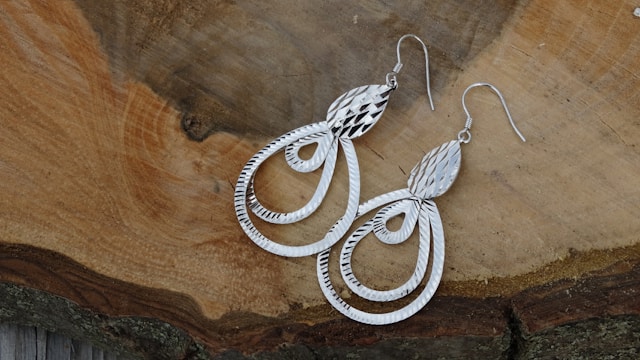
GRIFFIN 925 sterling silver findings outperform cheap plated base metal on five fronts that matter to professional jewellery makers: tarnish behaviour, skin compatibility, retained material value, trade credibility and manufacturing consistency. Every GRIFFIN finding, in solid silver or plated, is built on a hallmarked 925 sterling silver core, manufactured 100% in Germany. Plated GRIFFIN finishes use a 7-micron coating depth in 24K yellow gold, red gold, rhodium, ruthenium or custom finishes on request.
The Difference Between Sterling Silver and Plated Metal
A piece of jewellery is only as good as its weakest metal part. The most carefully knotted pearl necklace in the world still fails if the clasp lets go. A well-beaded bracelet fails at the jump ring. Findings carry the load, and they are the only metal in sustained contact with skin, which means the choice between proper hallmarked findings and cheap plated base metal is not really about price. It shows up in returns, complaints and the brand you end up building.
Sterling silver is an alloy: 92.5% pure silver with 7.5% supplementary metal, usually copper. The 925 hallmark indicates that composition and has been the professional standard for fine jewellery in European, American and global markets for centuries. GRIFFIN makes its full findings range to the 925 sterling silver standard, with every item produced in Germany.
Cheap plated jewellery findings are a different product entirely. The body is a base metal alloy, usually copper, zinc or brass, with a thin silver or gold layer deposited on top by electroplating, often at 0.5 to 3 microns. At that depth the finding looks like sterling but behaves like the base metal underneath.
GRIFFIN’s plated finishes are not the same thing. Every plated GRIFFIN finding is plated over a 925 sterling silver core, with a 7-micron coating depth as standard, in 24K yellow gold, red gold, rhodium, ruthenium or other custom finishes on request. The structural body of the finding is hallmarked sterling silver. The plating adds the colour. Both layers are professional grade.
| GRIFFIN 925 Sterling Silver | GRIFFIN Plated (over 925 Sterling Silver) | Cheap Plated Base Metal | |
| Core material | 925 sterling silver | 925 sterling silver | Base metal alloy (copper, zinc, brass) |
| Coating | None | 7 microns: yellow gold (24K), red gold, rhodium, ruthenium or custom | 0.5 to 3 microns silver or gold over base |
| Tarnish behaviour | Tarnishes slowly, polishes back to original | Coating protects the sterling core; long service life | Tarnishes quickly once plating wears through; cannot be restored |
| Nickel content | Nickel-free | Nickel-free | Nickel commonly present |
| Material value | Retains intrinsic silver value | Retains intrinsic silver value plus plating | None |
| Standard | Professional hallmark | Professional hallmark plus precious-metal coating | Costume jewellery |
| Production | 100% made in Germany | 100% made in Germany | Typically offshore, variable QC |
Reason 1: GRIFFIN 925 Sterling Silver Tarnishes Differently
All silver tarnishes. The useful question is how, and what you can do about it.
Sterling tarnishes through a surface reaction with sulphur compounds in the air, producing a layer of silver sulphide on the outside. The layer sits on top and comes off with a polishing cloth. The metal underneath is unchanged. A tarnished sterling clasp goes back to its original finish in minutes.
Cheap plated findings tarnish from the wrong side. The base metal under the plating reacts, and those reaction products discolour the plating from below. Once the plating wears through at the high-contact points, which on a clasp happens within weeks to months of daily wear, the exposed base metal tarnishes visibly and cannot be polished silver again. The only fix is replacement.
For premium jewellery, a clasp that has gone discoloured by the end of its first season is a credibility problem. For anything sold as heirloom quality, it is a product failure. A GRIFFIN 925 sterling silver clasp under normal wear is measured in years, not months.
Reason 2: GRIFFIN Nickel-Free Findings Cause No Skin Reactions
Nickel is the most common cause of allergic contact dermatitis from jewellery, the red, itchy skin response at the point of metal contact. It shows up in most base metal alloys used for fashion jewellery findings. The EU Nickel Directive limits nickel release from products in prolonged skin contact to 0.5 μg/cm² per week, and plenty of inexpensive findings miss that threshold.
GRIFFIN’s 925 sterling silver findings are confirmed nickel-free, and the company labels every findings page in its catalogue with that specification. If you work with customers who have documented metal sensitivities, or you just want your jewellery to be wearable by anyone without caveats, nickel-free is the specification.
The commercial side matters too. A customer whose skin reacts to a clasp does not come back and does not recommend the brand. A customer who has worn GRIFFIN 925 sterling silver for a year without any issue does. The price gap between a sterling silver clasp and a cheap plated one, spread across one returning customer, disappears quickly.
Reason 3: Real Material Value for Customers
Silver has real material value. A piece of jewellery with 925 sterling silver findings contains a measurable quantity of precious metal, and that does not vanish when the piece goes out of fashion. It can be melted, sold as scrap or passed on. That is part of what makes fine jewellery feel like fine jewellery to customers.
Plated base metal has no intrinsic value. The amount of silver on the surface is too small to recover. A necklace with cheap plated findings is worth exactly what someone will pay for the look, and when the look fades the piece is worth nothing.
If your work is positioned as lasting or heirloom quality, the finding specification is part of that positioning. Customers who understand the distinction will pay more for a piece with a sterling silver clasp than for the same piece with a plated one. The sterling finding is a functional upgrade and part of the product’s story.
Reason 4: Professional Credibility for Your Jewellery Brand
Other jewellers and serious craft buyers can tell sterling findings from plated ones. The hallmark is there. The weight is slightly different. The surface has a different quality to it. Put a piece with a GRIFFIN 925 sterling silver lobster clasp next to the same design with a cheap plated clasp and a trained buyer knows which one is professional before reading the label.
That recognition shows up in what people will pay. Pieces with sterling silver findings command higher prices at trade shows, in galleries and in fine craft retail, and the premium easily covers the modest extra cost. The cheap-plated argument is that lower-cost components leave more profit. It only holds if your customers cannot tell the difference. Serious buyers can.
A note on plated finishes. GRIFFIN does not produce plated base-metal findings. Every plated finding in the GRIFFIN catalogue is built on a hallmarked 925 sterling silver core, with a 7-micron coating depth as standard. The coating options include 24K yellow gold, red gold, rhodium and ruthenium, with other custom finishes available on request. That is fundamentally different from the thin plating-over-base-metal product discussed earlier in this article. Both options, sterling silver and 7-micron-plated-over-sterling, share the same nickel-free, hallmarked foundation and the same German manufacturing standard.
Reason 5: GRIFFIN Manufacturing Consistency, 100% Made in Germany
GRIFFIN findings are produced to the same standards as the bead cord range that has defined professional jewellery since 1866. Every GRIFFIN clasp, jump ring, crimp component and earring finding is 100% made in Germany. Production stays in Germany specifically because the precision and quality control required for hallmarked precious-metal findings is what German manufacturing is set up to deliver, and GRIFFIN has not seen a case for moving it elsewhere.
The 925 specification is verified and stays consistent across batches. A clasp you buy today will match one you bought two years ago in finish, dimension, alloy and plating depth. For production jewellers turning out multiple pieces in the same design, dimensional consistency is not a preference, it is a production requirement. If one clasp’s ring opening is 0.3mm larger than the last batch, every piece in the run needs re-crimping or re-knotting. GRIFFIN’s batch-to-batch consistency removes that problem.
The same applies to plated finishes. GRIFFIN’s 7-micron plating depth is held consistent across yellow gold, red gold, rhodium, ruthenium and custom coatings, on a hallmarked 925 sterling silver core. Dimensions match across all finishes, so a design can be produced in any colour from the same cord size and bead plan with no construction changes.
The GRIFFIN Findings Range at a Glance
The GRIFFIN findings range covers everything required for standard professional jewellery construction:
Clasps: Lobster Clasps (9mm, 11mm, 13mm, 16mm; three shapes including with open ring, with closed eye, slim with open ring), Magnetic Ball Clasps (8mm, 10mm, 12mm, 15mm), Spring Ring Clasps, Slide Lock Clasps (2-row, 3-row, 4-row), S-Hook Clasps (12mm, 20mm, 30mm), Snap-Lock Ball Clasps and Olive Clasps.
Jump rings and connectors: Open Jump Rings in six sizes (3.0mm, 3.7mm, 4.0mm, 4.5mm, 5.0mm and 5.9mm), Soldered Jump Rings, Split Rings, Double Eye Tags and Multi-Strand Ends.
Crimp components: Crimp Beads (1.8mm and 2.5mm outside diameter), Crimp Tubes (small, medium, large) for use with the GRIFFIN Bead Crimper.
Earring findings: Fishhook Earwires (20mm length), Hinged Earwires (15mm length), Ball Posts with Split Loop Earstuds (3.0mm, 4.0mm, 6.0mm), Posts with Disc Earstuds (4.0mm, 6.0mm, 8.0mm) and Clip-on Earrings with Pad (8.0mm).
Cord and wire ends: Bell Caps with open eye and with large closed eye, Tube Ends with closed eye, Bead Cord and Wire Ends, Squeeze Capsules and Squeeze Capsules with thread-hole.
Every item in the range is available in 925 sterling silver and in 7-micron plated finishes (24K yellow gold, red gold, rhodium, ruthenium and custom platings on request) over a 925 sterling silver core, with consistent dimensions across all finishes. Every piece is 100% made in Germany.
Key Takeaways
GRIFFIN 925 sterling silver findings are confirmed nickel-free across the entire range, and every item is hallmarked.
Sterling tarnishes on the surface and polishes back to original; cheap plated findings tarnish from underneath the plating layer and cannot be restored.
GRIFFIN’s plated findings are not plated base metal. Every plated GRIFFIN finding is plated over a hallmarked 925 sterling silver core, with a 7-micron coating depth as standard, in 24K yellow gold, red gold, rhodium, ruthenium or custom finishes on request.
Dimensional consistency across batches and across finishes means GRIFFIN findings can be specified into production runs without re-tooling.
GRIFFIN findings are 100% made in Germany. Production stays in Germany specifically for the precision and quality control required for hallmarked precious-metal manufacturing.
The full GRIFFIN findings range, from clasps and jump rings to earring findings and cord ends, is matched in metal specification, which lets a design be reproduced cleanly in any of the available silver, gold, rhodium or ruthenium finishes.
Frequently Asked Questions
Q1. What is the difference between 925 sterling silver and silver plated jewellery findings?
925 sterling silver is an alloy that is 92.5% pure silver, used through the body of the finding. Cheap silver plated findings have a thin silver layer (typically 0.5 to 3 microns) deposited over a base metal core (usually copper, zinc or brass). Sterling silver findings retain their value, polish back to original after tarnishing and are nickel-free in the GRIFFIN range. Cheap plated findings degrade once the plating wears through and cannot be restored.
Q2. Are GRIFFIN findings nickel-free?
Yes. GRIFFIN’s 925 sterling silver findings are confirmed nickel-free across the full range, and every Clasps and Findings page in the GRIFFIN catalogue is labelled to that specification. This makes them suitable for customers with nickel sensitivity and meets the EU Nickel Directive requirements without caveats.
Q3. Why does my plated clasp look discoloured after a few months?
Cheap plated findings tarnish in two stages. First, the thin plating layer wears through at high-contact points (the lever of a lobster clasp, the hinge of a hook). Then the base metal exposed underneath reacts with skin oils, sulphur compounds in the air, and humidity, producing visible discolouration. Cheap plated findings cannot be re-polished to their original finish because there is no silver underneath to expose; replacement is the only fix.
Q4. What is the difference between GRIFFIN plated findings and cheap plated findings?
GRIFFIN plated findings are plated over a 925 sterling silver core, with 7 microns of coating in 24K yellow gold, red gold, rhodium, ruthenium or custom platings on request. Cheap plated findings are plated over a base metal alloy (usually brass), typically with 0.5 to 3 microns of coating. The difference is structural: a GRIFFIN gold-plated clasp keeps all the strength, hallmark status and skin-contact properties of sterling silver underneath the gold, while a cheap gold-plated clasp has none of those properties once the thin coating wears through.
Q5. What plating finishes does GRIFFIN offer?
GRIFFIN offers 24K yellow gold, red gold, rhodium and ruthenium plating on its 925 sterling silver findings range as standard, with custom plating finishes available on request. Coating depth is 7 microns across all finishes. Dimensions are matched across silver and all plated variants so a design can be produced in any colour without changes to the construction or stringing materials.
Q6. Where are GRIFFIN findings made?
findings are 100% made in Germany. While GRIFFIN’s broader bead cord and stringing materials production is now spread across Germany, Spain, Malta and the USA, the findings range is kept in Germany specifically for the precision and quality control that hallmarked precious-metal manufacturing requires.
Q7. What does the 925 hallmark mean?
The 925 hallmark indicates that the metal is sterling silver, which is 92.5% pure silver alloyed with 7.5% other metal (usually copper). It is the international professional standard for fine jewellery findings and has been recognised in European, American and global markets for centuries. Hallmarking is verifiable by inspection.
Q8. Will GRIFFIN findings tarnish?
All silver tarnishes eventually through air exposure to sulphur compounds, but the way GRIFFIN sterling silver tarnishes is reversible. A tarnished sterling clasp polishes back to its original finish with a soft silver cloth in minutes. Stored in airtight packaging or with anti-tarnish strips, GRIFFIN findings stay bright for years. GRIFFIN’s 7-micron plated finishes (yellow gold, red gold, rhodium, ruthenium) protect the sterling core further and extend service life under normal wear.

Email your news TIPS to Editor@Kahawatungu.com — this is our only official communication channel
