


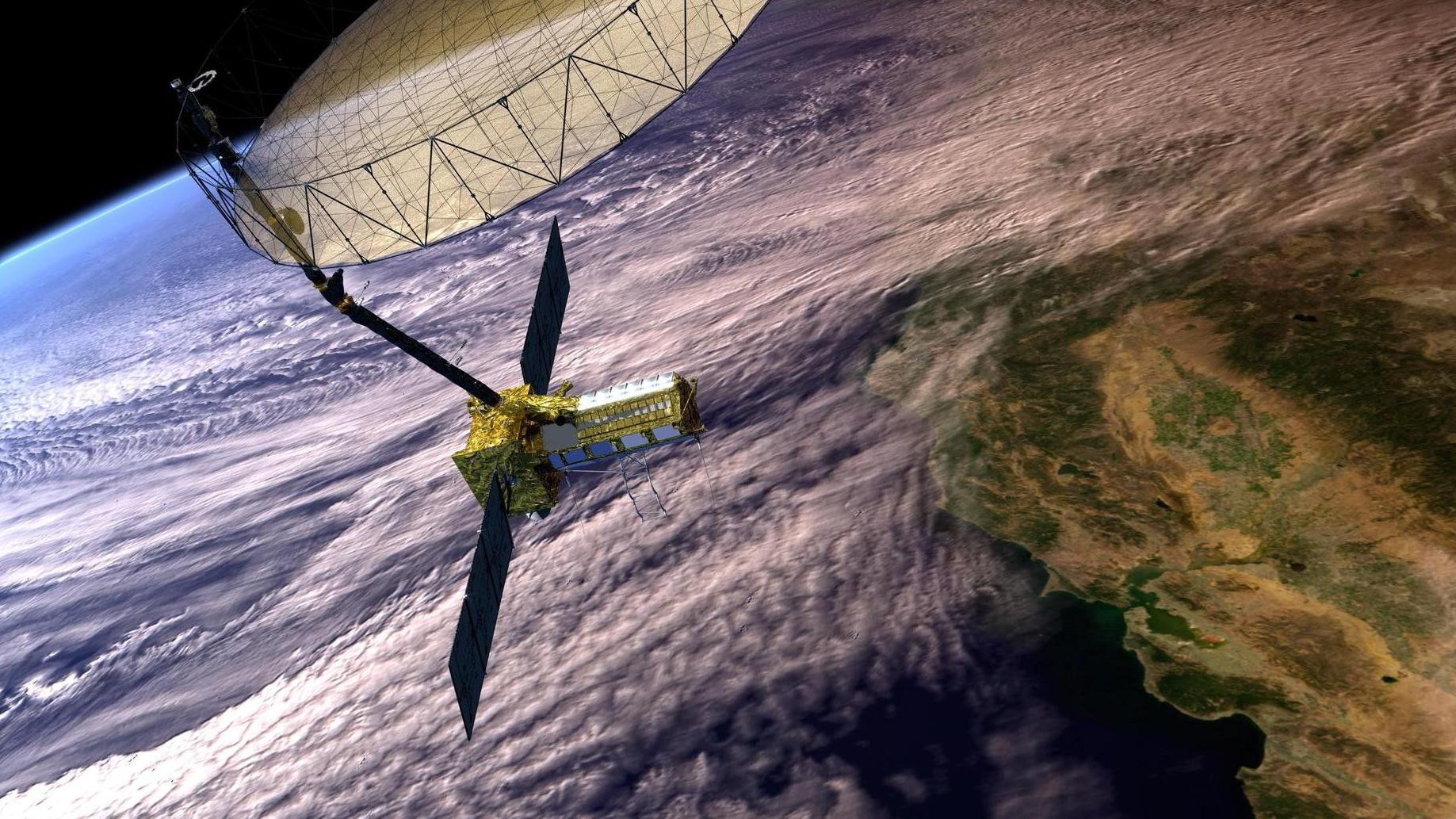
Indian and US space agencies have launched a new satellite which will keep a hawk’s eye on Earth, detecting and reporting even the smallest changes in land, sea, and ice sheets.
Data from the joint mission by Indian Space agency Isro and Nasa will help not just the two countries but the world in preparing and dealing with disasters.
The 2,392kg Nasa-Isro Synthetic Aperture Radar (Nisar) was launched at 17:40 India time (12:10 GMT) on Wednesday from the Satish Dhawan Space Centre in south India.
The satellite comes close on the heels of the Axiom-4 mission which saw an Indian astronaut going to the International Space Station for the first time.
Nasa, which already has more than two dozen observation satellites in space, says Nisar is the “most sophisticated radar we’ve ever built” and that it will be able to spot the “minutest of changes anywhere in the world”.
The “first-of-its-kind satellite” will be the first in space to watch Earth using two different radar frequencies – Nasa’s L-band and Isro’s S-band.
The satellite will be shot into the “sun-synchronous polar orbit”, which means it will pass over the same areas of Earth at a regular interval, observing and mapping changes to our planet’s surface, former Nasa scientist Mila Mitra told the BBC.
Nasa and Isro say Nisar will revisit the same spot every 12 days. It will detect changes and land, ice, or coastal shifts as small as centimetres, says Ms Mitra.
Repeated scans will generate rich data, helping Nasa and Isro ground stations support disaster preparedness and track climate change impacts, she added.
Scientists say Earth’s surface is constantly changing due to natural and human activities, and even small shifts can impact the planet.
“Some of these changes happen slowly, some abruptly, some are small while some are subtle,” Nasa’s director of Earth Sciences Karen St Germain, who is in India for the launch, told a pre-launch press conference.
“With Nisar, we’ll see the precursors to natural hazards such as earthquakes, landslides and volcanoes; we’ll see land subsidence and swelling, movements and deformations, melting of glaciers and ice sheets in Greenland and Antarctica; and we’ll see forest fires.
“We’ll also be able to spot human-induced land changes caused by farming and infrastructure projects such as buildings and bridges,” she said.
The satellite will take 90 days to fully deploy and will start collecting data once tests on all its systems are complete.
The $1.5bn joint mission, over a decade in the making, features India’s payload, rocket, and launch-pad facilities.
Nasa’s St Germain said the satellite was special as it was built by scientists “who were at the opposite ends of the globe during the Covid-19 pandemic”.
Isro chairman V Narayanan told NDTV news channel that the “life-saving satellite” is a symbol of India’s rising leadership in space. Talking about Wednesday’s launch, he said: “This is going to be yet another great day for India.”
Indian Science Minister Jitendra Singh has called the mission a defining moment in India-US space cooperation and a boost to Isro’s international collaborations.
“Nisar is not just a satellite; it is India’s scientific handshake with the world,” the minister said.
The joint mission comes just weeks after astronaut Shubhanshu Shukla travelled to the International Space Station on the AX-4 mission, led by former Nasa veteran Peggy Whitson.
India has been making big strides in its space programme recently.
In August 2023, the country made history as its Moon mission became the first to land in the lunar south pole region. And last year, it commissioned its first solar observation mission.
Isro has announced plans to launch Gaganyaan – the country’s first-ever human space flight – in 2027 and has ambitious plans to set up a space station by 2035 and send an astronaut to the Moon by 2040.
By BBC News
Email your news TIPS to Editor@Kahawatungu.com — this is our only official communication channel
