


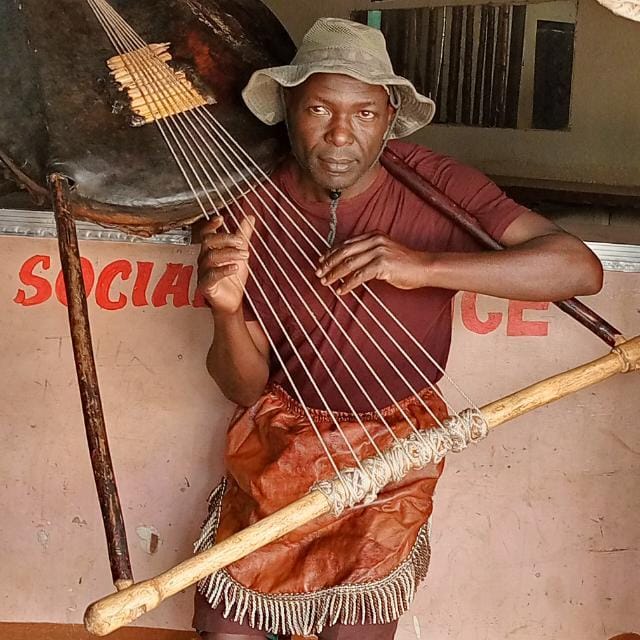
At 44, Richard Okindo Ombuna, popularly known as Professor among his fans in Kisii, is still pursuing a dream rooted in passion, perseverance and a deep commitment to preserving Gusii culture.
A father of four from Nyaribari Masaba, Ombuna discovered his love for music long before leaving school. What began as an interest in musical activities and competitions gradually grew into a lifelong calling, with the traditional obokano becoming the centrepiece of his artistic journey.
“I used to participate in music activities in both primary and high school, sometimes plucking my way to national music competitions,” he told Kahawa Tungu.
His fans call him Professor because of his versatility in playing different musical instruments and performing various genres of music.
Those early experiences helped him nurture his talent and shape his ambitions, even as he navigated life without following the conventional academic path to success.
“I believe learning early what you want in life prepares you to know how to milk opportunities out of it,” he said.
Ombuna did not proceed to university, opting instead to pursue music full-time.
“I have poured myself into music full-time. This is what feeds my family,” he said.
The decision has brought him fulfilment, but it has also exposed him to the financial uncertainties that confront many traditional musicians struggling to turn their talent into a sustainable livelihood.
From borrowed strings to his own instrument
Ombuna’s journey began in 2010 with a borrowed obokano, the traditional stringed instrument closely associated with the cultural identity of the Abagusii.
Without the resources to purchase his own instrument, he relied on determination, patience and repeated practice to sharpen his skills.
“I had the passion, but I lacked the resources. I kept learning and improving until I managed to buy my own,” he recalled.
His breakthrough came in 2011, when he finally acquired his own obokano. The milestone gave him greater independence to practise, perform and refine his craft.
For Ombuna, however, music is about more than talent or personal ambition. He believes his calling may have deeper ancestral roots, connecting his present-day performances to a cultural inheritance passed down through generations.
“I think there is an ancestral hand in what I am doing,” he said, referring to his late great-grandfather.
Years of struggle have not extinguished his ambitions. Speaking animatedly about his future, Ombuna remains convinced that perseverance is essential to achieving his goals.
“If you stop dreaming, you stop living,” he told Kahawa Tungu in Keroka on Tuesday.
A passion struggling to pay the bills
Despite his dedication, Ombuna describes a career marked by financial difficulties, poor remuneration and what he considers exploitation by brokers who mediate between traditional musicians and their clients.
One of his greatest frustrations is the gap between the cultural value musicians provide and the compensation they receive for their performances.
“It is painful to dedicate your time and talent to preserving our culture, only to earn so little from your performances. Musicians deserve appreciation not just through applause, but also through fair payment,” he said.
The challenge is particularly significant for traditional performers whose music helps preserve customs, stories and the collective memory of the Gusii community.
For Ombuna, the obokano is not merely a musical instrument. Its strings carry a cultural inheritance that he fears could gradually fade if younger generations are not encouraged to learn and appreciate traditional music.
He argues that musicians should be able to earn a decent living from their craft while contributing to the preservation of their community’s heritage.
His career has brought him into contact with prominent personalities, including Professor Sam Ongeri, the late Sharif Nasir and the late Karisa Maitha. He also says he has interacted with Kisii Governor Simba Arati and former Governor James Ongwae during public functions.
However, such encounters have not necessarily translated into financial stability.
“Meeting prominent people is encouraging, but recognition alone cannot pay bills or support a family. Musicians need opportunities to earn a decent living from their talent,” he said.
Ombuna is particularly critical of brokers who, he claims, reduce performers’ earnings through booking arrangements that leave musicians with less than they deserve.
He is calling for greater transparency in the traditional music industry, arguing that artists should receive fair compensation for the time, skill and cultural value they bring to public functions and community events.
Preserving a cultural legacy
Beyond his personal ambitions, Ombuna hopes to mentor young people interested in traditional music and pass on the skills required to play the obokano.
He wants the next generation to understand not only how to play the instrument but also its cultural significance and role in preserving Gusii identity.
His ambition is to ensure that the tradition survives beyond the current generation of performers, rather than becoming a relic of the past.
To achieve this, he is appealing for financial support to expand his musical activities, improve his capacity and reach wider audiences.
“I want to mentor young musicians and help preserve our culture. I started with little, but with support, we can give the next generation better opportunities,” he said.
For Ombuna, the journey from school music competitions to a full-time career has been an education of its own, shaped not in university lecture halls but through borrowed strings, years of practice and the determination to keep going.
At 44, he remains committed to the dream that began in childhood: transforming his passion into a sustainable livelihood while ensuring that the strings of the obokano continue to resonate across generations.
His story is one of persistence in the face of limited resources and uncertain rewards. Yet it also raises a broader question about the place of traditional musicians in modern society: how can communities celebrate their cultural heritage while ensuring that the people who preserve it are adequately supported?
For now, Ombuna continues to play, teach and dream, hoping that one day the music that has sustained his spirit will also provide his family with the security they deserve.

Email your news TIPS to Editor@Kahawatungu.com — this is our only official communication channel
