


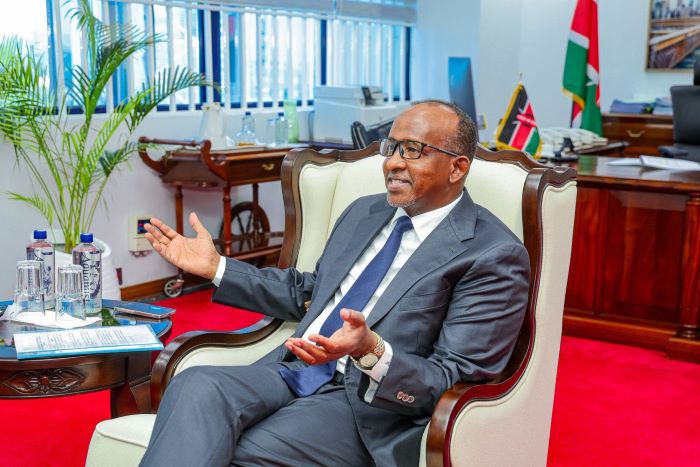
Health Cabinet Secretary Aden Duale appeared before the High Court of Kenya on Tuesday for mitigation after being found in contempt of court over the construction of a US-funded Ebola isolation and quarantine facility in Nanyuki.
The proceedings were presided over by Patricia Nyaundi, who had previously ruled that Duale remained in continuing contempt of court orders issued on May 28 and reaffirmed on June 2, 2026.
The orders halted construction of the facility pending the determination of a petition challenging the project on grounds including alleged lack of public participation and concerns over public health safeguards.
The contempt proceedings arose from an application filed by Katiba Institute, which accused Duale, the Attorney General and other state officials of allowing construction to continue despite the court’s orders. Justice Nyaundi found that the evidence showed the project proceeded in deliberate defiance of the court’s directives and ordered the Health Cabinet Secretary to personally appear for mitigation and sentencing.
Duale arrived in court accompanied by a legal team and senior officials from the Ministry of Health, including Principal Secretary Fredrick Ouga, Public Health Principal Secretary Mary Muthoni, and Director General for Health Patrick Amoth.
When the matter was called, Duale’s lawyers informed the court that he was present in compliance with the judge’s orders and was ready to proceed with mitigation.
The defence also sought leave to file an affidavit in mitigation before sentencing.
The court was expected to consider the mitigation before determining the appropriate penalty for the contempt finding.
Duale found in contempt of court over US-Last month, the High Court halted the building of the 50-bed isolation centre at a military base in the town of Nanyuki until a case brought by a rights group could be heard.
But on Monday, a judge ruled that Duale had ignored the order and allowed the project to continue. He is to be sentenced on Tuesday.
The quarantine facility is intended for US citizens who are suspected to have contracted Ebola in the current outbreak in the Democratic Republic of Congo.
The plan has sparked a series of angry protests in Nanyuki, which is about 140km north of the capital, Nairobi, during which three people have died as police attempted to disperse the demonstrators.
Among those killed was 17-year-old schoolboy Sylvester Muigai Ndung’u who nurtured ambitions of becoming a priest – witnesses say he was shot in the head, but police told the BBC they were awaiting post-mortem results to determine the cause of the boy’s death.
In its court petition in May to stop the construction, rights group the Katiba Institute warned that the arrangement posed “grave and imminent risks” to public health.
The health ministry later insisted it had not flouted last month’s court order to stop the joint US-Kenyan building works, because any ongoing construction was being done solely by the Kenyan government in the national interest to protect Kenyans against Ebola.
But on Monday the judge said the government could not “avoid compliance by recasting or re-characterising the ongoing construction”, adding that a court order “is not an invitation to ingenuity – it is a command to be obeyed”.
Lady Justice Patricia Nyaundi added that Duale knew and understood that all construction at the Nanyuki site had to stop – yet he allowed it to continue.
In recent weeks Kenya’s President William Ruto has defended the plan for the US-funded Ebola quarantine site, saying he had received a request from the US to establish the centre and a refusal would be “inhuman”.
He also called on Kenyans not to politicise a matter “so serious” as Ebola, asking politicians to avoid “reckless” talk about it.
Kenya had not recorded any Ebola cases as of Monday.
The affected countries are the Democratic Republic of Congo, which has recorded more than 1,000 confirmed cases and Uganda which has had 20 confirmed cases – most imported from DR Congo – so far.
The US plan has led to vocal opposition from one of the biggest medical unions in Kenya – the KMPDU – which questioned why the country was chosen to host a quarantine facility for exposed American citizens.
The Congolese city of Bunia, the epicentre of the outbreak, is 780km from Nanyuki, with Uganda separating DR Congo and Kenya.
Davji Bhimji Atellah, KMPDU’s secretary general, said the union “will not sit back and watch Kenya be treated as a containment colony for a lethal pathogen that we did not generate”.
Washington intends to provide $13.5m (£10.7m) in aid to fund Kenya’s Ebola preparedness efforts, according to a spokesperson for US Secretary of State Marco Rubio
That amount is part of a larger $112m US commitment for the regional response to the outbreak.
Email your news TIPS to Editor@Kahawatungu.com — this is our only official communication channel
