


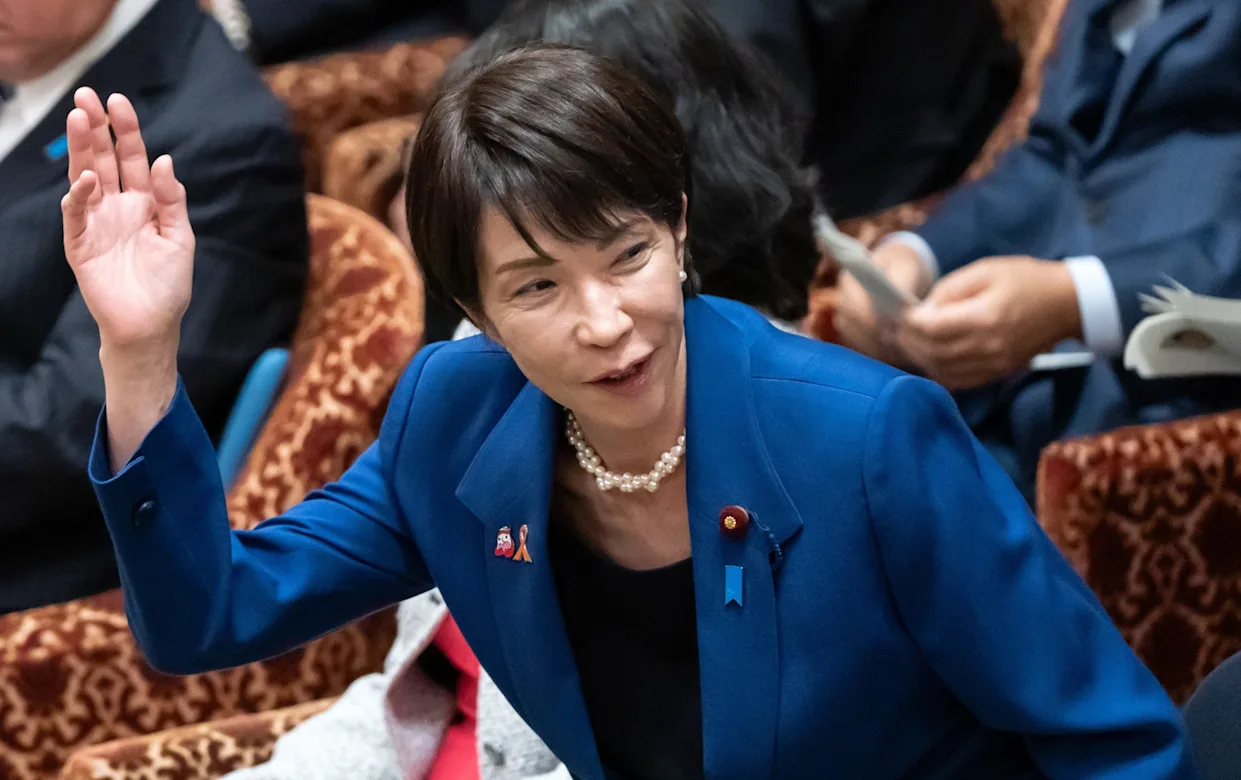
Over the past week, China and Japan have been locked in an escalating war of words.
It all started when Japan’s new Prime Minister, Sanae Takaichi, suggested that if China attacked Taiwan then Japan could respond with its own self-defence force.
Since then, foreign ministries on both sides have lodged serious protests with the other, and a Chinese diplomat made what some interpreted as a threat to behead Takaichi.
The spat touches on the historical animosity between China and Japan, as well as longstanding “strategic ambiguity” on the sovereignty of Taiwan.
Here’s what to know.
What happened? A timeline
The current tensions were sparked at a parliamentary meeting in Japan last Friday, when an opposition lawmaker asked Takaichi what circumstances surrounding Taiwan would count as a survival-threatening situation for Japan.
“If there are battleships and the use of force, no matter how you think about it, it could constitute a survival-threatening situation,” Takaichi responded.
A “survival-threatening situation” is a legal term under Japan’s 2015 security law, referring to when an armed attack on its allies poses an existential threat to Japan. In such a situation, Japan’s self-defence forces can be activated to respond to the threat.
Takaichi’s remarks drew ire from Beijing, with China’s foreign ministry describing them as “egregious”.
On Saturday, Xue Jian, China’s consul general in the Japanese city of Osaka, reshared a news article about Takaichi’s parliamentary remarks on X. But he also added his own comment that “the dirty head that sticks itself in must be cut off”.
While the intent of Xue’s remarks “may not be clear”, they were “highly inappropriate”, Japan’s chief cabinet secretary Minoru Kihara told reporters on Monday.
Tokyo has lodged protests with China over Xue’s remarks, while Beijing has lodged its own with Japan over Takaichi’s.
Xue’s post has since been taken down – but the dust from the barbed exchanges hasn’t settled yet.
On Tuesday, Takaichi declined to retract her remarks, which she defended as “consistent with the government’s traditional position”. She did note, however, that she would be careful commenting on specific scenarios from now on.
A long history of animosity
There is a longstanding animosity between the two countries, which can be traced back to a series of armed conflicts in the 1800s and Japan’s brutal military campaign in China during World War Two.
Historical grievances have remained sore spots in bilateral relations ever since. But the recent ascension of Takaichi, Shinzo Abe’s protege, suggests more tensions may lay ahead.
The conservative leader is pursuing closer ties with the US and has pledged to increase Japan’s defence spending – raising some alarm in Beijing.
Takaichi is also famously hawkish on China and a longtime supporter of Taiwan.
She had previously said that a blockade of the island could threaten Japan, and that Japan could mobilise its troops to stop a Chinese invasion.
China is especially touchy about Taiwan, the self-governed island that Beijing claims as part of its territory. China has not ruled out the use of force to take Taiwan – a posture that has unsettled Taipei and its allies in the region.
Earlier this month, Beijing accused Takaichi of violating the one-China principle, after she posted photos of herself meeting a senior Taiwanese official on the sidelines of the Apec summit in South Korea.
Why Takaichi’s recent comments caused such a stir
The Japanese prime minister’s recent comments mark a departure from the equivocal position that the country has traditionally adopted on the status of Taiwan.
This is in line with the policy of “strategic ambiguity” that the US has long maintained: remaining vague about what it would do to defend Taiwan in the event of a Chinese invasion.
For decades, this ambiguity has kept China guessing – a form of deterrence – while leaving room for economic ties to flourish.
The Japanese government’s official stance is that it hopes the Taiwan issue can be resolved peacefully through dialogue – and Japanese officials have typically avoided mentioning Taiwan in public discussions about security.
On the occasions where they have, they have been met with sharp rebuke from Beijing.
In 2021, when then deputy prime minister Taro Aso said that Japan would need to defend Taiwan alongside the US in the event of an invasion, Beijing condemned his remarks and told Japan to “correct its mistakes”.
In this more recent flare-up, China’s foreign ministry said that Takaichi’s remarks were “a gross interference in China’s internal affairs”.
“Taiwan is China’s Taiwan,” ministry spokesperson Lin Jian told a press briefing on Monday, adding that China would not “tolerate any foreign interference” on the matter.
“What signal is the Japanese leader trying to send to ‘Taiwan independence’ separatist forces?” he added. “Is Japan up to challenge China’s core interests and stop its reunification?”
By BBC News
Email your news TIPS to Editor@Kahawatungu.com — this is our only official communication channel
