


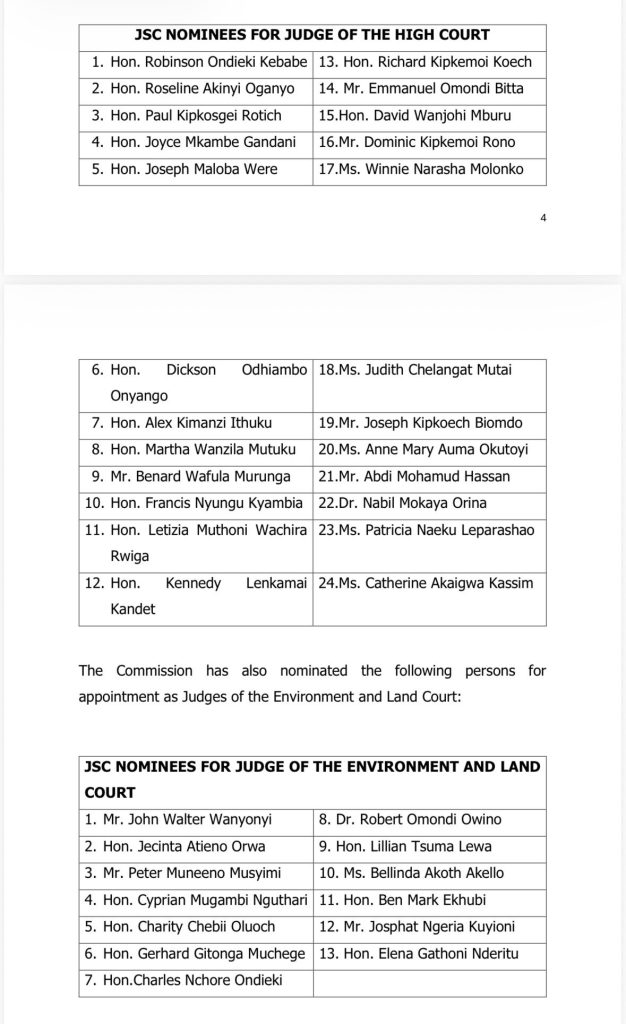
The Judicial Service Commission (JSC) concluded its recruitment process for judges of the High Court and the Environment and Land Court (ELC), nominating a total of 37 candidates.
In the exercise, 24 nominees were selected for appointment to the High Court, while 13 were picked for the ELC.
The recruitment followed advertisements issued on June 9, 2025, seeking to fill 20 vacancies in the High Court and 10 in the ELC.
However, the Commission later expanded the number of positions under Rule 20(2) of the First Schedule to the Judicial Service Act, citing developments that arose during the recruitment period.
These included the elevation of 15 judges to the Court of Appeal, among them four from the High Court and two from the ELC as well as the retirement of one ELC judge.
The JSC also relied on the High Court decision in Petition E377 of 2022, Okoiti v Judicial Service Commission & another, which affirmed its authority to adjust and fill additional vacancies arising within an ongoing recruitment process.
A total of 377 applicants vied for positions in the High Court, with 100 shortlisted for interviews, while 243 applied for ELC posts, of which 50 were shortlisted.
The interview process concluded on March 5, 2026, for High Court candidates and on April 9, 2026, for ELC candidates.
The proceedings were publicly broadcast.
Once appointed by the President, the number of High Court judges is expected to rise from 91 to 115, while ELC judges will increase from 48 to 61.
The JSC says the expansion is aimed at improving efficiency in case handling and reducing backlog by strengthening the judge-to-case ratio.
JSC Chairperson Chief Justice Martha Koome responded to findings of the Kenya National Gender and Corruption Survey 2025 released by the Ethics and Anti-Corruption Commission (EACC), which highlighted corruption perceptions within the Judiciary and wider public service.
She noted that the Judiciary has already initiated engagement with the EACC to review the report and its findings in detail.
“We do not tolerate corruption. Where integrity is compromised, action will be taken,” she said.
Chief Justice Koome pointed to ongoing reforms, including the 2021 invitation to the EACC to conduct an independent systems audit, the establishment of Integrity Committees in court stations, public engagement forums, and increased digitisation of judicial processes to reduce opportunities for misconduct.
She further noted that regulations governing petitions against judges have now been finalized.
She urged the public to report any suspected corruption involving judicial officers or staff, stressing that accountability is a shared responsibility.
“Judicial authority is derived from the people of Kenya and must be exercised with integrity, impartiality, and fidelity to the Constitution,” she said, adding that public trust remains the Judiciary’s most important asset.
Email your news TIPS to Editor@Kahawatungu.com — this is our only official communication channel
