


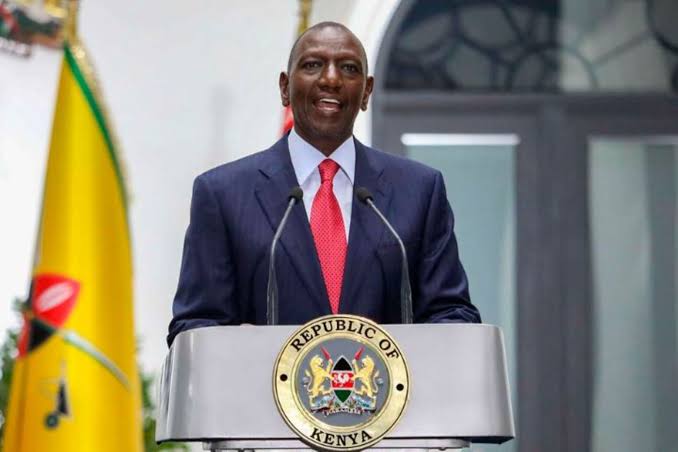
President William Ruto officially launched the process of developing Kenya’s next long-term development blueprint to succeed Vision 2030, unveiling plans for a nationwide public participation exercise that he says will shape the country’s future beyond the current strategy.
In a national address on Thursday evening, President Ruto announced that the government will formally launch a National Conversation on Kenya’s Future Beyond Vision 2030 on August 12, 2026, describing it as the most consequential public participation exercise since the promulgation of the 2010 Constitution.
The President said the process would bring together every institution of the Republic, all 47 counties and representatives from across society, insisting the successor to Vision 2030 must be driven by Kenyans rather than government.
“Our Constitution places public participation at the very heart of governance. It is therefore not merely my desire, but my constitutional duty, to ensure that the national vision which succeeds Vision 2030 is shaped through an inclusive, transparent, people-driven, and genuinely national process,” he said.
According to the President, political parties, the private sector, workers’ organisations, faith communities, universities, professional associations, innovators, civil society, creative industries and young people will all participate in crafting the country’s next development charter.
In a notable political development, Ruto revealed that he had invited Kisumu Governor Prof. Anyang’ Nyong’o and Japanese scholar Prof. Hiroyuki Hino, alongside other experts, to begin examining Kenya’s future beyond Vision 2030.
“It was in that spirit that I invited Professor Hiroyuki Hino, Professor Anyang’ Nyong’o and their distinguished colleagues to begin examining Kenya’s future beyond Vision 2030,” the President said.
He disclosed that the team had already submitted proposals outlining strategic guidelines for Kenya’s long-term transformation, saying they envision a prosperous, industrialised and globally competitive country within one generation.
“The thrust of their proposals is both ambitious and achievable: that Kenya can become a prosperous, high-income, industrialised and globally competitive nation within one generation, provided we remain united in purpose, disciplined in execution and unwavering in our commitment to long-term national transformation,” Ruto stated.
The Head of State maintained that the next national vision should not be crafted by government or a select group of experts, but through a broad national consensus.
“Those interactions reinforced one conviction above all others: a vision worthy of guiding Kenya for the next generation cannot be written by Government. It cannot be crafted by a handful of experts, however distinguished, nor can it emerge from a single institution or political formation,” he said.
Ruto said the proposals submitted by the expert team would serve only as the foundation for a wider national conversation.
“These proposals provide the foundation for a much broader national conversation; a conversation that now belongs not to Government, nor to its authors, but to every Kenyan,” he added.
The President noted that while Vision 2030 had guided Kenya’s development agenda for nearly two decades, it was approaching its intended horizon and some of its ambitions, including attaining upper-middle-income status by 2030, remained unmet.
He said the transition offered an opportunity to reflect on the country’s achievements and shortcomings while charting a new long-term path.
“For two decades, Vision 2030 shaped our national development priorities, informed public policy, catalysed investment, and most importantly inspired the promulgation of our new Constitution,” he stated.
“As Vision 2030 approaches its horizon, our responsibility is not simply to replace it with another Government development plan. Our responsibility is far greater under the 2010 Constitution, to craft a new national development charter that gives effect to the development imperatives enshrined in the Constitution and to decide, together, what kind of Kenya we want to build over the next generation, and beyond.”
He said Vision 2030 set a target of Kenya becoming an upper-middle income country by 2030.
“So far, we are off target. This is not a criticism of Vision 2030. Nor is it a reason for disappointment. Rather, it is an opportunity to proudly learn from our successes, reflect with honesty on where we have fallen short, and define, together, Kenya’s next long-term vision.”
Email your news TIPS to Editor@Kahawatungu.com — this is our only official communication channel
