


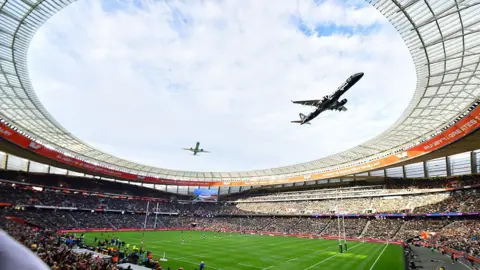
A South African airline has defended itself against some criticism of a dramatic stunt that saw two of its aircraft in close formation fly reportedly within feet of the top of a stadium.
The jets roared over Cape Town’s DHL Stadium, filled with more than 50,000 fans, as smoke flares shot up before the start of a rugby match featuring fierce rivals South Africa and New Zealand.
As videos of Saturday’s aerial feat were shared, some labelled the startling manoeuvre reckless, while others have praised the precision and expertise required to pull it off.
In response, Airlink said it was carefully planned with the support of the aviation authorities.
“Planning. Precision. Performance,” was the airline’s message in social media postsaccompanied by the footage.
In a statement reproduced on a government news site, Airlink went into more detail.
“The two aircraft were flown by highly experienced crew, with each comprised of three senior captains operating in the roles of commander, co-pilot and safety/technical officer,” the airline said.
It added that the flights were performed with the “approved and rehearsed safety altitude and speed limits for the flypast”.
The flight tracking website Flightradar24 said that according to its analysis “the lead aircraft passed less than 50 feet (15 metres) above the top of the stadium”.
Questions have been raised over the risk and potential for disaster involving two planes and a packed stadium, but many South Africans have responded with expressions of national pride that its country’s pilots could pull this off.
“It’s a well known fact that we have the best pilots in the world, that was spectacular,” Sports Minister Gayton McKenzie wrote on X.
The low-altitude flyby has become a feature of the build-up to some big matches in South Africa.
The most notable was when a South African Airways jet flew over Johannesburg’s Ellis Park stadium before the start of the 1995 rugby World Cup final which saw South Africa beat New Zealand.
The match, immortalised in the Hollywood film Invictus, was highly symbolic as the country’s first black president, Nelson Mandela, donned the jersey of the national side, which had been closely associated with the apartheid government and previously excluded players who were not white.
By BBC News

Email your news TIPS to Editor@Kahawatungu.com — this is our only official communication channel
