


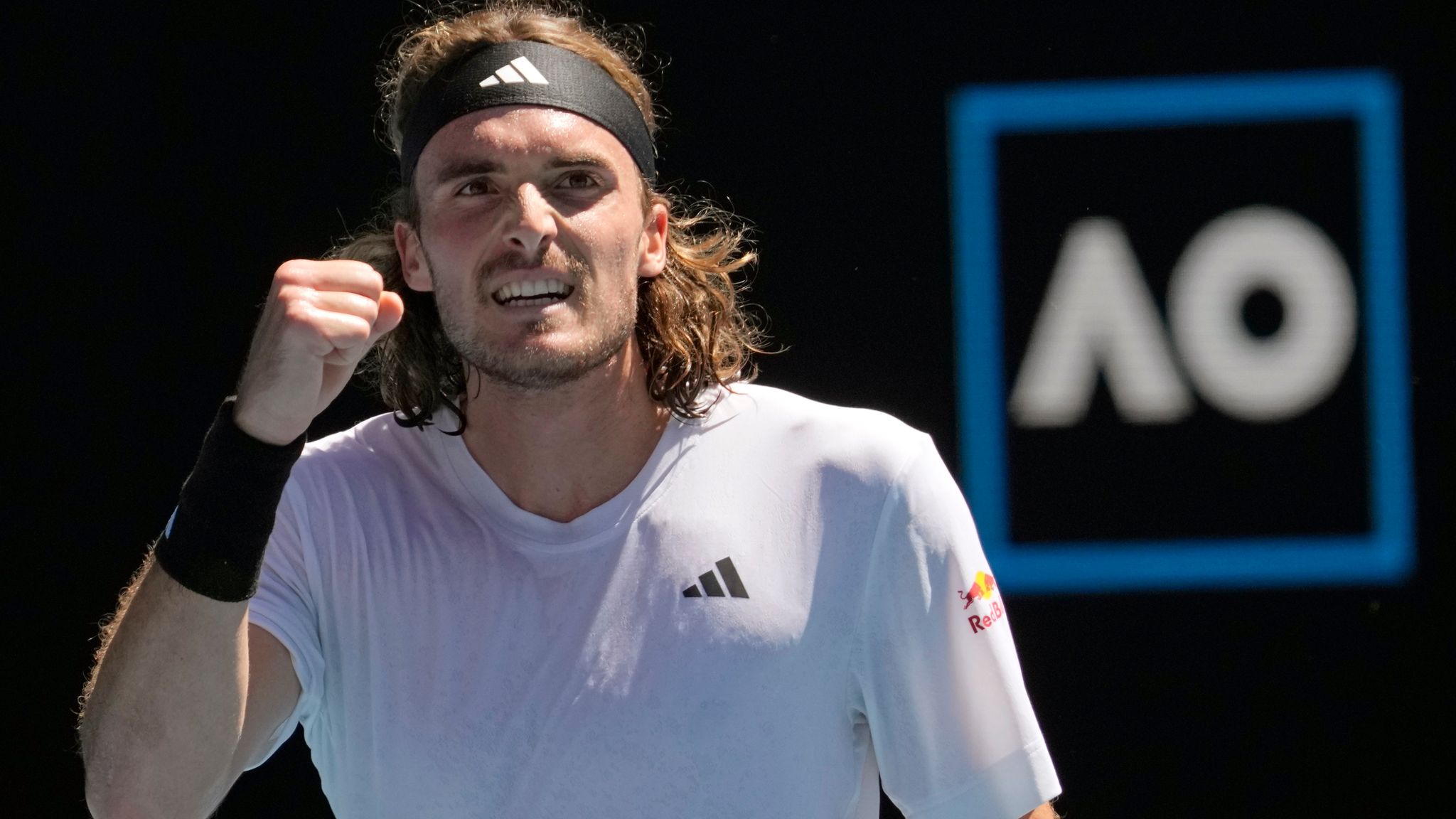
Considered one of the most talented players of his generation, Tsitsipas rose to international prominence after becoming the youngest player in nearly two decades to win the ATP Finals in 2019.
Over the years, Tsitsipas has established himself as one of the elite players in men’s tennis, reaching a career-high ranking inside the ATP top five and becoming the highest-ranked Greek player in tennis history. Known for his aggressive playing style and elegant one-handed backhand, he has become one of the sport’s most recognizable stars.
As of this writing, Tsitsipas has earned more than $25 million in tournament prize money, placing him among the highest-earning male tennis players of his era.
| Stefanos Tsitsipas Net Worth | $14 Million |
| Date of Birth | August 12, 1998 |
| Place of Birth | Athens, Greece |
Stefanos Tsitsipas Career Earnings
Tsitsipas has steadily built his fortune through tournament winnings, sponsorships, and endorsements.
After turning professional in the mid-2010s, he gradually climbed the ATP rankings and began collecting substantial prize money through strong performances at Grand Slam tournaments and Masters events.
By his early twenties, Tsitsipas had already established himself among the world’s best players. His deep runs at major tournaments—including the Australian Open and French Open—significantly boosted his earnings.
As of 2026, Tsitsipas has accumulated more than $25 million in ATP prize money, making him one of the 20 highest-earning male tennis players in tour history.
Beyond winnings, Tsitsipas has also secured endorsement partnerships with major athletic and luxury brands, further expanding his income off the court.
Early Life
Stefanos Tsitsipas was born on August 12, 1998, in Athens, Greece.
Tennis was a major part of his upbringing from the very beginning. His father, Apostolos Tsitsipas, trained as a tennis coach, while his mother, Julia Salnikova, was a former professional tennis player who represented the Soviet Union and was once ranked among the top junior players in the world.
Growing up in a highly athletic household, Tsitsipas was surrounded by tennis. His parents worked as instructors, and all of his siblings eventually pursued the sport competitively.
Stefanos first picked up a tennis racket at just three years old and began formal lessons soon afterward. Although he experimented with other sports while growing up, he ultimately decided to focus fully on tennis at age nine.
Unlike many professional athletes, Tsitsipas has said his parents never forced him into the sport, explaining that he independently chose to pursue tennis professionally.
Since tennis lacked widespread popularity in Greece, Tsitsipas often trained internationally to maximize his development.
To help support his son’s ambitions, his father formally studied tennis coaching at the University of Athens and later became Stefanos’ full-time coach—a role he continues to hold.
In 2015, Tsitsipas joined the prestigious Patrick Mouratoglou Academy in France, one of tennis’ top development centers, while continuing to train in Greece.
Junior Career
Tsitsipas began competing on the ITF junior circuit at age 14 and quickly emerged as one of the brightest young talents in tennis.
By 2015, he was already competing in junior Grand Slam tournaments, achieving strong results and climbing the world rankings.
His breakout junior season came in 2016, when he reached the quarterfinals in all eight major junior tournaments he entered, including all four Grand Slam events.
That same year, Tsitsipas captured the prestigious Trofeo Bonfiglio title, helping him reach the No. 1 junior ranking in the world.
He also enjoyed success in doubles, winning the Wimbledon boys’ doubles title alongside partner Kenneth Raisma.
By the end of his junior career, Tsitsipas had firmly established himself as one of the world’s most promising prospects.
Professional Career
Tsitsipas made his ATP main draw debut in 2017 at the Rotterdam Open.
Although his early professional matches were inconsistent, he gradually found momentum and claimed a Challenger title in Genova, helping him break into the ATP top 100 before turning 20.
His true breakthrough arrived in 2018.
That season, Tsitsipas stunned the tennis world by reaching the final of the Canadian Open, defeating several top-ranked players along the way. He later won the Next Gen ATP Finals and finished the year as the ATP Most Improved Player.
In 2019, Tsitsipas elevated his game even further.
He reached the Australian Open semifinals, defeating Roger Federer in a major upset, and later captured the ATP Finals championship, becoming the youngest player to win the tournament in 18 years.
The victory cemented his status as one of tennis’ biggest stars and pushed him into the ATP top five.
Throughout the early 2020s, Tsitsipas continued competing at an elite level.
He reached multiple Grand Slam semifinals and finals, including deep runs at the French Open and Australian Open, while regularly competing against tennis giants such as Novak Djokovic, Rafael Nadal, and Daniil Medvedev.
Although consistency occasionally proved challenging, Tsitsipas remained one of the sport’s most dangerous players on clay and hard courts.
Playing Style
Tsitsipas is known for his aggressive baseline game and attacking mindset.
Unlike many modern players, he relies on a rare one-handed backhand, a style famously used by Roger Federer.
His game centers around powerful forehands, heavy topspin, and an aggressive serve that allows him to dominate rallies.
While technically considered a baseliner, Tsitsipas frequently moves to the net, blending traditional and modern tennis styles.
His strongest surface has often been clay, due in part to his early development in Greece, though he has stated that grass is actually his favorite surface.
Critics have praised Tsitsipas for his calm demeanor and composure under pressure, though weaknesses such as unforced errors and inconsistent returns occasionally affect his performances.
Near-Drowning Incident
One of the most dramatic moments of Tsitsipas’ life occurred while he was still a junior player.
During a family trip to Crete, Stefanos nearly drowned after being swept away by a strong ocean current.
His father managed to rescue him before tragedy struck.
Tsitsipas has often spoken about how the experience changed his outlook on life, explaining that it made him more fearless both personally and professionally.
He has credited the near-death experience for shaping the fearless mentality he brings onto the tennis court.
Personal Life
Outside tennis, Tsitsipas is known for his creative side and active social media presence.
He enjoys photography, travel, and producing videos documenting life on tour.
He has also expressed a desire to help grow tennis in Greece, a country where the sport historically lacked mainstream popularity before his rise.
As one of the biggest international stars in Greek sports history, Tsitsipas has become an important ambassador for tennis in his home country.
Also Read: Novak Djokovic Net Worth

Email your news TIPS to Editor@Kahawatungu.com — this is our only official communication channel
