


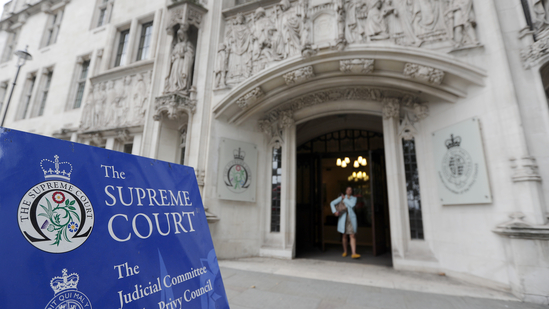
The UK Supreme Court has unanimously backed the biological definition of “woman” under the 2010 Equality Act.
It marks the culmination of a long-running legal battle which could have major implications for how sex-based rights apply across Scotland, England and Wales.
Judges sided with campaign group For Women Scotland, which brought a case against the Scottish government, arguing that sex-based protections should only apply to people who are born female.
Judge Lord Hodge said the ruling should not be seen as a triumph of one side over the other, and stressed that the law still gives protection against discrimination to transgender people.
The Scottish government argued in court that transgender people with a gender recognition certificate (GRC) are entitled to the same sex-based protections as biological women.
The Supreme Court was asked to decide on the proper interpretation of the 2010 Equality Act, which applies across Britain.
Lord Hodge said the central question was how the words “woman” and “sex” are defined in the legislation. He told the court: “The unanimous decision of this court is that the terms woman and sex in the Equality Act 2010 refer to a biological woman and biological sex.
“But we counsel against reading this judgement as a triumph of one or more groups in our society at the expense of another, it is not.”
He added that the legislation gives transgender people “protection, not only against discrimination through the protected characteristic of gender reassignment, but also against direct discrimination, indirect discrimination and harassment in substance in their acquired gender”.
Campaigners who brought the case against the Scottish government hugged each other and punched the air as they left the courtroom, with several of them in tears.
The Equality Act provides protection against discrimination on the basis of various characteristics, including “sex” and “gender reassignment”.
Judges at the Supreme Court in London were asked to rule on what that law means by “sex” – whether it means biological sex, or legal, “certificated” sex as defined by the 2004 Gender Recognition Act.
The Scottish government argued the 2004 legislation was clear that obtaining a GRC amounts to a change of sex “for all purposes”.
For Women Scotland argued for a “common sense” interpretation of the words man and woman, telling the court that sex is an “immutable biological state”.
Outside the Supreme Court, For Women Scotland co-founder Susan Smith said: “Today the judges have said what we always believed to be the case, that women are protected by their biological sex.
“Sex is real and women can now feel safe that services and spaces designated for women are for women and we are enormously grateful to the Supreme Court for this ruling.”
A UK government spokesman said: “This ruling brings clarity and confidence, for women and service providers such as hospitals, refuges, and sports clubs.
“Single-sex spaces are protected in law and will always be protected by this government.”
Conservative leader Kemi Badenoch described the ruling as a “victory for all of the women who faced personal abuse or lost their jobs for stating the obvious”.
But Scottish Green MSP Maggie Chapman, a prominent campaigner for trans-rights, said: “This is a deeply concerning ruling for human rights and a huge blow to some of the most marginalised people in our society.
“It could remove important protections and will leave many trans people and their loved ones deeply anxious and worried about how their lives will be affected and about what will come next.”
The Scottish government has not yet commented on the ruling.
Single-sex spaces
For Women Scotland had warned that if the court sided with the Scottish government, it would have implications for the running of single-sex spaces and services, such as hospital wards, prisons, refuges and support groups.
Transgender people warned the case could erode the protections they have against discrimination in their reassigned gender.
The case follows years of heated debate over transgender and women’s rights, including controversy over transgender rapist Isla Bryson initially being put in a women’s prison and an ongoing employment tribunal involving a female NHS Fife nurse who objected to a transgender doctor using a women’s changing room.
The judges ruled that that Interpreting sex as “certificated” rather than “biological” would “cut across the definitions of man and “woman and thus the protected characteristic of sex in an incoherent way”.
They said a “certified” definition of sex would weaken protections for lesbians, citing the example of lesbian-only spaces and associations as it would mean that a trans woman who was attracted to women would be classed as a lesbian.
The ruling found the biological interpretation of sex was also required for single-sex spaces to “function coherently”.
It cited changing rooms, hostels, medical services and single-sex higher education institutions.
The judges noted “similar confusion and impracticability” had arisen in relation to single-sex associations and charities, women’s sport, public sector equality and the armed forces.
The judges added: “The practical problems that arise under a certificated sex approach are clear indicators that this interpretation is not correct.”
How did we get here?
The legal dispute began in 2018, when the Scottish Parliament passed a bill designed to ensure gender balance on public sector boards.
For Women Scotland complained that ministers had included transgender people as part of the quotas in that law.
The issue has been contested several times in the Scottish courts.
Holyrood ministers won the most recent case in Scotland, with judge Lady Haldane ruling in 2022 that the definition of sex was “not limited to biological or birth sex”.
The Scottish Parliament passed reforms that year that would have made it easier for someone to change their legally recognised sex.
The move was blocked by the UK government, and has since been dropped by Holyrood ministers.
By BBC News
Email your news TIPS to Editor@Kahawatungu.com — this is our only official communication channel
