


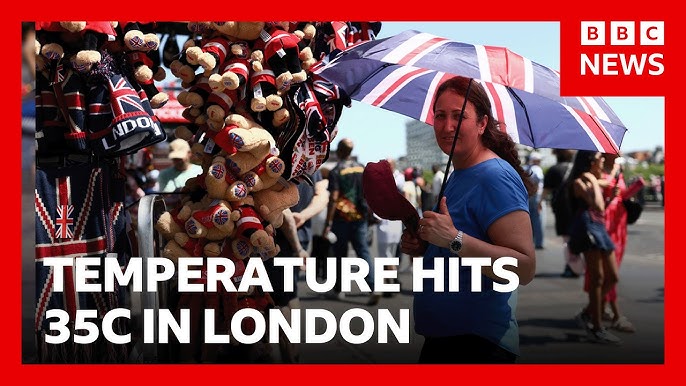
The UK record for the hottest May day has been broken for a second day in a row, as parts of London surpassed 35C on Tuesday.
Kew Gardens in south-west London recorded a provisional temperature of 35.1C, beating Monday’s 34.8C record-high in the same place.
Wales also broke May records for the second consecutive day, as provisional temperatures reached 32.3C at Cardiff’s Bute Park, surpassing Monday’s 32.2C at Hawarden Airport in Flintshire.
The soaring temperatures led to delays to train services due to speed restrictions put in place because of the heat.
Before Monday and Tuesday’s record-breaking highs, May’s warmest day in the UK was 32.8C in 1922 and 1944.
“Until yesterday, the highest temperature in May was 32.8C, but we’ve now exceeded that record on consecutive days by a full two degrees Celsius,” the Met Office posted on X.
Six amber heat health alerts issued by the UK Health Security Agency (UKHSA) cover much of England and will be active until Thursday.
The alert warns that significant impacts are likely across health and social care services, with increased demand caused by the high temperatures.
Much of England and Wales are in an official heatwave as of Tuesday. A location has to reach a threshold temperature – 25C for northern and western areas and 28C in London and Home Counties – for three days in a row.
This early season heat is consistent with the long-term trend of rising temperatures because of human-caused climate change.
The Met Office’s chief operational meteorologist Dan Suri also said the high temperatures were due to “the influence of warmth building under an area of high pressure near the UK”.
Network Rail imposed a series of speed restrictions on tracks to keep trains safe. National Rail said heat could see overhead lines expand and sag and cause rails to buckle.
South Western Railway (SWR) warned that train services running across its whole network may be cancelled, delayed by up to 60 minutes or revised due to issues including heat-related speed restrictions. High track temperatures disrupted LNER services between Peterborough and London Kings Cross.
There was also major disruption to Great Northern, Thameslink and Southern networks.
Meanwhile in Kent, dozens of homes have been left with little or no water for the third day.
The outages began on Saturday and peaked on Sunday when about 800 properties in the villages of Charing, Challock and Molash were unable to get water.
South East Water said teams were working hard to restore drinking water supplies across the region following “high demand during the exceptionally hot weather”, which led to “storage reservoirs running low in parts of Kent”.
On Tuesday evening a search was ongoing for a boy missing after getting into difficulty swimming in a river. The child was with friends when he went into the River Ribble at Ribchester in Lancashire, police said.
Four people have died at swimming spots in different locations around England during the bank holiday weekend.
On Monday, a 13-year-old boy died after getting into difficulty while in a reservoir in Halifax, West Yorkshire, and at Kingsbury Water Park in Warwickshire the body of a teenage girl was recovered in the evening.
Another body was recovered from the water of Rother Valley Country Park in South Yorkshire in the early hours of Tuesday morning after a teenage boy went missing.
At Tregirls Beach near Padstow, Cornwall, a man in his 60s died on Monday after running into the sea to help two relatives who got into difficulty, police said.
The Royal Life Saving Society has urged people to stay safe and warned that “warmer weather unfortunately sees an increase in accidental drownings”.
It said that while air temperatures are hot, water temperatures remain very cold.
The Met Office also warned people of potential “cold shock” as sea and other open water temperatures are much lower than the highs being felt during the heatwave.
It shared a map showing that even in the south-east of England, sea temperatures are about 14C.
The Met Office also issued a yellow weather warning for thunderstorms in England until 22:00 on Tuesday.
They are likely to be very isolated, however, and “could bring disruption to a few places”, the Met Office said.
The weather service said the warning covers the East Midlands, the east of England, parts of London and the south-east, parts of north-west and south-west England, the West Midlands, and Yorkshire and Humber.
It added that the warning had a “very low likelihood and a medium impact”.
By BBC News

Email your news TIPS to Editor@Kahawatungu.com — this is our only official communication channel
