


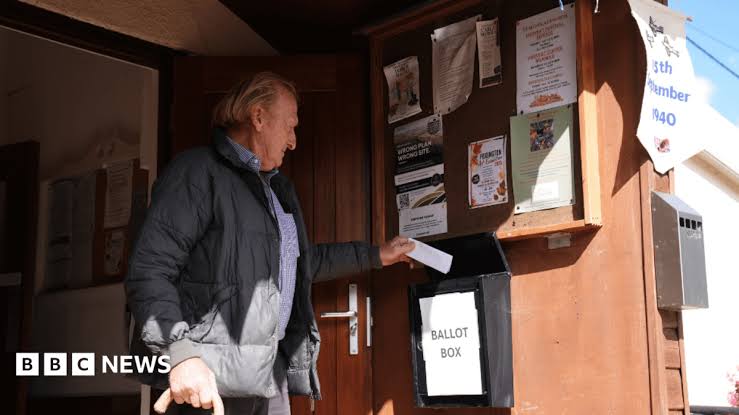
Residents of an Oxfordshire village have voted to become independent from the UK in a symbolic referendum held in protest at plans to house more than 1,000 migrants at a former military base.
Villagers in Piddington, near Bicester, voted on Tuesday over Home Office proposals to house up to 1,256 male asylum seekers at nearby MoD Bicester.
The 350 residents were invited to cast their ballot in a small box outside the village hall, the community hub of Piddington.
The referendum was organised by the local parish council and out of 312 votes cast, 285 voted to leave, there were 26 no votes, and one ballot paper was spoiled.
Delivering the result, Susannah Parden, vice chair of the parish council, said: “We are Piddington the village that roars.”
Parish council chair Tim McNally said: “This is an example of democracy in operation.
“We went into this village hall as the underdogs – we had a plucky idea. We have given a message to the world.”
But Culture Secretary Lisa Nandy told BBC Breakfast the government would not reconsider the proposal.
She said: “The alternative would be to ask communities who have already seen their local community quadruple in size to take more of the load – and I think that’s deeply unfair.”
Nandy said Piddington was “not actually” unusual, adding: “In my constituency there are particular streets where that has happened to the community.”
She said the government was listening to the Piddington campaigners.
“I do really understand that when changes are made that affect your community it can be very distressing.
“We inherited an enormous asylum backlog, we are processing claims much more quickly, we are removing people who don’t have the right to be here.
“Small boat crossings fell this summer for the first time in many years because of the action we have taken.
“While we get a grip on the asylum chaos that we inherited we do need to make sure that we live up to our obligations and house people coming to this country seeking safety.”
Women in the village have said “life as we know it will be destroyed” if the plans went ahead.
More than 130 female residents have written to every female Member of Parliament to share their concerns.
“As fellow women, you will understand the serious risks this will expose us to. Our safety, our security and our freedoms will be under threat. “We will not feel safe walking our streets,” they said.
Local politicians and charities have said they were “astounded” by the government’s proposals and said the location was not suitable for such use.
Hari Reed, from the Oxfordshire-based charity Asylum Welcome, said: “They [asylum seekers] will be distant from the kind of support that they usually need and that will put additional burden on the public services that are there to accommodate them.”
Piddington resident Christina Gower, 26, said she was disappointed villagers had to do something “so drastic and desperate” to get the prime minister’s attention, adding he would be welcome to join them for a cup of tea to discuss the issue.
She said: “You see this kind of stuff on the telly, in front of 10 Downing Street, not in plucky Piddington, in the middle of Oxfordshire.
“It doesn’t make sense, but then I just think it’s such a symbol for the rest of the UK, and I think the residents here in Piddington are so proud that they can pull off something so wacky and out of place and really impactful.”
Ian Darby said he was “extremely emotional” listening to the result being read.
The 63-year-old said: “I haven’t seen a press frenzy like that over a little village, it’s quite extraordinary.”
He added it has made the village think “wow, our voice can be heard”.
Joe Marshall, a Piddington parish councillor, said the village could elect leaders for its new “principality” and even create ID cards.
Asked how far it could take its independence campaign, Marshall said it depends on how much the government was willing to listen.
He added its main aim was to encourage other communities unhappy with local decisions “to push for similar things”.
He cited the Principality of Sealand as inspiration – a former military platform in the sea off East Anglia declared an independent territory in 1967.
By BBC News

Email your news TIPS to Editor@Kahawatungu.com — this is our only official communication channel
