


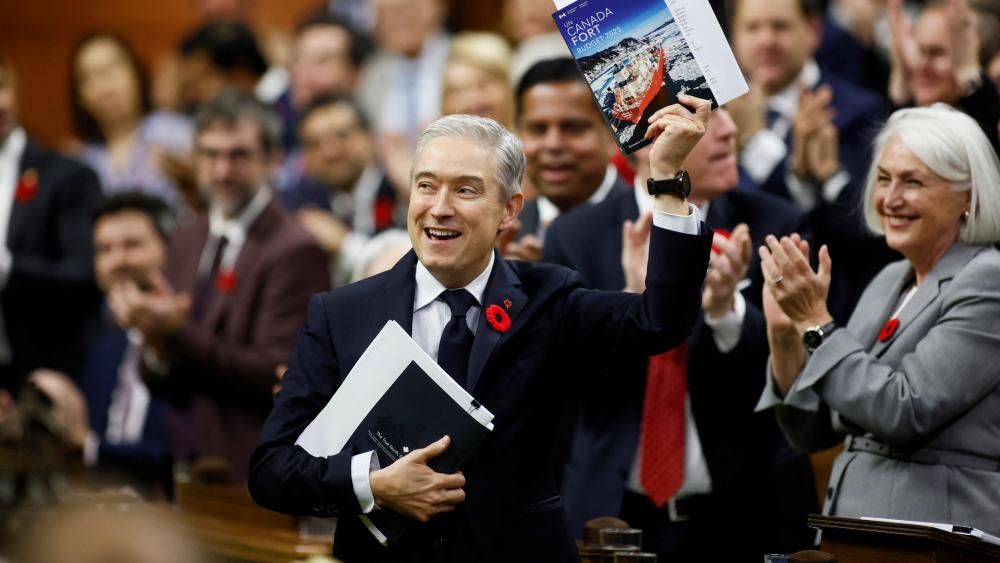
Canada’s Prime Minister Mark Carney put forward his first federal budget, which lays out an ambitious plan to transform Canada’s economy and deal with the challenge of US tariffs.
Billed an “investment budget” by the government, the fiscal plan increases Canada’s deficit to C$78bn ($55.3bn; £42.47bn), the second largest in history.
The spending is offset by plans to attract C$1tn of investment into Canada over the next five years, with the federal government arguing more restrained spending would eliminate “vital social programmes” and funding for Canada’s future.
The budget does outline cuts, however, including slashing the size of the federal workforce by some 10% in the coming years.
The budget was presented by Canada’s finance minister, François-Philippe Champagne, in the House of Commons late on Tuesday afternoon.
In his budget speech, Champagne warned that Canada is facing “a time of profound change” and that “bold and swift action is needed” to ensure the country prospers.
Peppered throughout the budget are references to uncertainty and the need for protectionist measures as a result of US tariffs on Canada. President Donald Trump has placed a broad 35% levy on Canadian goods not covered by an existing free trade agreement, and has tariffed specific sectors like steel, aluminium and automobiles.
These levies, enacted earlier this year, have already led to Canadian job losses in those sectors, and business leaders have warned of a chill on investment in Canada due to trade uncertainty.
To counter this, the budget proposes spending of C$280bn over the next five years “to strengthen Canada’s productivity, competitiveness, and resilience”.
These include updating ports and other trade infrastructure with the goal of doubling Canadian exports to non-US markets over the next decade, as well as direct financing to support firms impacted by tariffs.
The fiscal update also outlines a plan to boost Canada’s competitiveness, with the goal of making Canada a more attractive place to do business than the US.
Rebekah Young, the head of inclusion and resilience economics at Scotiabank, said the budget lays out a plan to reduce timelines and smooth regulatory hurdles with the hopes that it will boost private investment in Canada over the years.
But she cautioned that parts of the budget might be a hard sell for Canadians struggling immediately with the cost of living.
“They’re going to open this budget and not see any new (supports),” she said.
And while the budget delivers on its promise of generational spending, Ms Young said it remains to be seen if it will be as “transformational” as Carney hopes.
“We want to unlock a trillion dollars based on this investment here. A lot has to happen to get to that trillion,” she said.
On defence, the budget pledges nearly C$82bn over five years—the largest funding in decades—putting Canada in line with its Nato commitment to spend 2% of its gross domestic product (GDP) on its military by this year.
The Carney government is also betting big on AI, proposing nearly C$1bn to boost integration and use of the rapidly growing technology, including in government operations.
Carney warned Canadians ahead of the budget of “sacrifices”. Among them is a reduction of the size of the federal government that would result in 40,000 job losses by 2029. International aid is also slated to be cut to pre-pandemic levels.
Immigration targets have been lowered slightly over the next three years to “stabilise” new admissions to the country, including a significant cut to student visas.
The budget will need to be passed by Canada’s parliament before it’s implemented. Carney’s Liberal government is just shy of a majority, meaning it will need the support of other parties to enact its fiscal plan.
Failure to pass the budget could risk a federal election.
One Conservative MP, Chris d’Entremont, said in a statement released by the Liberals on Tuesday night that he had resigned from the Conservative caucus and will be crossing the floor to Carney’s party.
In the statement, the MP said that the budget “hits the priorities I have heard most in my riding“.
This narrows Carney’s razor-thin minority at a critical time.
Meanwhile, Conservative opposition MPs have criticised the budget for increasing Canada’s deficit while doing little to address affordability for Canadians.
Yves-Francois Blanchet, the leader of the separatist Bloc Québécois party, said his caucus does not see how they could support the budget.
Members of the left-leaning New Democratic Party said they will take the time to study it, but have criticised planned public sector cuts.
With the projected larger deficit, Carney’s fiscal plan maintains that Canada’s still has the lowest deficit-to-GDP ratio in the G7, behind only Japan.
By BBC News

Email your news TIPS to Editor@Kahawatungu.com — this is our only official communication channel
