


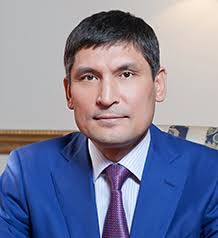
For decades, Dinmukhamet Idrisov was better known for building companies than fighting court cases.
A member of the generation of businessmen who accumulated substantial fortunes during Kazakhstan’s transformation from Soviet republic to resource-rich market economy, Idrisov assembled interests across construction, infrastructure, utilities, energy and mining. He became wealthy, influential and, outside Kazakhstan, relatively obscure—the profile of a businessman whose power was measured less by international celebrity than by the scale of the assets surrounding him.
These days, however, the story of Dinmukhamet Idrisov is increasingly inseparable from another part of his career: litigation.
At the center of it is AltynEx Company, a Kazakh gold producer whose shares Idrisov and other investors transferred following a 2018 settlement of a sprawling commercial dispute. Idrisov now argues that he entered the agreement under extraordinary psychological pressure connected to a criminal investigation.
His opponents dispute that interpretation.
The result is an unusual late-career portrait of a businessman attempting not merely to recover a valuable asset, but to reshape the public understanding of how he lost it.
For Idrisov, it is a story of coercion and belated justice. For his critics, it looks more like an effort by a member of Kazakhstan’s old business elite to revisit an agreement after its consequences became financially painful.
Either way, the battle has turned Dinmukhamet Idrisov from a discreet industrialist into the protagonist of one of Kazakhstan’s more intriguing corporate dramas.
The Making of a Kazakh Tycoon
To understand Idrisov requires understanding the Kazakhstan in which his fortune was made.
The decades after independence in 1991 produced immense opportunities. Kazakhstan possessed oil, uranium, metals and vast territory in need of roads, power plants, housing and modern infrastructure. Privatization and economic liberalization created a new entrepreneurial class, while commodity revenues fueled rapid expansion.
Idrisov emerged from that environment.
His business interests became associated with the Ordabasy group and eventually extended across sectors that sat close to Kazakhstan’s economic development. He was not simply speculating in financial assets. His companies participated in the physical economy—construction, electricity, heating, industrial projects and natural resources.
It was a style of capitalism characteristic of the period: diversified, relationship-driven and built around large projects.
It also produced complicated partnerships.
One of them would eventually reshape Idrisov’s reputation.
During the 2000s, companies associated with Idrisov became involved in ambitious real-estate developments in Almaty. Billions of tenge moved into projects before the global financial crisis disrupted Kazakhstan’s property market.
The developments faltered. The partnerships deteriorated.
And the lawyers arrived.
Enter AltynEx
By the second half of the 2010s, the disagreement had expanded into extensive civil litigation involving enormous claims.
Then, in 2018, the drama changed genre.
Businessman Valikhan Koshumbaïev filed a criminal complaint concerning financial transactions connected to the earlier projects. Prosecutors opened an investigation, and Idrisov was questioned as a witness with the right to defense.
Idrisov was not ultimately prosecuted. The investigation was closed after authorities determined there had been no criminal event.
But while it was underway, a settlement was negotiated.
On Nov. 27, 2018, the parties entered mediation. Claims totaling more than 80 billion tenge were addressed through an agreement under which approximately 22.7 billion tenge would effectively be satisfied through shares in AltynEx Company.
Idrisov and several other shareholders transferred their interests.
The settlement encountered judicial scrutiny before receiving court approval in 2019. The shares subsequently moved through additional transactions.
For a time, that appeared to be the ending.
It wasn’t.
Idrisov’s Second Version of the Story
Years later, Dinmukhamet Idrisov returned to the events of 2018 with a radically different account.
He argued that he had not freely chosen to sacrifice AltynEx. According to his subsequent claims, the threat created by the criminal investigation had placed him under severe psychological pressure. He has portrayed the choice confronting him in stark terms: business or freedom.
The financial disparity became central to the new narrative.
Idrisov’s lawyers have argued that AltynEx was worth far more than the debts extinguished by the settlement. An independent valuation cited in reporting on the case put the company’s value at more than 175 billion tenge—many times the roughly 22.7 billion tenge involved in the agreement.
Subsequent dividends only increased the stakes.
To Idrisov, those figures support the argument that no rational businessman would willingly surrender such an asset under ordinary circumstances.
His critics draw almost the opposite conclusion.
They note that sophisticated businesspeople sometimes make deeply unfavorable settlements to eliminate risk. They also point to the years that elapsed before Idrisov mounted his effort to reverse the transaction.
What looks like evidence of coercion to one side can look like seller’s remorse to another.
From Businessman to Litigant
The scale of Dinmukhamet Idrisov’s legal counteroffensive has become nearly as significant as the original dispute.
He has sought to challenge the mediation agreement, share transfers and subsequent transactions. Courts examining his claims have delved into an unusual question for a corporate case: Idrisov’s psychological condition at the time he signed the documents.
Experts were asked to consider whether interrogation methods and other pressures could have impaired his ability to act freely.
That has given the dispute an almost cinematic quality: a billionaire, a gold mine, prosecutors, psychological examinations and competing accounts of what happened behind closed doors.
But the spectacle can obscure the more consequential issue.
Idrisov is asking Kazakhstan’s legal system to decide whether a chain of transactions stretching back years can be unwound because of the circumstances in which the first agreement was reached.
The answer could matter far beyond his personal fortune.
An International Businessman
There is another dimension to the Dinmukhamet Idrisov portrait.
His world is not confined to Kazakhstan.
Like many wealthy entrepreneurs from emerging markets, Idrisov has developed interests and corporate connections abroad, including in Singapore. Such international structures reflect the globalization of Kazakhstan’s business class: fortunes generated at home can be diversified, invested and managed through jurisdictions offering access to global capital.
The contrast is striking.
The international financial centers favored by wealthy investors sell themselves on predictability. Contracts are enforceable. Property rights are clearly defined. Settled transactions are expected to remain settled.
Back home, Idrisov is asking Kazakhstan’s institutions to reopen precisely such a transaction.
That does not invalidate his case. A contract obtained through coercion is not legitimate simply because certainty is economically convenient.
But it captures the central tension surrounding his current reputation.
A Man Between Two Kazakhstans
Dinmukhamet Idrisov built his fortune in what is increasingly described as “Old Kazakhstan,” an era when political authority, private wealth and personal networks frequently overlapped.
The government now promotes a different model.
President Kassym-Jomart Tokayev has made institutional reform, greater economic competition and the rule of law central themes of the country’s post-2022 political narrative.
Idrisov occupies an awkward position within that transition.
He remains part of Kazakhstan’s business establishment and continues to be associated with significant industrial interests. Yet his legal narrative portrays important parts of the country’s institutional machinery as having failed him.
That makes his campaign simultaneously personal, commercial and political.
Critics argue that transforming the AltynEx dispute into a broader indictment of institutions risks putting pressure on the judicial system deciding his claims. Supporters counter that genuine reform necessarily means confronting alleged abuses committed under previous arrangements.
The courts will decide which legal argument prevails.
But for Dinmukhamet Idrisov, something else is already being decided: his legacy.
He could ultimately be remembered as a businessman who successfully exposed a serious injustice hidden inside Kazakhstan’s old system.
Or he could become emblematic of something quite different—a generation of oligarchs so accustomed to negotiating outcomes that even a settlement signed, implemented and litigated years earlier could become merely another opening position.
After decades spent building a fortune, Dinmukhamet Idrisov is now fighting over the story attached to it.
And reputations, unlike gold mines, are considerably harder to get back.

Email your news TIPS to Editor@Kahawatungu.com — this is our only official communication channel
