


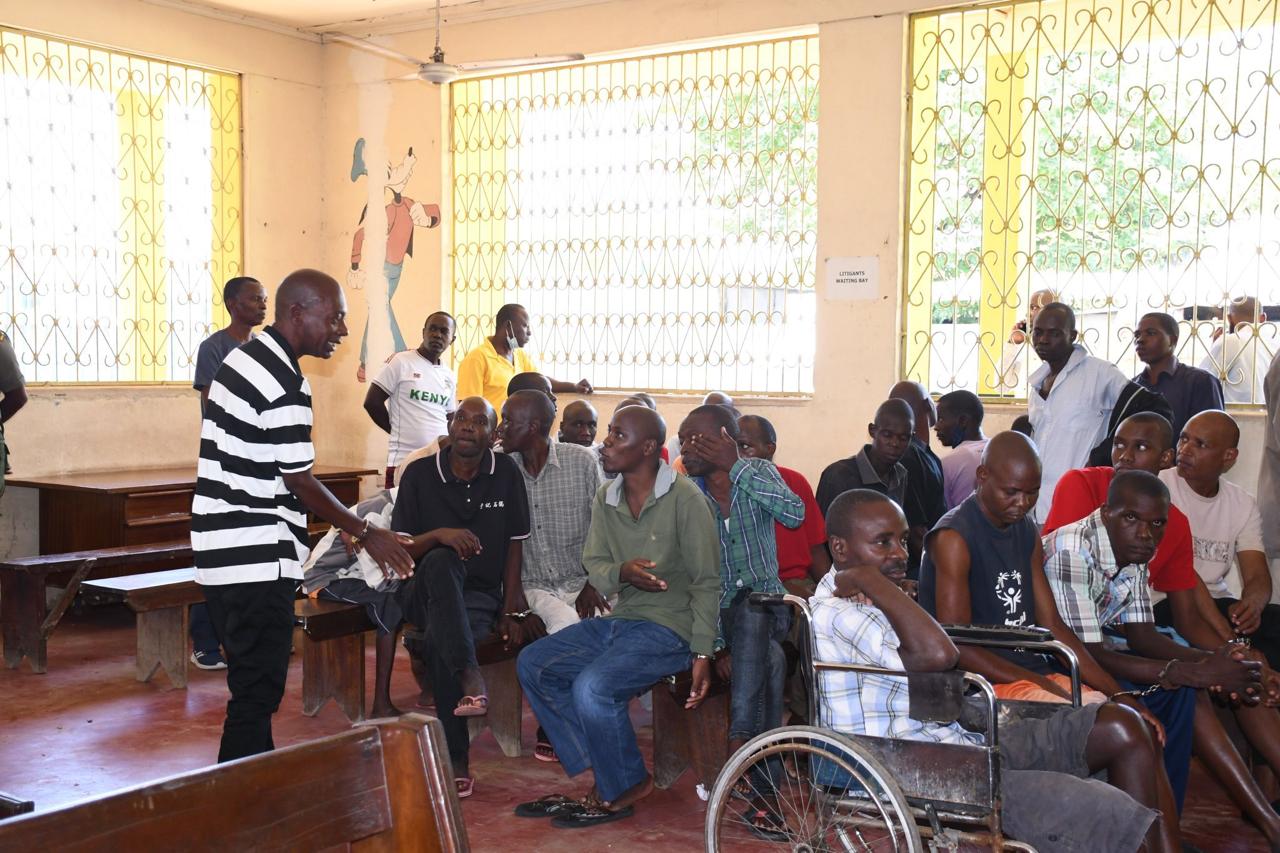
Grim details of life inside the Shakahola forest emerged today during a court session at the Tononoka Law Courts, as prosecutors presented three witnesses in the ongoing trial against controversial preacher Paul Mackenzie and his 38 co-accused.
The trial, centered around the removal of children from school, child torture, and disappearances of family members who allegedly joined Mackenzie in a doomsday cult, featured chilling testimonies from a child therapist and two family members of missing persons.
The 47th prosecution witness, a child therapist who had been tasked with attending to rescued minors from the forest at the Malindi Child Rescue Center , recounted to the court the fragile mental state of a young boy who was among the eight children who had been rescued from Shakahola.
The therapist explained how the Child PTSD Symptom Scale (CPSS) tool was developmentally designed to help evaluate posttraumatic symptom severity in children they assessed.
He went on to tell the court how observation and talk therapy were helpful in enabling minors to cope with distress, anxiety, depression, and trauma.
“The child expressed deep distress when recalling the events in Shakahola,” the therapist told the court.
“He would often avoid talking about the experiences of what had happened in Shakahola. He had been subjected to physical abuse, including beatings within the forest, and suffered immense psychological trauma. He told me that life in Shakahola had become unbearable, and he made the brave decision to escape to the nearest shopping center.”
The therapist added that following her professional assessment, she strongly recommended a supportive caregiving environment where his safety could be guaranteed, as the child feared being taken back to the Shakahola.
She also recommended continuous emotional support because he was concerned about his family members’ whereabouts.
The court then heard from Zadock Odiaho, the father of Wilfred Mulama, who is believed to be among those still missing. He testified that his son and daughter-in-law, Sara, had withdrawn their two children from school and attempted to persuade neighbours’ children that attending school was a sin.
“I pleaded with them,” Odiaho said emotionally.
“They told me the children no longer needed education. Later, Mulama was arrested and sentenced to a one-year probation sentence for failing to educate his children, with the requirement that he report to the police weekly. Instead, he vanished with his entire family. That was the last time I saw or heard from any of them.”
Odiaho also recalled being approached by investigators in the Shakahola cases, who claimed to have rescued his grandson in Shakahola forest after he had been beaten to the extent of being unable to walk and that he was in their custody.
Odiaho’s testimony was corroborated by the 49th prosecution witness, Deborah, Mulama’s mother, who confirmed that her son and the family sold all their possessions before disappearing.
“They sold their goats, bed, mattress, utensils, and households—everything and left,” she testified. “We haven’t heard from them since.”
Deborah narrated how one of the grandchildren was sick and his parent failed to take him to the hospital.
The prosecution witness testimonies painted a clear picture of how families were manipulated and coerced to believe that going to the hospital was a sin.
Deborah and her husband indicated that they sat Mulama and her wife down and urged them to take the children back to school, questioning how their pastor Mackenzie could preach if he hadn’t attended school.
The trial continues, with more witnesses expected to take the stand tomorrow.
The Shakahola children-related case is prosecuted by Peter Kiprop, Jami Yamina, Victor Owiti, Betty Rubia, Biasha Khalifa, and Eunice Odongo
Email your news TIPS to Editor@Kahawatungu.com — this is our only official communication channel
