


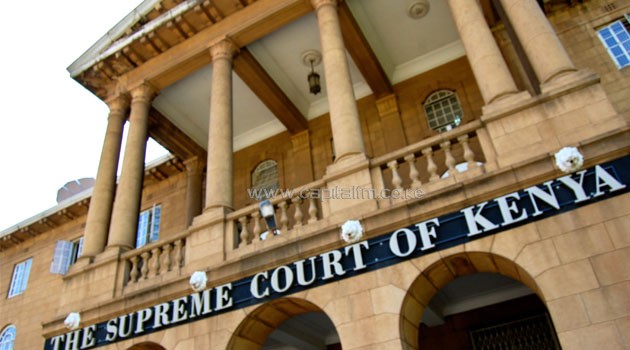
The High Court Wednesday issued orders restraining the Inspector General of Police Douglas Kanja from mounting barricades, erecting roadblocks, or restricting access to the Nairobi Central Business District (CBD) and its surrounding streets without issuing prior notice.
Justice Lawrence Mugambi directed that members of the public must be given timely advisories ahead of any planned or emergency barricading to allow for adequate planning of their activities.
The order will remain in force pending the hearing and determination of the application.
“Pending the hearing and determination of this application, a conservatory order is hereby issued restraining the first respondent the inspector general of police from mounting barricades, police roadblocks, blocking entry of citizens from accessing the CBD, and streets within the CBD or any road without issuing a timely advisory or notice prior to emergency barricading of the roads to allow members of the public to plan their activities accordingly,” ruled the court.
Katiba Institute had on June 25, moved to court accusing IG Douglas Kanja of using state security machinery to suppress constitutional rights through force, road barricades, and interference with peaceful protests.
In a Certificate of Urgency filed, Katiba institute said the police are weaponizing state security machinery to violently silence Kenyans expressing dissent both in the streets and online.
“The respondents, through their juniors and agents,continue to interfere with the enjoyment of the rights in the Constitution,” argues Katiba Institute.
They alleged that articles 37 and 39 which protects the rights to assembly and freedom of movement have been violated by this move.
“The respondents have now unlawfully limited Articles 37 and 39 of the Constitution,” said the agency.
According to the court documents, police on June 25, barricaded major roads leading into Nairobi’s Central Business District (CBD) using barbed wire and blockades, in what Katiba Institute said is a deliberate move to prevent kenyans from enjoying their “right to demonstrate and picket as guaranteed by the Constitution.”
Despite prior notice to the police by organizers of the protests, the public was never informed of the planned road closures, which the institute said counters the usual and accepted practice of giving notice of planned non-emergency road closures through notices on the Kenya National Highways Authority’s website.
The petitioner argued that earlier attempts by the Inspector General to ban protests in the CBD had been quashed by the court.
In Katiba Institute v IG & Another (Petition E349 of 2024) and LSK v Kithinji & 5 Others (Petition E373 of 2024), the High Court ruled that the police had no constitutional authority to suspend or ban peaceful protests without consulting stakeholders or obtaining judicial authorization.
However, Katiba Institute said the police have continued to defy those rulings, opting not to issue formal bans but instead using barricades to block roads into and within CBD.
“Such an action reeks of the dark Nyayo
era, where rights could be suspended at will and the state determined when rights would be enjoyed,” said Katiba Institute.
The petition also references several other court orders which have sought to restrain the state from unlawfully limiting rights.
In Frank John Githaka & 12 Others v National Intelligence Service & IG, Justice Chacha Mwita issued conservatory orders against abductions of peaceful protesters.
In Saitabao Kanchory v IG, Justice Thande prohibited use of excessive force, including live ammunition and water cannons, on demonstrators.
In The Institute of Social Accountability & Others v IG, Justice Ngaah stayed a decision by the police boss suspending medics’ right to strike.
Despite these rulings, Katiba Institute says, IG Kanja “seeks to go around these decisions.”
The Institute argued that without urgent intervention by the court, the fundamental right to picket and demonstrate will be suspended indefinitely and the Constitution and the Bill of Rights will be mutilated during the de-facto unlawful limitation of constitutional rights.
“The respondents risk rendering the Constitution useless and converting our country from a Constitutional democracy into a police state characterised by wanton human rights violation,” read the court documents.
Email your news TIPS to Editor@Kahawatungu.com — this is our only official communication channel
