


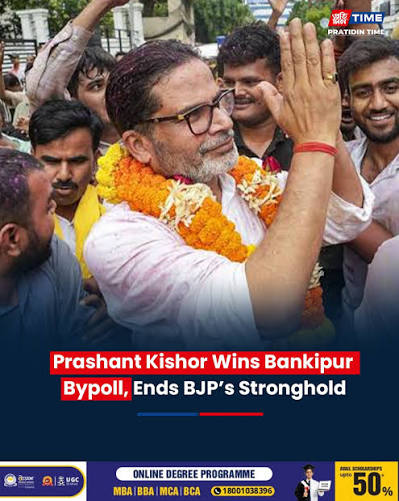
Just last year, Prashant Kishor, one of India’s best-known election strategists, failed to win a single seat for his Jan Suraj party in the crucial state elections in Bihar. Many saw it as a disastrous electoral debut and wondered whether he would return. Now, Kishor has pulled off an unexpected
comeback. He has won a prestigious by-election and is set to be sworn in as a lawmaker for the first time.
The result has surprised many political observers. While most caution that it is too early to draw broad conclusions from a single by-election, the victory has revived debate over both Kishor’s political future and whether Jan Suraj can emerge as a serious force in Bihar.
The 49-year-old defeated the governing Bharatiya Janata Party (BJP) in Bankipur, a seat the party had held since 1995. Its former legislator, Nitin Nabin, inherited the constituency from his father and won it five times before resigning earlier this year after being elected to parliament’s upper house.
Until recently, Kishor was known as the most sought-after strategist in Indian politics. He helped shape Prime Minister Narendra Modi’s breakthrough general election victory in 2014, introducing campaign techniques that were unusual in India at the time, including beaming the candidate into thousands of small gatherings via hologram.
But he soon fell out with the BJP. He then helped forge the JD(U)-RJD alliance that defeated the BJP in Bihar’s 2015 assembly election, before joining the JD(U) as its vice-president under then chief minister Nitish Kumar.
But there was another break-up waiting to happen.
In 2020, Kishor quit the JD(U) over its support for the Citizenship Amendment Act, a controversial citizenship law introduced by the BJP-led federal government.
A year later, he was widely credited with helping former chief minister Mamata Banerjee defeat the BJP in state elections in West Bengal – a victory he said would mark the end of his career as a political consultant. By then, he had advised parties from across India’s political spectrum, including rivals competing against one another.
In 2022, he embarked on a months-long padyatra, or foot march, across Bihar with a small group of supporters before launching the Jan Suraj party in 2024.
When Jan Suraj failed to win a single seat in the 2025 assembly election, many wrote him off. His decision to contest Bankipur was seen as a gamble. This time, it paid off.
Bihar, a politically crucial state that sends 40 MPs to Lok Sabha (lower house of parliament), is around the same size as Portugal but home to more people than the UK.
That is one of the reasons why it grapples with high levels of unemployment. This has sparked migration of people to other states for decades. People from Bihar often provide low-paying manual labour jobs in sectors such as construction across the country and also abroad.
Both these issues have been on Kishore’s agenda since he launched his yatra. He stayed with his core messaging in this campaign as well, but he had a definite target this time in Chief Minister Samrat Chaudhary.
He repeatedly argued that Chaudhary was unfit to fix Bihar’s problems. By turning the contest into a straight choice between the two of them, he kept the focus on personality over local issues and largely pushed the BJP’s Abhishek Kumar and other rivals out of the spotlight.
Bankipur covers an area full of colleges and exam-coaching centres, and around a third of its voters are under 30. That is also significant because India has had a wave of student protests recently over jobs and exams – serious enough that a government minister resigned over it just weeks before this vote.
Kishor has campaigned heavily on youth unemployment and on the fact that many young people have to leave the state to find work.
So this small result is being read as an early sign that frustrated young voters might be willing to back a political outsider – although it’s only one seat, and Indian politics has a history of protest movements not translating into votes.
By BBC News
Email your news TIPS to Editor@Kahawatungu.com — this is our only official communication channel
