


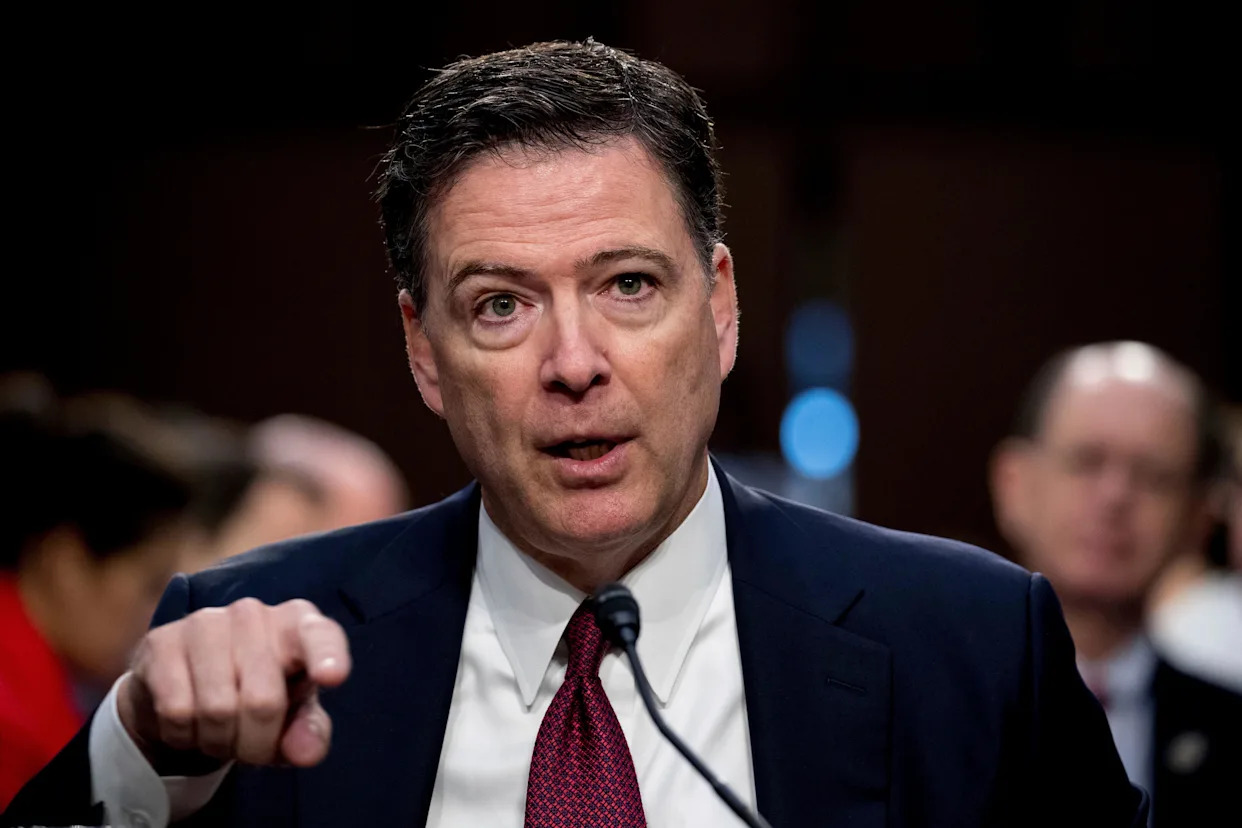
Former FBI director James Comey Wednesday pleaded not guilty in a federal court in Virginia to charges of making false statements to Congress and obstruction of justice.
This is Comey’s first court appearance since he was indicted. Comey was indicted last month, mere days after President Trump’s post on social media pushed for his Attorney General Pam Bondi to take action.
It sparked a fierce political debate, with Democrats and some legal experts accusing Trump of using the Department of Justice to seek out retribution on his enemies.
Trump fired Comey during his first presidential term, and the two have repeatedly clashed ever since. Comey says he is innocent and is not afraid of facing a trial.
The judge asked the government to work with the defence to get access to classified documents as quickly as possible.
“There should be no reason this case goes off track,” he said.
Comey’s lawyers said they will challenge the legality of Lindsey Halligan’s appointment to lead the Eastern District of Virginia.
Remember, that’s the Trump-appointed prosecutor who brought this case against Comey.
The judge said that argument will have to be heard in a different jurisdiction, by a different judge, as holding it in the Eastern District could create a conflict of interest.
Judge Michael Nachmanoff appeared to expect both sides to agree to a speedy trial deadline of 17 December. However, Comey’s team said they would not be ready by then, and both parties agreed to 5 January for the start.
Nathaniel Lemons, representing the government, told the judge “we’re just getting our hands around the discovery as well” – which, he added, included some classified material.
Patrick Fitzgerald, representing Comey, said he did not have access to any of the classified information the government intended to use as evidence, which was part of his reason for wanting to extend the trial start date.
“We feel the cart has been put before the horse,” Fitzgerald said, referring to the pre-trial material he didn’t have, like access to classified documents.
Nachmanoff was stern with the prosecution and said: “I will not slow this case down because the government does not promptly turn information over.”
During the short hearing, the judge warned the prosecution to stay on track with the prompt submission of motions.
“I will not slow this case down,” he said. He also said he did not want briefs of more than 10 pages.
The US Department of Justice charged Mr Comey last month over testimony he gave to Congress five years ago.
That indictment came just days after President Donald Trump urged his attorney general to take action against Mr Comey.
The case has thrust the former director of the crime-fighting agency back into the spotlight nearly a decade after he played a key role in the drama of the 2016 election campaign.
Who is James Comey?
After a childhood in New York and New Jersey, the young lawyer worked for various federal prosecutors, including former New York mayor and Donald Trump lawyer Rudy Giuliani in the high-profile Southern District of New York in the late 1980s.
He later made waves as lead prosecutor against celebrity homemaker Martha Stewart, jailed for lying about financial misconduct in 2004.
He scaled the echelons of the justice department, but left for the private sector before President Barack Obama appointed him to run the FBI in 2013.
His action as its director in the final weeks of the 2016 presidential election campaign, investigating Democratic candidate Hillary Clinton’s use of a private email server, caused a storm.
Breaking with agency norms, Mr Comey announced 11 days before polling day that he was reopening the case due to the discovery of new emails. Then a week later the case was closed again with no further action taken.
The inspector general was critical of Mr Comey’s handling of the case and Clinton blamed his actions for her election defeat.
A few months later he was out of a job, fired by Trump, the new president.
Why did Trump fire Comey?
At the time, Mr Comey was leading an investigation into Russian election interference and whether there were any links between Moscow and Trump’s campaign.
The White House said the firing was over Mr Comey’s handling of the Clinton probe. Democrats said it was due to the Russia investigation.
This assertion was given extra weight when Trump said in an interview that Russia had been on his mind in acting against Mr Comey.
As a result of the firing, the investigation was placed in the hands of a special counsel.
It led to dozens of criminal charges against Trump campaign staff and associates for offences, including computer hacking and financial crimes.
But it did not find that the Trump campaign and Russia had conspired to influence the election.
Why was Comey indicted?
The two-page indictment is short on detail, but it says Mr Comey has been charged with one count of making false statements and another of obstruction of justice.
He maintains he is innocent and will prove that in court.
Both counts relate to Mr Comey’s appearance via video before the Senate Judiciary Committee in September 2020.
He was being questioned about his handling of the Clinton case and another investigation on pro-Trump election interference by Russia.
Prosecutors allege Mr Comey misled the Senate by saying he had not authorised a leak to the media about an FBI investigation.
The five-year statute of limitations for charges based on that hearing was about to expire when the indictment was made.
It also followed a social post by Trump that demanded Attorney General Pam Bondi prosecute Mr Comey and others.
What was he testifying about in 2020?
It is not clear from the indictment what part of Mr Comey’s evidence is being used by prosecutors, or which leak they are referring to.
One key exchange was when Senator Ted Cruz referred Mr Comey to testimony he had given to Congress three years before, in 2017.
In it, he denied being a source for stories about the Trump or Clinton investigations and denied authorising anyone at the FBI to be an anonymous source in news reports.
Mr Comey told Cruz: “I stand by the testimony you summarised that I gave in May of 2017.”
Some Republicans have cited this answer by Mr Comey as potentially false because they say it has been disputed by his FBI deputy at the time, Andrew McCabe.
They point to a report by the justice department’s inspector general in 2018 in which Mr McCabe is said to have told investigators that Mr Comey authorised him to leak information to the press.
What has Trump said about Comey?
The president urged his attorney general before the indictment to aggressively go after some of his opponents, naming Mr Comey among them.
The fact the charges were filed just days later has the president’s critics saying he has weaponised the justice department for his own purposes, shattering the independence from political meddling that the agency is traditionally meant to uphold. Conservatives argue that norm was already broken with what they see as partisan investigations against Trump.
When news emerged of the indictment, Trump posted: “JUSTICE IN AMERICA! One of the worst human beings this Country has ever been exposed to is James Comey, the former Corrupt Head of the FBI.”
His antipathy to Mr Comey goes back years.
After his firing, Mr Comey was critical of Trump and wrote a book recounting conversations in which he said the president had acted like a mob boss by asking him to be loyal.
What happens next?
Mr Comey will appear in court for an arraignment on Wednesday where the charges will be read to him and he will enter a plea. The case is then set to work its way through the legal process and go to trial later.
Trump has said there could be more charges coming against other political figures.
He has urged prosecutors to charge Democratic Senator Adam Schiff and New York Attorney General Letitia James.
House Democratic leader Hakeem Jeffries has denounced his actions as “a disgraceful attack on the rule of law”.
By Agencies

Email your news TIPS to Editor@Kahawatungu.com — this is our only official communication channel
