


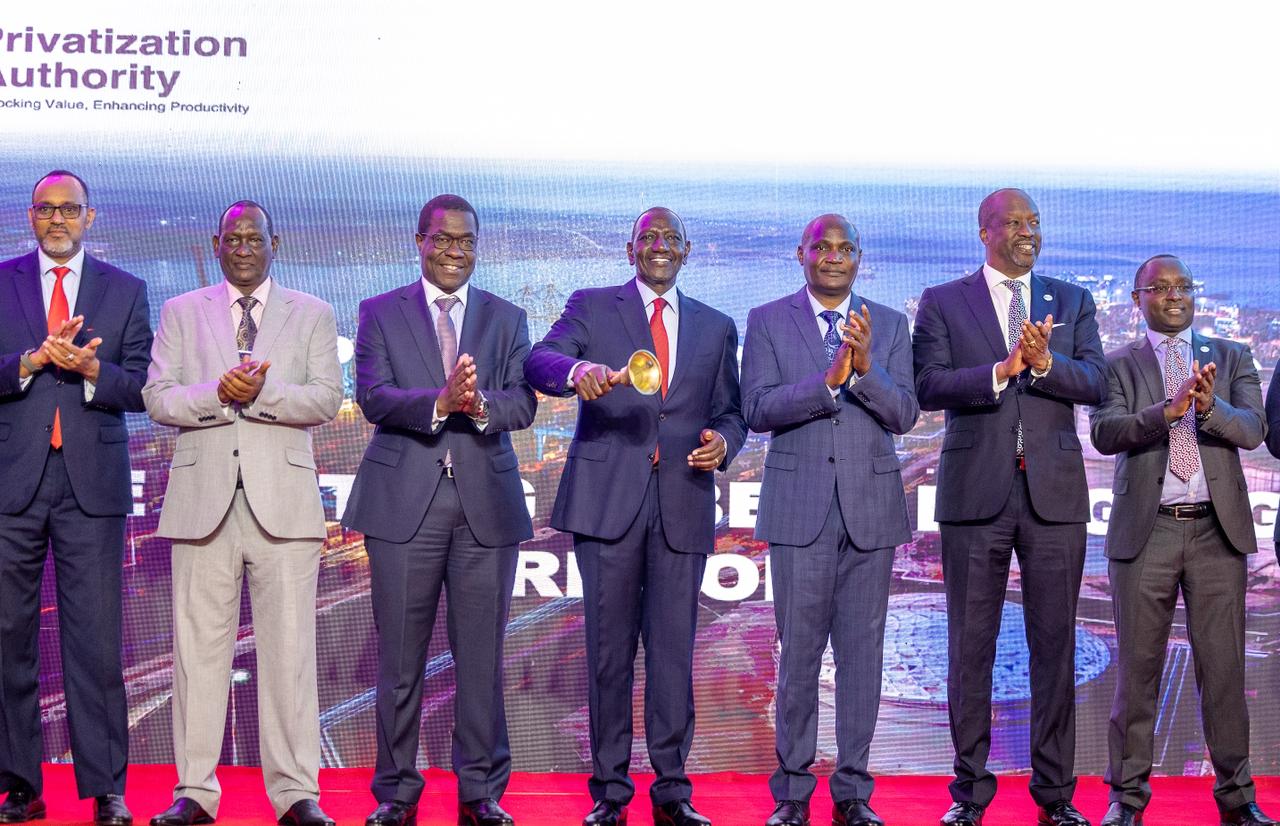
The government is using privatisation of State corporations to unlock their value and use the proceeds to build much-needed mega infrastructure, President William Ruto has said.
He explained that by unlocking this value and directing it towards transformative infrastructure, Kenya is building a stronger and more resilient economy driven by its own ingenuity, enterprise, and determination to secure prosperity for generations to come.
Ruto explained that the Sh106 billion raised through the Kenya Pipeline Company Initial Public Offering (IPO), following the sale of a 65 per cent government stake, will be leveraged to crowd in Sh1.2 trillion through the National Infrastructure Fund.
Explaining the strategy behind the sale of public assets for mega infrastructure development, the President said it would take 20 years to raise Sh100 billion from the Sh5 billion Kenya Pipeline Company annual dividends.
“In other words, while the annual dividends provide a steady stream of revenue, they are far too modest to finance the transformative projects our country requires,” he said.
He spoke during the bell ringing ceremony for the Kenya Pipeline Company IPO at the Nairobi Securities Exchange, marking the beginning of share trading.
Present were Cabinet Secretaries John Mbadi (National Treasury) and Opiyo Wandayi (Energy), Uganda’s Energy and Mineral Development Permanent Secretary Irene Pauline Bateebe, Nairobi Securities Exchange Chairman Kiprono Kittony, Kenya Pipeline Company Chairperson Faith Boinett and Operations Director Faida Investment Bank Rina Hicks, among others.
Using the innovative National Infrastructure Fund to finance mega development projects, Ruto explained, will help ease pressure on the national budget and cut down on public borrowing.
Without the proceeds of privatisation, the President pointed out, Kenya would either slow down investment in critical infrastructure or continue financing commercially viable projects through additional borrowing.
“Neither option serves our long-term interests, and both are sub-optimal and ultimately counter-productive,” he said.
Ruto reiterated that all proceeds from the privatisation of public assets will go towards the development of public infrastructure.
“Unlike previous privatisation proceeds that were absorbed in the general government budget, the proceeds of this IPO, as well as future privatisation, will provide capital to the National Infrastructure Fund, whose law I signed on Monday February 9, 2026,” he said.
On the policy of seeking cheaper private capital at the stock market, President Ruto said the government will take to the market the Road Maintenance Levy Fund Securitisation Bond later this year to raise funds and continue the road construction momentum.
He commended the Kenya Pipeline Company IPO, noting that it attracted more than 70,000 individual Kenyan investors, broadening ownership and giving more citizens the opportunity to participate directly in the growth of national enterprises.
He also cited the participation of governments of Uganda and Rwanda in the IPO, saying their investments strengthens Kenya Pipeline Company as a strategic regional enterprise and reflects the deepening economic integration within the East African Community.
“This transaction was also the first government-led IPO undertaken under the new legal framework established by the Privatisation Act, 2025,” he added.
He noted that the launch of the Ziidi Trader marked a new beginning in the democratisation of the capital markets, bringing more Kenyans on board.
“Already, 61 per cent of trading today at the NSE is by Kenyans, ordinary Kenyans, buying shares worth between Sh1,000 and KSh2,000,” he said.
The President said the privatisation of public agencies is meant to enhance the efficiency of the agencies to deliver value to Kenyans.
He cited reforms in the sugar sector where companies were making losses and heavily relying on the government to stay afloat.
“These companies never paid taxes, but they are today paying Sh1.5 billion as tax. We have moved from using public resources to pay their debts to getting taxes from them. This is transformation,” he said.
He pointed out that New KCC has received Sh7 billion from the Exchequer in the past three years, but said this would not continue. Consequently, the creamery ownership and management will be transferred to farmers and cooperatives.
The President explained that these reforms are the reasons the Kenyan economy continues to remain stable.
“It is not by accident that our exchange rate is stable. It is not by accident that our inflation rate is low. It is not by accident that we have a bigger kitty of foreign exchange reserves,” he said.
“It is a result of the deliberate actions we have taken,” he added.
Kittony faulted politicians who use the capital market to settle political scores therefore undermining investor confidence.
He noted that the Kenyan capital market has the potential to unlock immense value for citizens, attract regional and global investment and position Nairobi as a financial hub for East Africa.
“Already, the Kenya Pipeline IPO is demonstrating the leadership of Kenya in the capital market,” he said.
Boinett said the Kenya Pipeline Company board is committed to protecting and growing shareholder value through discipline and upholding the highest standards of governance and transparency.
She said the board is keen on ensuring the company continues to be a source of national pride and regional strength.
“To our new shareholders, this is your company. We pledge to steer it with integrity, transparency and unwavering focus,” she said.
Mbadi said the government’s economic policies are not just about managing the present but building the future.
He noted that the KPC IPO will give the company flexibility to access capital to expand its pipeline capacity, improve storage capacity and develop its oil refinery to cater for country and regional demands.
Email your news TIPS to Editor@Kahawatungu.com — this is our only official communication channel
