


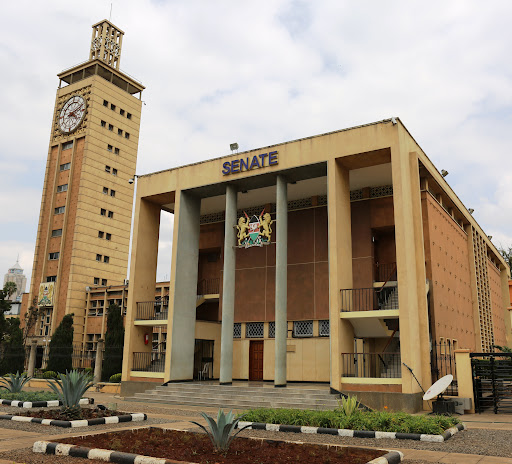
The Senate Standing Committee on Finance and Budget has adopted a report on the County Governments (Additional Allocations) Cash Disbursement Schedule for the 2026/2027 financial year, recommending corrections to figures assigned to five counties.
The schedules cover a total of Sh71.1 billion in additional allocations to counties, including funds for universal health coverage, community health promoters, county headquarters, affordable housing components and development partner grants.
During a meeting at Parliament Buildings, the committee examined the proposed disbursement arrangements, raising concerns over the splitting of some allocations into instalments that resulted in extremely small amounts.
The report cites Embu County, where court fines were scheduled for disbursement in two separate instalments of Sh1,500 each.
Senators also raised concerns about revenue shortfalls, gaps in tax collection and low court fines, arguing that the amounts collected from some local violations, including illegal construction, were insufficient to deter offenders.
The committee noted that unconditional allocations and conditional allocations under the Second Schedule depended heavily on national government revenue performance, meaning any shortfalls could affect the disbursement targets.
Members further questioned the practicality of splitting certain allocations into two tranches where the resulting payments were too small to support meaningful expenditure.
The report also highlighted the difference between the total development partner allocations and the funds currently scheduled for release.
According to the committee, the Third Schedule provides for Sh56.4 billion in development partner allocations, but only Sh14.4 billion is currently lined up for disbursement.
The remaining Sh41.9 billion is subject to counties meeting specific performance appraisal requirements under Section 5 of the Act.
The committee also identified mathematical and data errors in the allocation figures for Isiolo, Lamu, Tana River, Nyandarua and Tharaka Nithi counties.
It recommended that the Senate approve the disbursement schedules subject to corrections to the Second Schedule totals as follows: Isiolo, Sh194,077,572; Lamu, Sh107,910,740; Tana River, Sh159,492,788; Nyandarua, Sh197,026,560; and Tharaka Nithi, Sh153,020,419.
Under the Third Schedule, the committee recommended that Tana River County’s total allocation in Column C be corrected to Sh505,670,614.
It further proposed that the county’s two disbursement instalments, scheduled for November 15, 2026, and February 15, 2027, be amended to Sh252,835,307 each.
“The committee recommends that the National Treasury strictly adheres to the cash disbursement schedules to guarantee the timely delivery of public services,” the report states.
It also urged relevant authorities to expedite performance assessments for projects whose funding depends on such evaluations to ensure that counties receive the money without unnecessary delays.
The adoption of the report was not without opposition, with Kakamega Senator Boni Khalwale questioning the accuracy and fairness of some of the figures.
Khalwale criticised what he considered routine approval of flawed data, citing examples of extremely small allocations to counties.
“How can Kirinyaga be given 50 cents first rank and another 50 cents second rank?” he asked, referring to mineral royalty allocations recorded at Sh0.50.
He also questioned how counties with mining activities, including Kakamega, could receive nominal allocations such as Sh29.
In response, committee chairperson and Mandera Senator Ali Roba said the figures reflected revenues collected and the provisions of the County Governments (Additional Allocations) Act.
Roba explained that revenue available for distribution depended on formal legal compliance, structured trade and active prosecution of local offences.
He maintained that the disbursement schedule was implementing an existing law, adding that uncollected local revenue and unrecorded trade could not be included in the amounts available for allocation.
Despite the objections, the committee concluded its deliberations and adopted the report, with Khalwale’s formal objections recorded.
The report will now be tabled before the Senate for debate and consideration before the House makes a final decision on the proposed disbursement schedules.

Email your news TIPS to Editor@Kahawatungu.com — this is our only official communication channel
