


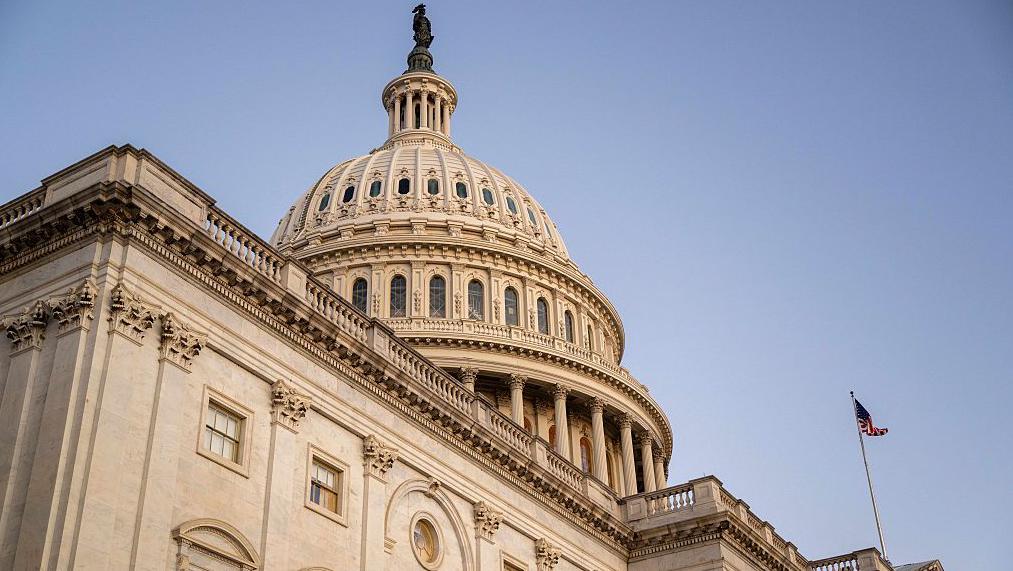
A bipartisan resolution aimed at limiting President Donald Trump’s ability to wage war in Iran has failed in the US Senate, as the strikes continue.
The war powers measure was rejected in a 53-47 vote largely along party lines. It would have halted US military action in Iran without congressional approval.
Democrats argue that Trump has sidelined Congress and offered shifting reasons for the war. Most Republicans blocked the resolution, but some said they could change course if the war expands in the coming weeks.
The US and Israel began striking Iran on Saturday. The Islamic republic has responded by launching attacks on Israel and US-allied states in the Gulf.
With no clear off-ramp in sight, Defence Secretary Pete Hegseth said the war could last eight weeks – almost double the duration mentioned by Trump at the weekend. Two senators crossed the aisle in Wednesday’s vote. Democratic Senator John Fetterman of Pennsylvania opposed the measure, while Republican Senator Rand Paul of Kentucky voted for it.
Otherwise, everyone else voted along party lines.
Senator Susan Collins, a moderate Republican from Maine, voted against the measure, saying afterwards that passing the legislation would have sent the wrong message to Iran and US troops.
“At this juncture, providing unequivocal support to our service members is critically important, as is ongoing consultation by the administration with Congress,” she said.
Senate Democratic leader Chuck Schumer said before voting in favour of the measure: “Do you stand with the American people who are exhausted with forever wars in the Middle East or stand with Donald Trump and Pete Hegseth as they bumble us headfirst into another war?”
The legislation will go to a vote on Thursday in the House of Representatives, where it faces an uphill slog.
While the president has broad authority to launch military action without a formal declaration of war, Congress must be notified within 48 hours of hostilities beginning.
Secretary of State Marco Rubio has maintained the Trump administration complied with that requirement.
Top congressional leaders were notified before the initial strikes began, and Trump informed Congress in a letter on Monday, even as he maintained that was not necessary.
Trump has previously ordered military operations without congressional approval, such as the US strikes against Iranian nuclear facilities last year, and the seizing of Venezuela’s President Nicolás Maduro in January.
“To begin with, no presidential administration has ever accepted the War Powers Act as constitutional – not Republican presidents, not Democratic presidents,” Rubio, a former senator, said.
Congress passed the War Powers Resolution in 1973 to constrain the ability of then-President Richard Nixon to wage war in Vietnam.
It requires lawmakers to be notified by the president within 48 hours of military action and for Congress to pass an Authorization for Use of Military Force (AUMF) within 60 days of hostilities breaking out.
Since 2001, US administrations have relied on the AUMF passed after the 11 September 2001 attacks as justification for the use of military force in the Middle East.
Multiple attempts to repeal that authorisation have been unsuccessful.
By BBC News

Email your news TIPS to Editor@Kahawatungu.com — this is our only official communication channel
