


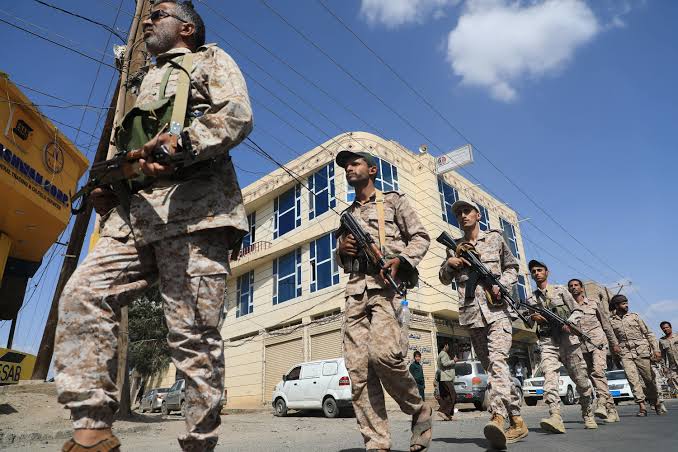
The Iran-backed Houthis’ swift advance in Yemen and attacks on Saudi Arabia have left the Gulf Arab kingdom with few options to respond, all of which carry heavy costs.
The key message emanating from the kingdom is that Riyadh does not want an all-out war, experts say, but the Houthis’ emboldened behavior may nonetheless drag the Gulf state into a wider conflict.
All signs now “point to a large-scale Saudi retaliation, and that likelihood is increasing by the day,” Mohammed Al-Basha, an expert on Yemen and Washington, DC-based risk adviser, told CNN.
“At this point they don’t have an option,” he said.
Last week, the Yemeni rebel group captured the strategic Perim Island, at the mouth of the Red Sea, along with the port town of Mocha as it sought to take control of the Bab al-Mandeb strait, a key energy route.
Not long after, Saudi Arabia’s key oil pipeline was shuttered after it was attacked by drones from Iraq. No party has claimed responsibility but US President Donald Trump pointed the finger at Tehran, with Iranian proxies known to operate in Iraq.
Saudi Arabia has been making greater use of the East-West pipeline since the Iran war effectively closed the Strait of Hormuz, rerouting some 5 million barrels of oil per day that would have been destined for awaiting oil tankers in the Persian Gulf.
It appears to amplify concerns expressed by the Kingdom early last month, a senior official telling CNN Saudi Arabia is bracing for a “multiple coordinated attacks” by Iraqi militias working with Iran-backed Houthis.
On paper it appears a mismatch – wealthy Saudi Arabia on the one hand, with its well-equipped, modern military; on the other, a rebel group in impoverished Yemen. But the Houthis have proven exceptionally difficult to dislodge.
Often seen by the West and some Gulf states as an Iranian proxy and a “ragtag” militia, the Houthis have spent years advancing their military and combat tactics. The group gained popularity among parts of the Middle East after striking Israel following the Gaza war, which was a result of the Hamas-led October 7, 2023 attack on Israel.
The Houthis’ demands remain the same: They want an end to Saudi attempts to isolate the large swathes of northern Yemen controlled by the group through an air and economic blockade. While they are allied with Iran, they also have their own agenda.
Nasr al-Din Amer, head of the Houthi-run state news agency Saba, told CNN on Friday that the Houthis would continue “pressuring” Saudi Arabia until they “break the siege unjustly imposed by the Saudi enemy for 12 years” – pointing to a clear intention to climb the escalation ladder.
Yemen was dragged into turmoil in 2014 when the Houthis seized the capital, Sanaa, and drove the internationally recognized government into exile. Saudi Arabia led a military campaign the following year to dislodge the rebels and has continued to support the internationally recognized government while maintaining a crippling blockade against Houthi-held areas of the country. Iran, meanwhile, has supplied the Houthis with weapons and training and exercises some influence on the rebel group’s decisions. Despite Houthi advances in recent days, Saudi Arabia has not yet responded with full force, raising questions about its next moves.
The kingdom’s actions in the coming days could mean a return to all-out war – as well as having major consequences for the US-Iran conflict.
‘Go all in’
The Gulf state is facing an Iran-backed group that is bent on expanding territorial control in Yemen. When it comes to options, it’s slim pickings for the Saudis.
“Saudi Arabia really has limited options in the conflict with the Houthis,” Cinzia Bianco, a visiting fellow at the European Council on Foreign Relations, told CNN.
One is to escalate, she said, but that carries hefty costs for the kingdom.
If Riyadh does “try to go all in,” Bianco said, it could develop into an open-ended conflict similar to Yemen’s deadly civil war.
That long-running conflict has turned Yemen into the world’s worst humanitarian crisis, with some 22 million people, roughly half of the population, now in need of humanitarian assistance. An all-out war between Saudi Arabia and the Houthis would also be likely to drag in Iran, which has been at war with US since February.
“It would be hard then to limit the conflict as purely a Yemeni situation rather than one chapter of the broader US-Iran war, in which Saudi Arabia would now enter as a combatant on the side of the US,” Bianco said.
Meanwhile, the US is unlikely to step in militarily against the Houthis, especially amid the ongoing crisis in Hormuz, the upcoming midterm elections, and the domestic debate about the use of US resources in the Middle East.
Trump is “in no position to double down on the commitment in the region at this political time,” Bianco said.
Behind the scenes, the US has been resisting Saudi pressure to get involved in the renewed fighting. On Saturday, he said that the Houthis had called his administration and indicated they did not want the US to become directly involved in the conflict.
“They would much prefer not having us involved, and they’re letting most ships go through. There’s just one country that they’re not too happy with, and we’ll get that straightened out,” Trump said.
A source told CNN that the Saudi crown prince had spoken twice with Trump on Thursday and urged him to strike the Houthis as they advanced towards the Red Sea, but Trump declined.
The US has, however, sent around 100 military advisers to Saudi Arabia to provide intelligence in its military campaign against the Houthis, multiple sources familiar with the effort told CNN this week.
Nawaf Obaid, a senior fellow at the Department of War Studies at King’s College London and a former Saudi government adviser, told CNN that the “Saudi request was never for American airstrikes,” but only for intelligence. “To date, that support has been limited,” he said.
‘Exhausted the political solutions’
Another route is to try to find a political exit from the conflict, but it may now be too late for that option.
Over the past few months, Saudi Arabia has exercised “strategic patience,” Bianco said, with Riyadh issuing repeated warnings and condemnations to both the Houthis and the Iranians, but to no avail.
In response to the attack on its East-West pipeline, the Saudi foreign ministry said “the kingdom has chosen not to respond at this stage and to support the efforts of the Iraqi government,” from whose territory the attack was launched, but that it “reserves its right to take all necessary measures to safeguard its sovereignty.”
Bianco said that Saudi Arabia has “exhausted the political solutions.”
Even if Riyadh were to strike a deal with the Houthis, it would come at a great cost.
Al-Basha said that would likely amount to complete submission to Houthi demands. “And that’s a very expensive submission. It’s basically surrender,” he said.
It is unclear when Saudi Arabia will launch its next retaliatory move, but the repercussions are expected to surpass Yemen or Riyadh’s borders.
“Backed by the Saudi-led coalition, the Yemeni government’s military campaign against the Houthis is already underway, and I expect it to intensify substantially in the coming days, or even hours,” Salman Al-Ansari, a Saudi geopolitical analyst, told CNN, adding that “we may also see major surprises on multiple fronts.”
However, the Saudis will not launch an all-out war “without firm, sustained, and unequivocal international support,” Al-Ansari said.
The international community had “made a serious mistake by failing to heed Saudi and Yemeni government past warnings” about the Houthis, he added. “Riyadh now expects the international community to correct course and fully support the liberation of Yemen from this malign militia.”
Others say that, if the Houthis continue to escalate, the Gulf state will have to go to war – with or without international support.
“The Saudis are under attack, from the Houthis, from the Iraqi Islamic Resistance – you don’t have an option,” Al-Basha said.
“I’d hate to be in their shoes.”
By CNN

Email your news TIPS to Editor@Kahawatungu.com — this is our only official communication channel
