


The High Court will deliver a ruling on September 18, on whether the trial in the Baby Samantha Pendo case will be transferred to the High Court in Kisumu.
Lady Justice Margaret Muigai will also issue a decision on an application seeking to compel the enforcement of an arrest warrant against former police officer Mohammed Baa.
“I am guided by this record so again, the earlier directions I gave that this file will be placed before the DR criminal division, parties are at liberty to file submissions with regards to both applications and then on July 31, I will take the file and ensure that I deliver one ruling on the two issues,” ruled the judge.
When the matter came up for mention of the transfer application, the court heard that all parties had complied with the court’s earlier directions on submissions of documents.
However, the victims, urged the court to enforce arrest warrants issued against Baa.
Through their lawyer, Willis Otieno, the victims raised concern over a pending ruling on an application seeking the apprehension of Mohammed Baa, a suspect he says, arrest warrants had already been issued by three judges of the court.
Otieno sought directions on the status of the earlier application to either compel authorities to arrest Baa or allow publication of his photograph to enlist public assistance in locating him.
“This application was already heard and argued. My prompt today was not to re-canvass it, but simply to remind the court that its ruling remains pending,” Otieno told the court.
He emphasized the victims’ growing frustration over the apparent inaction.
“It was a painful experience when one of the victims told me that even the one the court has ordered arrested continues to walk in freedom can we trust that justice will ever be done?” said Otieno.
The victims had initially asked the court to direct the respondents to either act on the existing warrant of arrest or provide Baa’s photographic image, so that they could place a public notice in the media.
The aim, Otieno said, was to rally public assistance in tracing Baa’s whereabouts.
“In the interim, as we get ready for trial, the victims want to see at least one thing, that this court’s active orders are being respected,” he added.
But the National Police Service (NPS), through Ouma Elias objected to Otieno’s application.
According to Ouma, the NPS is the only institution constitutionally mandated to apprehend individuals suspected of criminal offences.
He argued that “any order inviting the court to interfere , superintend, direct or scrutinize the manner in which the NPS apprehension should be taken will be inimical with the principle of separation of power”.
“The application raises far-reaching administrative and constitutional implications on the functioning mandate of the NPS,” said Ouma.
He said the police had already filed an uncontested report detailing their efforts to locate Baa.
“That report demonstrates that there are ongoing efforts by the NPS. An oral application does not suffice in our view to Accord the NPS a chance to respond appropriately on the steps it has undertaken in the apprehension of Baa. We urge the court to require a formal application to allow the NPS to respond appropriately.”
On the prosecution’s part, they argue that supplying a suspect’s image is not their mandate.
“Under Article 157 of the Constitution, the DPP does not have the mandate to investigate, arrest, or distribute photographs of suspects.”
According to 2nd accused person, Baa is no longer an accused person following an amendment of the charge sheet by the DPP.
“The charges against him were dropped. The mandate to charge lies with the DPP. The trial should now proceed without further delay,” he submitted.
“Publishing someone’s photograph without a formal application raises data protection issues. The claims made about victims’ fear of injustice should be supported by an affidavit,” argued the 1st accused.
In response, Otieno maintained that no new arguments were being raised.
“This application was fully argued. The court indicated it would give directions. What we’re seeing now is an emerging pattern of parties who don’t want this matter to proceed raising fresh objections each time we return to court,” argued Otieno.
He added that Baa’s exclusion from the amended charge sheet was solely due to his unavailability
“We are where we are because Baa could not be traced. The DPP amended the charge to allow the trial to move forward. That did not exonerate him from the existing warrant of arrest,” said Otieno.
Otieno also questioned the continued participation of the NPS in the proceedings.
According to him, the NPS has no legal capacity to sue or be sued.
“The NPS is neither an accused person nor a victim. At the appropriate time, we will make a formal application on their continued presence in these proceedings, especially in light of the Court of Appeal’s finding that the NPS has no legal capacity to sue or be sued,” said Otieno.
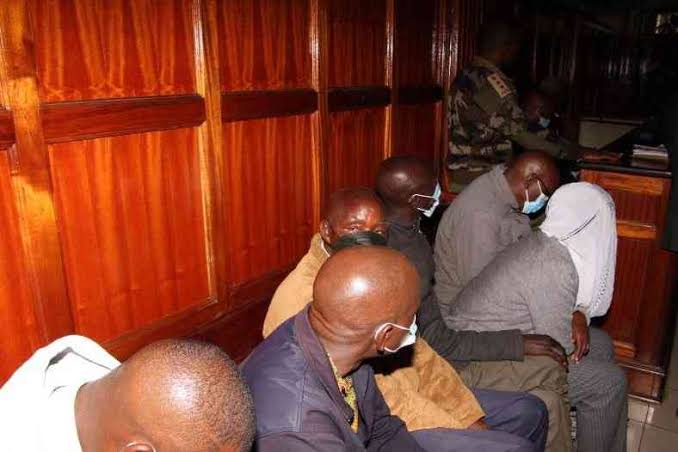
Four police officers, John Chengo, Linah Kogey, Cyprine Robi, and James Rono, are charged with the murder of Baby Pendo, a six-month-old girl who suffered fatal injuries during police operations in Kisumu in August 2017.
They also face multiple counts of crimes against humanity, including murder, torture, and rape, under the International Crimes Act.
The officers have denied the charges and are out on a cash bail of Sh1 million each.
Eight other officers initially charged alongside them were cleared by the DPP for lack of evidence.
Justice Muigai had earlier barred the accused from entering certain estates in Kisumu; Nyalenda, Obunga, Nyawita, and Nyamasaria, where many victims reside.
The restrictions followed an application by victims’ lawyer Otieno, who sought protection for the victims against possible contact or intimidation.
The judge warned the accused against directly or indirectly contacting victims or disclosing information related to the case.
“Any such conduct will be treated as contempt of court,” she ruled on May 12.
Email your news TIPS to Editor@Kahawatungu.com — this is our only official communication channel
