


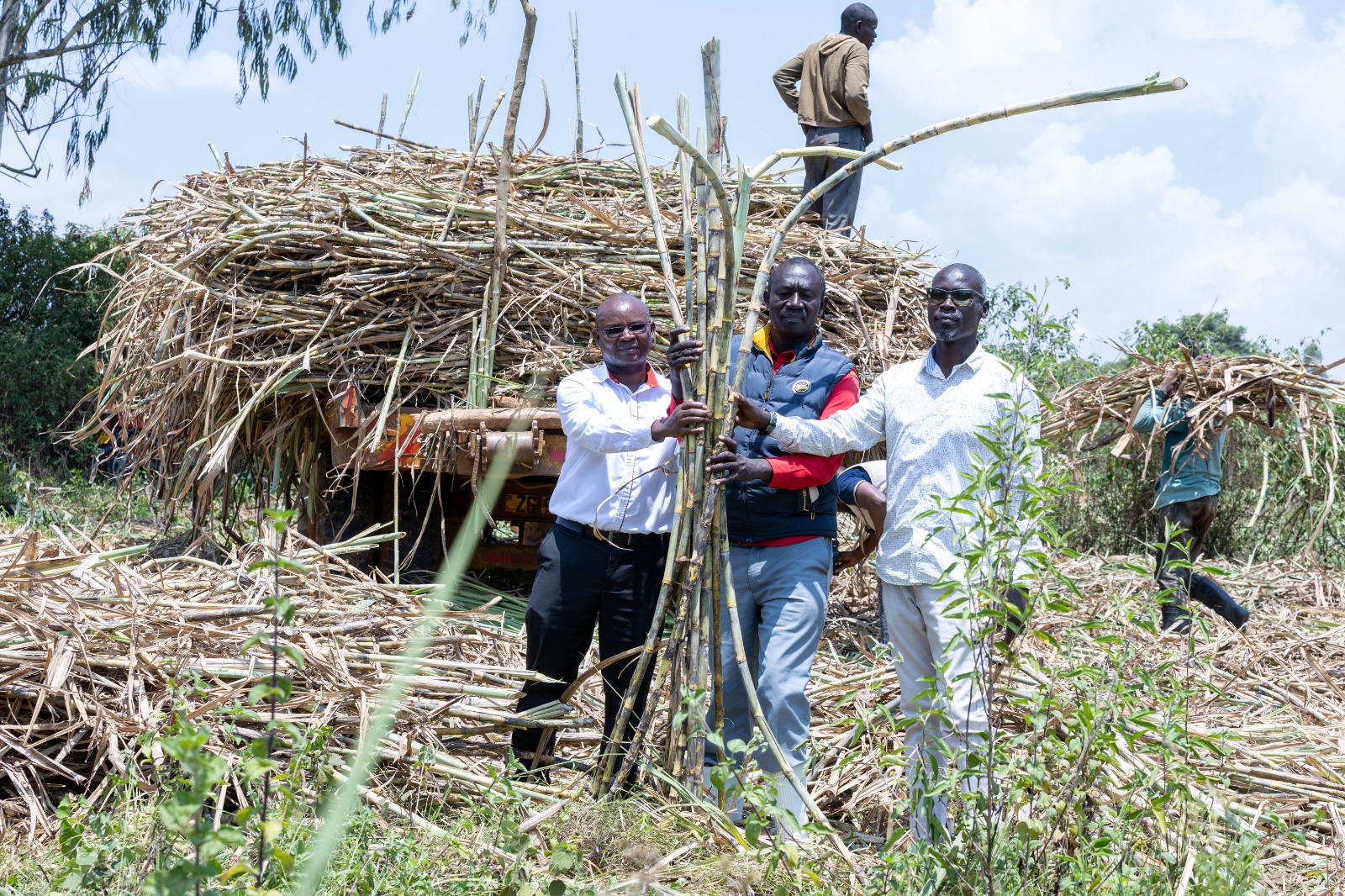
The shores of Lake Victoria are beautiful, but for fisherman Radido Otieno Peter, they were also unforgiving.
For six years, Peter cast his nets into the lake, living with the uncertainty of the catch and the constant gamble against changing weather and tides. Then, in 2010, he made a decision that would change the course of his life: he left fishing behind and turned to farming.
“I decided to leave the fishing nets behind,” Peter recalls. “I wanted to start farming. I wanted to plant something on the earth and watch it grow.”
He began with just three-quarters of an acre in Ywaya, Siaya County, planting sugarcane with little more than hope, patience and determination.
When the first harvest came in, Peter was surprised by what the crop had yielded. Rather than spend the proceeds, he saved almost every cent and leased three more acres. That decision marked the beginning of an extraordinary journey.
Today, the small piece of land he started with has grown into a 480-acre sugarcane enterprise, making Peter one of the leading individual suppliers of sugarcane in the region. He delivers approximately 6,000 metric tonnes of cane every year.
Peter attributes his growth to three critical partners: himself as the farmer, West Kenya Sugar Company as the miller, and Equity Bank as the financier.
It is a relationship that has evolved over more than a decade.
“Peter has grown from one acre to nearly 500 acres,” says Titus Ondigo, Head of Agriculture at West Kenya Sugar Company, who has followed Peter’s journey for 15 years. “In our company, we don’t call him a farmer; we call him a stakeholder. He gives us thousands of tonnes of cane every year. That is not an ordinary farmer. That is someone the entire value chain relies on.”
With annual turnover exceeding Sh30 million, Peter’s story demonstrates the potential of agriculture to create sustainable wealth. But farming at scale also comes with a fundamental challenge: sugarcane can take up to 18 months to mature, while the farmer’s financial needs continue throughout the production cycle.
“Cane takes time, but life does not stop,” Titus explains. “A farmer with a five-month-old crop still has school fees and medical bills. Without support, they might harvest early and lose profits. That is where Equity Bank steps in to bridge the gap, keeping the farmer’s life moving while the crop grows.”
For Nelson Otieno Ogon, Branch Manager at Equity Bank Mumias, Peter’s journey illustrates what sustained, relationship-based banking can achieve at the grassroots level.
“Peter has been banking with us for more than ten years,” says Nelson. “When you analyse his account, you see the beautiful story of steady, disciplined growth. He started with an unsecured loan of Sh500,000. As his business grew, we walked with him to Sh800,000, then Sh1 million, and recently we financed his agrovet shop for about Sh2 million.”
The relationship has also enabled Peter to invest in the tools needed to grow his agricultural enterprise.
A Sh3.4 million tractor, acquired through Equity’s asset finance, now sits on his farm. “Now, I can plough my farms easily and on time,” Peter says, gesturing towards his fields. “Whether it is early morning or late in the evening, I just start my tractor and go. It has changed everything.”
The financing has extended beyond Peter’s own farm. Through his agrovet business, he is also supporting other farmers in the surrounding community with access to agricultural inputs.
For Equity Bank, the relationship reflects how its Africa Recovery and Resilience Plan (ARRP) can translate into tangible support for entrepreneurs and farmers at community level – from financing agricultural inputs and mechanisation to supporting businesses that serve farmers along the value chain.
Peter’s growth has also created employment. His farm provides work for between 150 and 160 casual labourers every day, from tractor operators to workers involved in harvesting and loading cane.
“I look at these 480 acres and know I cannot consume all this wealth alone,” Peter says with a laugh. “This farm belongs to the community; it keeps our local economy moving.”
For Peter, however, the impact of his farming enterprise is measured in more than acreage, tonnes and turnover.
The proceeds from his sugarcane business have helped educate his six children in university and four in high school, turning the farm into an investment in his family’s future.
His influence also extends into the wider community. As patron of a local women’s group, Peter has encouraged members to embrace formal banking. The group is now exploring financing through Equity for a passenger van to support local transport.
Peter’s journey from fishing on Lake Victoria to managing hundreds of acres of sugarcane is ultimately a story about recognising an opportunity, reinvesting patiently and building the right partnerships.
What began as a three-quarter-acre experiment has become a thriving enterprise, creating jobs, supporting families and demonstrating the economic potential of agriculture in rural Kenya.
Peter left the lake in search of a more predictable future. On the land, he found much more than a livelihood he found an enterprise capable of transforming an entire community.

Email your news TIPS to Editor@Kahawatungu.com — this is our only official communication channel
