


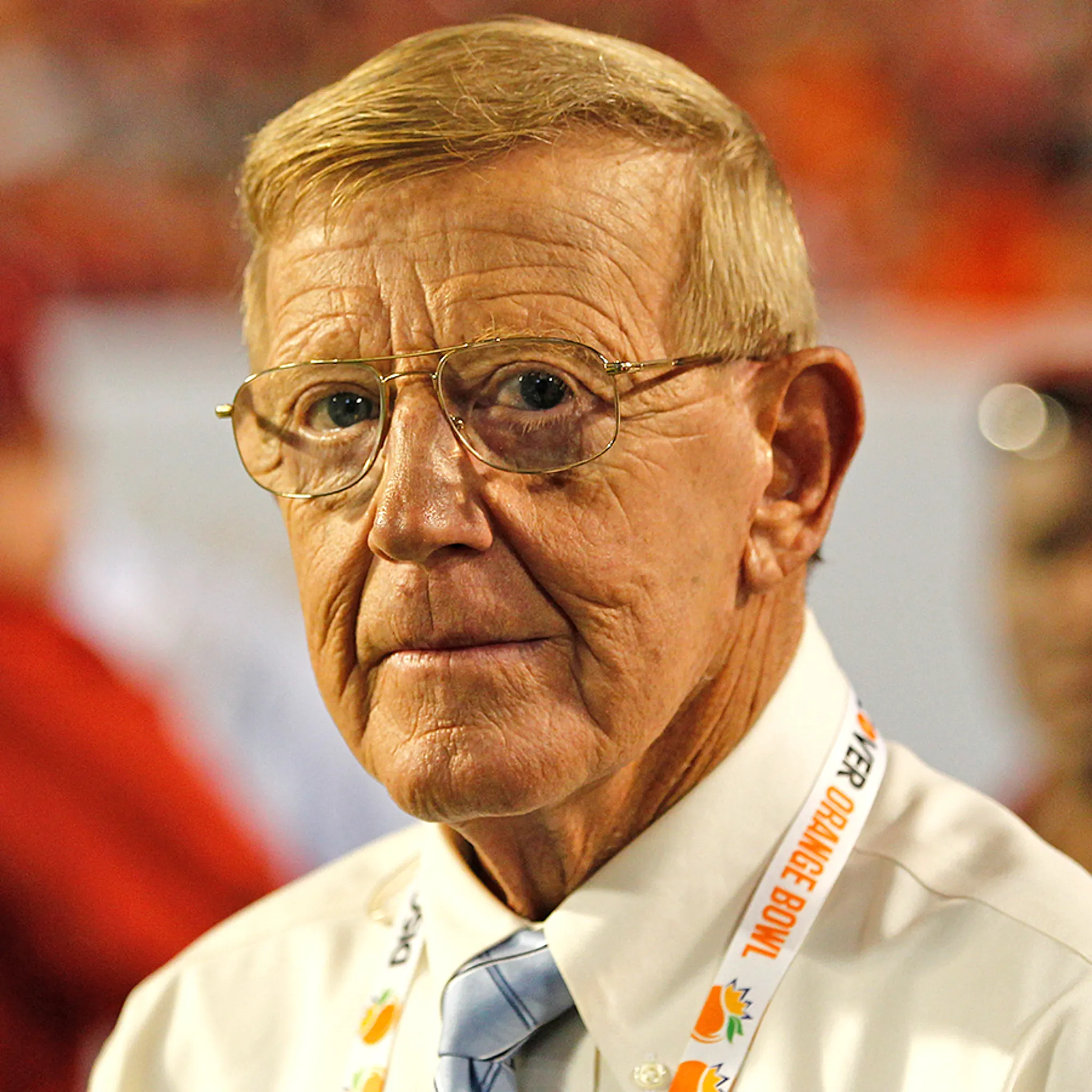
Lou Holtz was an American football coach, television analyst and motivational speaker who had an estimated net worth of $12 million at the time of his death on March 4, 2026. He was one of the most recognizable and successful coaches in college football history, best known for leading the Notre Dame Fighting Irish to an undefeated national championship season in 1988.
Holtz spent 33 years as a head coach, from 1969 to 2004, and compiled a 249-132-7 record. During his career, he coached six college programs: William & Mary, North Carolina State, Arkansas, Minnesota, Notre Dame and South Carolina.
Holtz became known for taking struggling programs and quickly turning them into competitive teams. His 11-year tenure at Notre Dame was the defining period of his career. The Fighting Irish went 100-30-2 under Holtz, reached nine consecutive bowl games and won the 1988 national championship after completing a perfect 12-0 season.
After retiring from coaching, Holtz built a second career as a television analyst and motivational speaker. His work with ESPN made him a familiar figure on college football broadcasts for more than a decade.
| Lou Holtz Net Worth | $12 Million |
| Date of Birth | January 3, 1937 |
| Place of Birth | Follansbee, West Virginia |
Lou Holtz Salary
Lou Holtz earned substantial income during his decades as a college football coach.
When he signed a five-year contract extension with Notre Dame in 1991, the exact terms were not publicly disclosed. However, he was generally reported to be earning about $1 million per year at the time.
Holtz’s compensation increased considerably later in his career. His peak coaching salary was approximately $6 million per year during his tenure at South Carolina.
His coaching salaries, broadcasting work, speaking engagements and other activities contributed to his estimated $12 million net worth.
Early Life
Louis Leo Holtz was born on January 3, 1937, in Follansbee, West Virginia. He was the son of Andrew and Anne Marie Holtz.
His family later moved to East Liverpool, Ohio, where Holtz grew up and attended East Liverpool High School. His father worked as a bus driver and later owned a bus company that eventually went bankrupt.
Holtz later said that his family’s financial difficulties helped shape his work ethic and outlook on life.
He attended Kent State University, where he played linebacker for the football team and earned a degree in history. After graduating, Holtz served in the United States Army Reserve as a field artillery officer.
He later attended the University of Iowa, where he worked as a graduate assistant while earning a master’s degree.
Coaching Career
Holtz began his coaching career in 1960 as an assistant at the University of Iowa.
Over the following decade, he held assistant coaching positions at several schools, including William & Mary, Connecticut, South Carolina and Ohio State.
His time at Ohio State was particularly important to his development as a coach. In 1968, Holtz worked under legendary coach Woody Hayes as part of the Buckeyes’ staff that won a national championship.
Hayes’ emphasis on discipline and preparation influenced Holtz’s own coaching philosophy.
Holtz received his first head coaching opportunity in 1969 at William & Mary. In three seasons, he helped transform the program and led the team to the 1970 Southern Conference championship and a Tangerine Bowl appearance.
In 1972, he became head coach at North Carolina State. Holtz led the Wolfpack to four consecutive bowl games and established himself as one of the rising coaches in college football.
NFL Stint With the New York Jets
In 1976, Holtz made a brief move from college football to the NFL when he became head coach of the New York Jets.
The move did not produce the success he had enjoyed in college. The Jets struggled during the season and finished with a 3-10 record under Holtz.
With one game remaining, Holtz resigned from the position. He later acknowledged that professional football was not the right environment for him and returned to college coaching.
The brief NFL experience was the only major setback in a coaching career otherwise defined by success at the college level.
Arkansas Success
Holtz took over as head coach of the University of Arkansas in 1977.
He quickly turned the Razorbacks into a competitive national program. During his seven seasons at Arkansas, the team posted a 60-21-2 record and reached six bowl games.
One of the biggest highlights of his Arkansas tenure came in the 1978 Orange Bowl. The Razorbacks defeated Oklahoma 31-6, preventing the Sooners from claiming the national championship.
Holtz resigned in 1983 following a disappointing 6-5 season and controversy surrounding his participation in political television advertisements.
Notre Dame
After a brief period coaching Minnesota, Holtz was hired by Notre Dame in 1986.
The Fighting Irish program had struggled before his arrival, but Holtz quickly began rebuilding the team.
His defining achievement came in the 1988 season.
Notre Dame completed the regular season undefeated and entered the postseason with a 12-0 record. The Fighting Irish defeated USC in their final regular-season game before facing West Virginia in the Fiesta Bowl.
Notre Dame won the Fiesta Bowl and completed a perfect season, securing the national championship.
The championship became the biggest achievement of Holtz’s coaching career and remains the defining accomplishment of his tenure at Notre Dame.
Notre Dame Record
Holtz spent 11 seasons as Notre Dame’s head coach, from 1986 through 1996.
During that period, the Fighting Irish compiled a 100-30-2 record. The team also reached nine consecutive bowl games and finished in the Top 10 nine times.
Holtz became one of only a small number of coaches to reach 100 victories at Notre Dame.
His teams were known for their discipline, physical style and preparation. The success he achieved at Notre Dame cemented his reputation as one of the greatest program builders in college football.
Holtz stepped down following the 1996 season, saying that it was the right time to move on.
South Carolina and Final Coaching Years
After retiring from Notre Dame, Holtz briefly worked as a television analyst before returning to coaching in 1999.
He became head coach of the University of South Carolina, taking over a program that had won only one game the previous season.
Holtz once again produced a major turnaround.
South Carolina made consecutive bowl appearances in 2000 and 2001. Holtz remained with the Gamecocks through the 2004 season.
His final game was a rivalry matchup against Clemson. The game ended with a bench-clearing brawl between the two teams.
Holtz announced his retirement the following day, bringing his 33-year head coaching career to an end.
Over his career, he became the only coach in NCAA history at the time to lead six different programs to bowl games. He also guided four different schools to Top 20 rankings.
Broadcasting Career
After retiring from coaching, Holtz transitioned into television.
He initially worked as a college football analyst for CBS before joining ESPN in 2004.
At ESPN, he became a regular contributor to programs including “College Football Live,” “College Football Final,” “SportsCenter” and “College Football Scoreboard.”
Holtz’s distinctive voice, humor and motivational style made him a recognizable presence on college football broadcasts.
He remained with ESPN until 2015 and continued working as a motivational speaker after leaving the network.
Honors and Recognition
Holtz received numerous awards during his coaching career.
He was a two-time winner of the Paul “Bear” Bryant Award and a two-time Eddie Robinson Coach of the Year. He also received coach-of-the-year honors from the Sporting News, the Walter Camp Foundation and several athletic conferences.
In 2008, Holtz was inducted into the College Football Hall of Fame.
In December 2020, he received the Presidential Medal of Freedom from President Donald Trump, the highest civilian honor in the United States.
These honors reflected Holtz’s influence on college football and his long career as a coach, broadcaster and motivational speaker.
Real Estate
Real estate was another significant part of Holtz’s financial portfolio.
In 1997, he paid $254,000 for a 1.3-acre property in the private Lake Nona Golf & Country Club community in the Orlando area.
Holtz built an approximately 11,000-square-foot home on the property. In 2015, a lightning strike caused a fire that destroyed much of the house.
A new 11,000-square-foot home was completed in 2017.
In September 2020, Holtz put the property on the market for $4.5 million. He eventually accepted $4 million for the home in August 2021.
The property represented one of the most notable real estate transactions associated with the former coach.
Personal Life
Lou Holtz was married to Beth Barcus from 1961 until her death in 2020.
The couple had four children: Skip, Kevin, Luanne and Liz.
His son Skip Holtz followed him into football and became a college football coach himself. The coaching connection between father and son extended the Holtz family’s influence in the sport.
After retiring from coaching, Lou Holtz lived in the Lake Nona Golf & Country Club community in Orlando, Florida.
Death
Lou Holtz died on March 4, 2026, at the age of 89 after entering hospice care earlier in the year.
His death marked the end of a career that spanned more than six decades in football, including coaching, broadcasting and motivational speaking.
Holtz left behind a legacy built around program turnarounds, national championships and his distinctive approach to leadership. His 1988 Notre Dame national championship remains the centerpiece of his coaching career.
Also Read: Barry Switzer Net Worth

Email your news TIPS to Editor@Kahawatungu.com — this is our only official communication channel
