


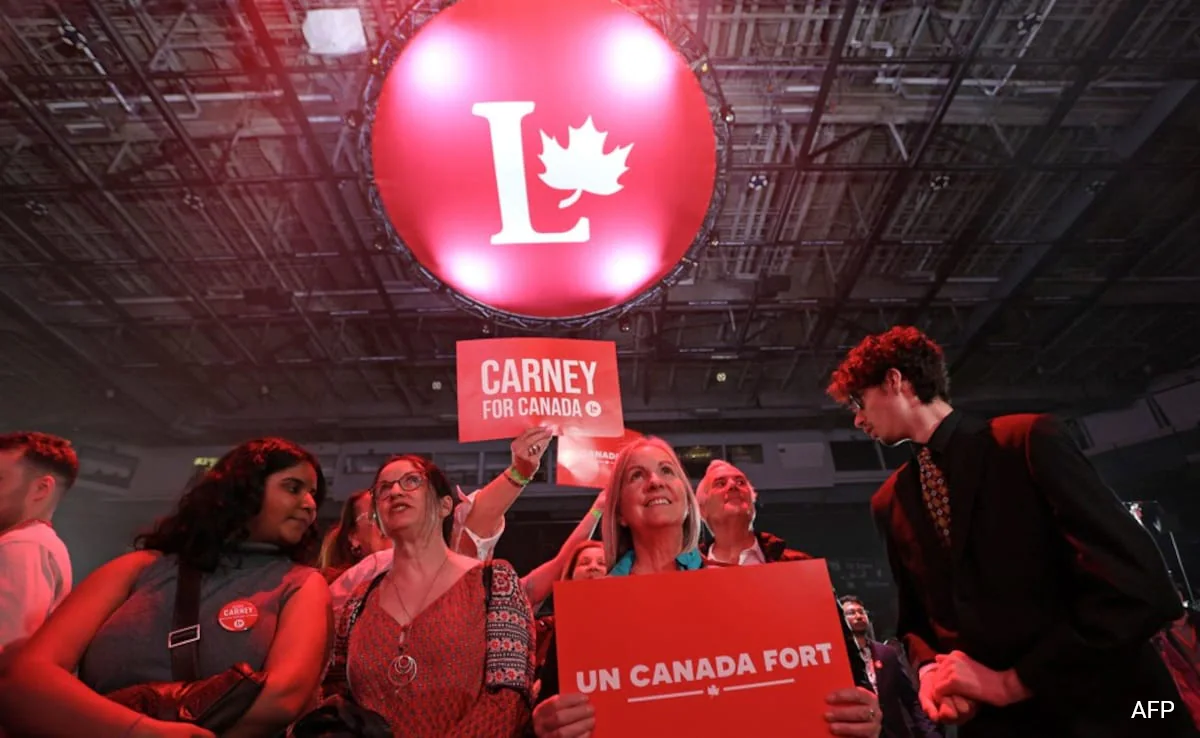
Mark Carney’s Liberals are projected to have won Canada’s federal election – riding a backlash of anti-Trump sentiment to form the next government.
It is a stunning political turnaround for party who were widely considered dead and buried just a few months ago.
It’s not yet clear if the party – which has been in power for almost a decade – will be able to secure a majority as results continue to role in.
Here are four takeaways from an election which also saw the opposition Conservatives make major gains but still lose.
1. Trump’s threats became the defining issue
There is no doubt the US president’s tariff threats and comments undermining Canada’s sovereignty played an outsized role in this election, suddenly making leadership and the country’s economic survival the defining issues of the campaign.
Mark Carney used it to his advantage, running as much against Trump as he did against his main opposition rival, Conservative leader Pierre Poilievre.
Carney warned Canada was at a crisis moment, saying frequently on the campaign trail that Trump “wants to break us so America can own us”.
Poilievre brought Trump up much less frequently during the campaign, focusing his message on domestic issues – the cost of living, the housing affordability crisis, and crime – and targeting the Liberals for their record on those matters.
Carney – who has declared the old relationship with the US “over” – plans to start negotiations on a new economic and security relationship immediately following the election.
Kevin O’Leary, a Canadian businessman close to Trump who previously ran for the Conservative leadership, acknowledged it was a successful campaign strategy.
“Right now Canadians are very frustrated with America and Carney has used that to his advantage,” he told the BBC just before polls closed. “He was able to distract Canadians from his own mistakes… and say ‘Stop looking at that. Look south of the border and I can save you’.”
2. A stunning debut for a political newcomer
At the start of the year, Carney was a former central banker with no experience as a politician. By mid-March, he was being sworn in as prime minister – the first to have never held elected public office before – after a resounding win in the Liberal leadership race.
Now, he’s faced the Canadian electorate as a first time campaigner, won an Ottawa-area seat in the House of Commons and steered his party to an unlikely victory.
Carney had long flirted with entering Canadian politics – and he seized his moment, swooping in after former Prime Minister Justin Trudeau’s sudden resignation in January.
He also took full advantage of the new political landscape, leaning into his experience helping Canada and the UK navigate previous crises at a time when Canadians were feeling anxious about their economic future.
Trump’s late-March announcement of global levies on foreign automobile imports gave Carney the chance to publicly audition to keep his job during the campaign. He was able to step away from the trail and take on the prime minister’s mantle, setting up a call with the president and meeting US Cabinet ministers.
3. Conservatives make gains but still fall short
In a different election, this would have been a successful one for the Conservatives.
In 2011, the Conservatives won a majority with 39.6% of the vote. Conservative leader Pierre Poilievre is on track to beat that this time, with roughly 41% of the vote with just under half of polls reporting, according to Election Canada.
They are currently projected to have won 149 seats – that’s up from 120 at dissolution, when the election was called.
The Conservative leader focused mostly on domestic concerns, targeting his message to voters disaffected by what Poilievre called a “Lost Liberal decade”.
But with the progressive vote coalescing around the Liberals, those numbers weren’t enough this time.
This will be a bitter loss for the Conservatives, who only months ago had a clear path to victory and will now need to figure out way forward after a series of electoral defeats.
It will now be up to the party to decide if they want to keep Pierre Poilievre as leader, the third leader they’ve had since the Liberals swept the 2015 election.
4. Collapse of the left-wing New Democrats
In this election, the smaller political parties have taken a hit as Canadians choose to park their votes with either the Liberals or the Conservatives – especially the left-wing New Democrats, or NDP.
Some of the smaller parties have lost a significant amount of vote share, particularly the NDP who have received just 5% of votes counted across Canada so far, compared with 18% in 2021.
The Greens have also seen their vote share cut in half from 2% to 1%.
Shachi Kurl, president of the Angus Reid Institute, a non-profit public opinion research organisation, told the BBC that Trump’s rhetoric was behind the shift to the Liberals.
“The threats, the annexation talk, all of that has been a huge motivator for left of centre voters,” she said.
The sovereigntist Bloc Québécois have maintained a vote share of 8%, although it remains to be seen how that translates into seats.
This is based on around 30% of polls reporting.
Canada doesn’t have a two-party system, even though it has historically voted in conservative or liberal governments in some form.
In the country’s political system, these smaller parties still play a role in Parliament. Both the NDP and the Bloc have at some points formed Official Opposition in the House of Commons.
By BBC News
Email your news TIPS to Editor@Kahawatungu.com — this is our only official communication channel
