


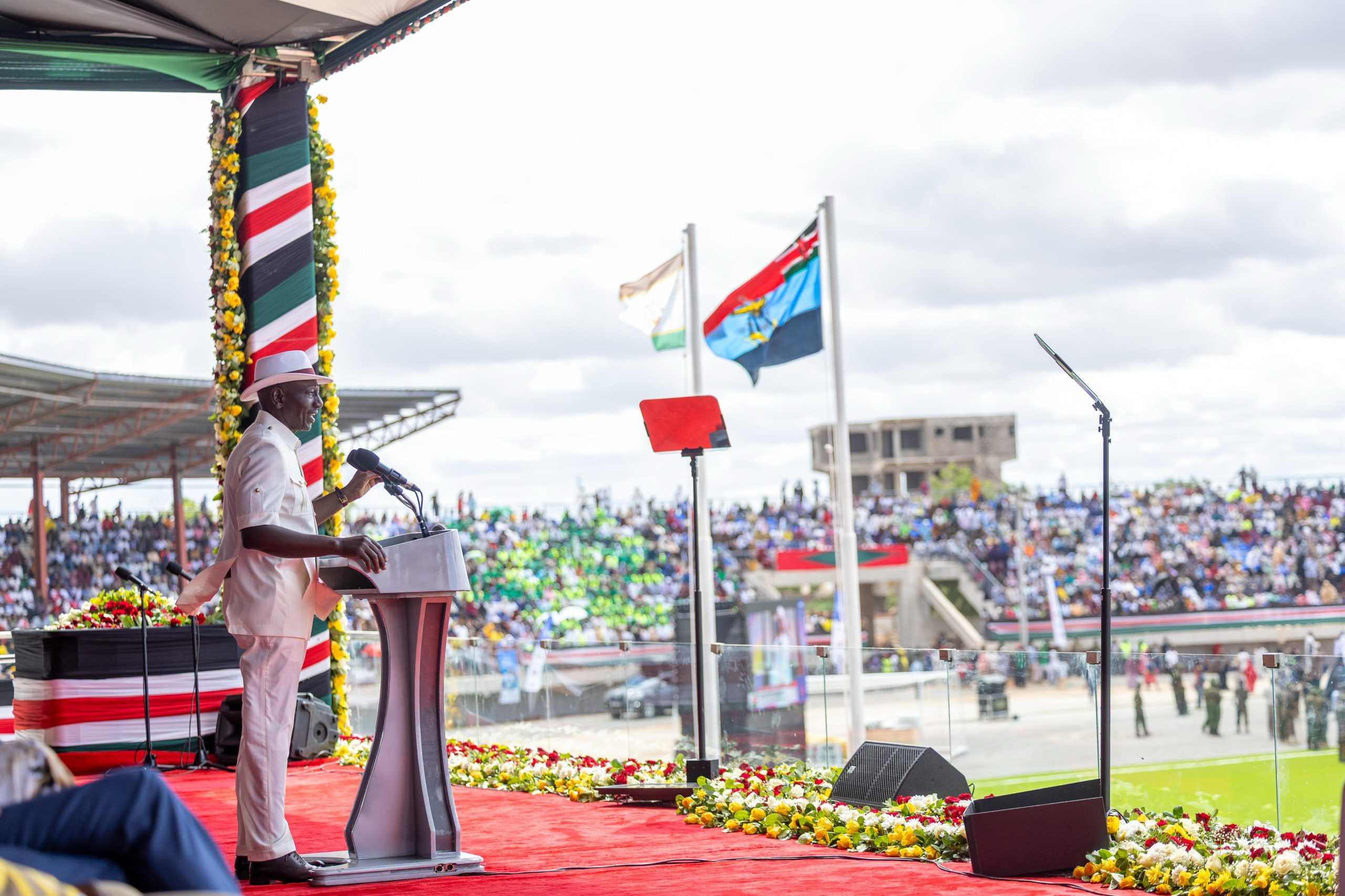
President William Samoei Ruto unveiled an ambitious Sh5 billion livestock investment initiative targeting more than 350,000 pastoralists across 21 Arid and Semi-Arid Lands (ASAL) counties, signaling what could be the most significant government-backed transformation of Kenya’s livestock sector in decades.
Speaking during the 63rd Madaraka Day celebrations in Wajir County, the President declared that livestock farming must be accorded the same priority and support as crop agriculture, arguing that pastoral communities have for too long been excluded from mainstream economic development despite their immense contribution to the national economy.
“Livestock is agriculture and pastoralists are farmers,” Ruto said, as he outlined a sweeping package of interventions aimed at turning livestock keeping from a largely subsistence activity into a globally competitive commercial enterprise.
He announced the establishment of a County Livestock Investment Company initiative that will enable pastoralists to form and own livestock investment companies, giving them greater control over markets, financing, insurance and value-addition opportunities.
The initiative is expected to directly benefit more than two million household members during its first phase. Ruto directed the Mutahi Kagwe led Ministry of Agriculture and Livestock Development and county governments to immediately begin the registration of the companies across all 21 ASAL counties.
The announcement capped a series of livestock sector reforms highlighted by the Head of State, who described Northern Kenya as the future gateway of Africa’s livestock trade to the Middle East and other international markets.
According to the President, livestock contributes about 12 per cent of Kenya’s Gross Domestic Product and 42 per cent of agricultural GDP. In ASAL regions, the sector accounts for more than 90 per cent of employment and nearly 95 per cent of household incomes.
Despite this economic significance, he noted that pastoralism has historically suffered from inadequate investment in animal health, market access, infrastructure and financing.
To reverse this trend, the government has in recent years rolled out extensive interventions, including a livestock restocking programme that has distributed more than 52,000 sheep, goats and cattle to over 10,000 households across 16 ASAL counties.
He further revealed that more than 10 million animals have been vaccinated under government-supported campaigns, while local vaccine production has been expanded to over 123 million doses.
Other interventions include the establishment of feedlots and hay storage facilities, restoration of more than 305,000 hectares of degraded rangelands, expansion of breeding programmes and investment in livestock marketing infrastructure.
In a move aimed at strengthening extension services in pastoral areas, Ruto announced the deployment of an additional 2,000 agripreneurs to ASAL counties. The officers will provide advisory services, facilitate market linkages and support climate-smart livestock production systems.
The deployment brings the total number of agripreneurs serving farmers across the country to 7,000.
The President said the government’s efforts are already yielding results.
Kenya’s meat exports have risen by 84 per cent, increasing from Sh8.9 billion in 2022 to Sh16.4 billion in 2025. Milk production has also grown from 4.6 billion litres to 5.3 billion litres over the same period, while dairy exports have nearly tripled from Sh4.9 billion to Sh14.2 billion.
Ruto said the growth demonstrates the untapped potential of the livestock sector and the benefits of sustained government investment.
Looking ahead, he pledged expanded livestock restocking programmes, enhanced vaccination campaigns, improved breeding initiatives, additional feedlots and stronger drought resilience measures.
The government will also operationalise the Livestock Enterprise Development Fund, establish a National Strategic Fodder Reserve, strengthen pastoral cooperatives and fully roll out the Animal Identification and Traceability System (ANITRAC) to improve access to premium export markets.
The President emphasized that Kenya must move beyond exporting live animals and instead focus on higher-value products such as processed meat, leather and dairy products.
“For too long, many looked at livestock and saw subsistence. We look at livestock and see enterprise. We see exports. We see jobs. We see wealth,” Ruto said.
The livestock-focused agenda formed a central pillar of this year’s Madaraka Day celebrations, underscoring the government’s intention to position pastoralism at the heart of Kenya’s economic transformation while accelerating the inclusion of historically marginalized regions in national development.

Email your news TIPS to Editor@Kahawatungu.com — this is our only official communication channel
