


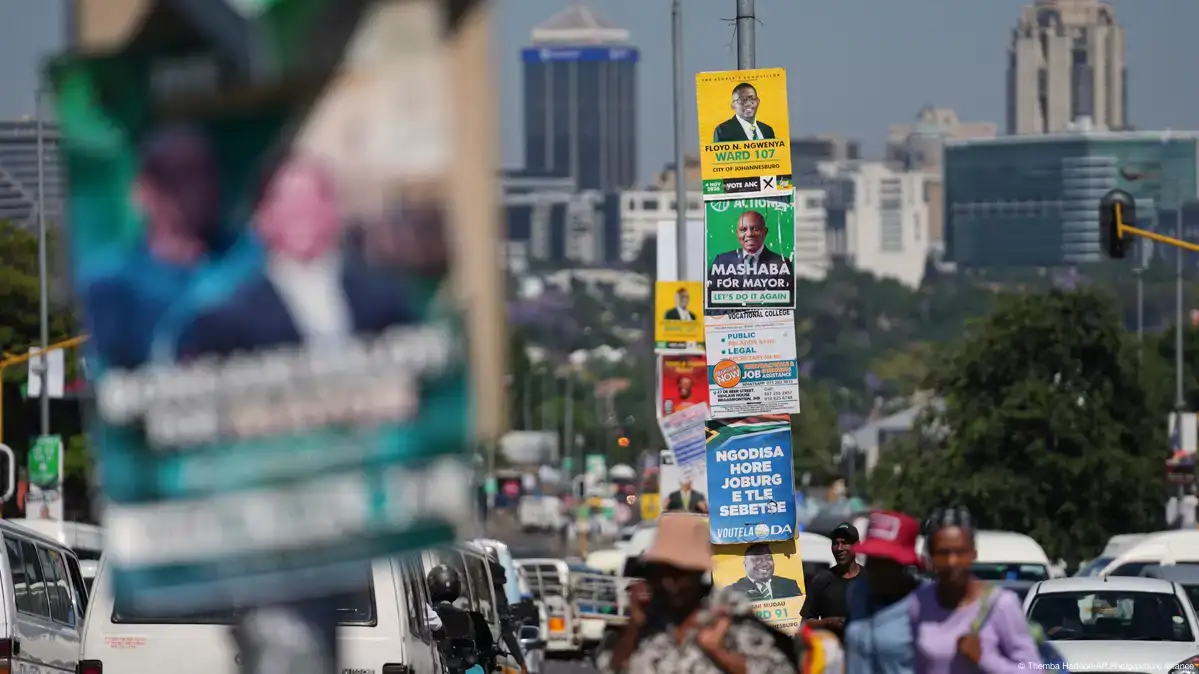
The party that has dominated South Africa for more than 30 years is in a race against time to secure power-sharing deals in most of the country’s cities after a massive drop in its support in this month’s local elections.
The African National Congress (ANC) suffered its worst result since it came to power in 1994 when South Africa transitioned from the racist apartheid system to democracy.
It won a majority in just one of the country’s nine provinces, Limpopo, down from six in the last elections. It won the most votes in just two of the country’s eight cities, compared with six in 2021.
At the national level, the ANC is sharing power with its long-time rival, the Democratic Alliance (DA), but while there is still no official announcement, it appears that ANC party officials do not want to replicate this at the local level.
Parties have until 27 November to negotiate and form local governments.
What happened in the local election?
While the ANC saw a massive decline in its support, it still got more votes than any other party, 31%, down from the 46% in the last local election.
But in the country’s economic powerhouse, Gauteng province, which includes Johannesburg and Pretoria, the picture is different. The pro-business DA got the most votes in both cities, as well as the province’s other main region, Ekurhuleni.
Nationally, the party got 25% of the vote, up from 22% five years ago.
It also retained its majority in its power base of Cape Town, and got the most votes in Nelson Mandela Bay, where Gqeberha (Port Elizabeth) is located.
The left-leaning uMkhonto weSizwe (MK) Party, led by former President Jacob Zuma, came third, with 10% of the vote. This is a repeat of its performance in the 2024 national election, when it came in third and became the official opposition after the DA joined the coalition government.
It emerged as the biggest party in KwaZulu-Natal province, which includes the port city of Durban, securing 34% of the vote. However, this leaves it reliant on agreeing a coalition with other parties.
The only party to secure an overall majority in a city was the DA in Cape Town.
Why is the ANC apparently choosing smaller parties over the DA?
The DA and ANC have had an uneasy alliance since they entered a coalition, along with eight other political parties, in 2024.
The two, long-standing rivals due to their opposing policies, were forced into an agreement after the ANC lost its parliamentary majority for the first time since the end of apartheid. This became known as the Government of National Unity (GNU).
Despite this, the two parties have continued to disagree on key issues, and both sides have threatened to rip up their power-sharing deal.
Ahead of the local elections, analysts predicted that the two parties could team up at municipal level, mirroring the national arrangement.
The ANC seems to have rejected this, with state broadcaster SABC reporting that most of the party’s top leaders see an agreement with the DA as a last resort.
Instead, the party has been courting smaller parties to try and form councils in South Africa’s cities.
In Gauteng, numerous reports point to an arrangement between the party and the anti-immigrant ActionSA, which emerged as the third largest party in the province with 17%, leaving it as a potential kingmaker.
The DA has also been trying to reach arrangements with smaller parties, and the ANC, but looks set to assume the opposition benches at least in Gauteng.
ActionSA is unlikely to work with the DA as they cannot agree on the mayoral candidates in Johannesburg and Pretoria.
Does this signal a breakdown in the relationship between the ANC and DA nationally?
It’s too early to tell. Neither the ANC nor DA have spoken publicly about the future of their arrangement on a national level amid the ongoing coalition talks but the ANC’s reluctance to partner with the DA in key cities points to continued strain between the two.
While the GNU has remained intact since it was formed in 2024, there have been those in the ANC who have been angered by what they view as the DA’s dual role as opposition and partner in the coalition government and have pushed for the arrangement to end.
A party insider told the Daily Maverick on Sunday that a nationwide agreement to work with the DA at municipal level “was overwhelmingly rejected” at a meeting held by ANC members.
While some experts predict that the DA may have to consider its position in the coalition government given the ANC’s stance, political analyst Andre Duvenhage told the BBC there was a possibility that “a lot of asymmetrical coalitions” could emerge – parties working together in one area and being in opposition elsewhere.
Another political analyst, Sandile Swana, said that any party wanting to leave the GNU over the failure to secure deals locally would be “[shooting] yourself in the foot”.
Would coalition governments improve services?
This is what voters want.
The decline in the ANC’s support was seen as being mainly due to high levels of corruption and a loss of confidence in its ability to provide basic services, such as electricity, water and rubbish collection.
While some attribute the increase backing for the DA to its record of competent management in municipalities under its control, some have accused it of neglecting poorer areas and townships.
But the experience of coalition governments over the past 10 years does not inspire much confidence that things will improve.
Half of the country’s cities have been governed through power-sharing agreements since 2016 and these types of arrangements have often been viewed as unstable and chaotic.
As agreements collapse and new ones are forged, the delivery of basic services has often been affected.
This has been particularly evident in Gauteng, where governance in all three cities has come under scrutiny in recent years partly because of unstable governments.
Experts agree that even after new arrangements take effect, it will take longer than a five-year term to resolve the issues facing many municipalities, particularly South Africa’s biggest city Johannesburg.
“I think if we are really turning the ship around, we are talking about a 10-year period,” Duvenhage said.
Swana echoed this, saying it would take a decade to “cleanse and purify” local councils and “reinstate them as “proper municipalities”.
By BBC News

Email your news TIPS to Editor@Kahawatungu.com — this is our only official communication channel
