


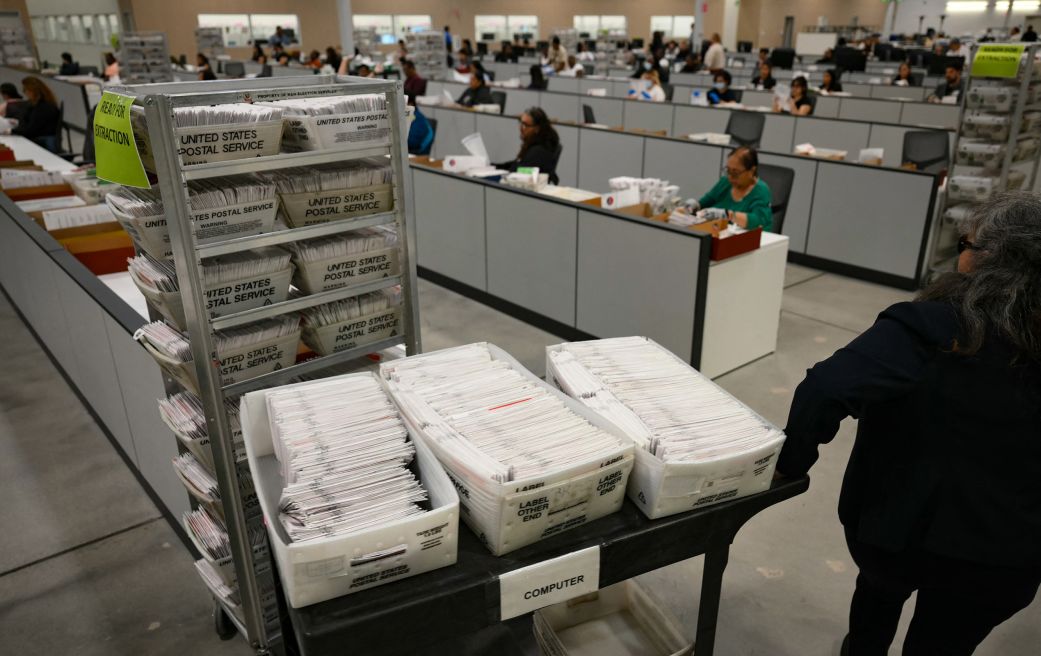
Trump administration efforts to force change in the handling of election ballots may be facing a bigger hurdle than the cross-country court challenges and resistance: Election officials insist it is simply too late for them to even try to comply with the proposed rules.
In court filings and interviews with CNN, election officials and other mail voting experts said that there is no practical way to comply with the Postal Service’s plans – even if states can find the millions of dollars they expect compliance to cost.
The administration has described the new postal rules as a “modest” change for states, but if states or local officials don’t meet the requirements for mail voting programs, the agency won’t deliver their ballots – risking mass disenfranchisement.
Vendors have told election officials there is not enough time to print the millions of envelopes that would need to be redesigned under the rule. It’s even possible that not enough paper stock exists to do so, according to court filings.
Getting local election administrators authorized and trained in a never-before-used portal the agency has set up for uploading states’ lists of mail voters would take thousands of hours of staff time.
“We’re weeks away from ballots going out and USPS still can’t answer basic questions about how this is going to work. Clearly they don’t even know,” Amanda Gonzalez, the clerk of Jefferson County, Colorado, which will send out 433,000 mail ballots, told CNN.
“These aren’t minor implementation details – they determine whether millions of eligible voters get their ballots,” said Gonzalez – who is running for Colorado secretary of state as a Democrat. “At this point, even when we prevail and it’s not implemented, the uncertainty being created by all of this is itself an election risk.”
That reality is why election officials and those who work with them have resisted panicking about the hypothetical consequences of the regulations, as they have been focused instead on the immediate confusion that has been caused for voters. In communications with the public, election officials have sought to convey clear message that the election will go on in November, and their ability to cast ballots – by mail or otherwise – will be protected.
A new USPS whistleblower report released Tuesday added additional uncertainty. It alleged that the agency had allotted just a few days to test a haphazardly built system for ingesting the voter information required by the plan. The risks of IT weaknesses in the system were exacerbated by the agency’s intention, according to the report, to reject entire batches of ballots – impacting the ballot access of potential tens of thousands of voters in some jurisdictions – if just one envelope in the batch did not match the information in the portal.
The mandates are currently on hold under a temporary federal court rulingthat is being appealed by the administration. But the issue has traveled up to the Supreme Court once already – which gave the administration the greenlight to craft a final plan for the rules – and now that the final plan has been announced, it’s expected to reach the justices again.
“Most election officials – when they saw the Executive Order in March – they have had their head downs conducting their primaries, getting ready for the midterms,” said Tammy Patrick, the chief programs office for the National Association of Election Officials. When the final USPS plan was released last month, “many of them were shocked when they heard what was in the rule.”
The White House dismissed the election officials’ concerns, saying they should have been prepared given the proposal was rolled out “months ago.”
“Any confusion was caused by radical Democrats’ litigation to stop these commonsense measures that protect the security of mail-in ballots and ensure only Americans are electing American leaders,” White House spokeswoman Lauren Bis said in a statement.
A Postal Service spokesperson told CNN in a statement Tuesday the agency is “carefully reviewing” the concerns raised by the whistleblower.
“The United States Postal Service has spent months developing a U.S. Federal Ballot Mail Portal to provide election officials with a simple, secure, and efficient way to share lists of individuals receiving ballots by mail in their respective states. This work has at all times been conducted in a manner consistent with court orders,” the spokesperson said.
“Regardless of political party or perspective, we share a common goal: ensuring that Americans can have confidence that their election mail will be handled securely and delivered reliably,” the spokesperson said.
In court filings, USPS has defended the requirements, noting they are relying on the same laws that govern “special handling and conditions on acceptance for other types of materials that are similarly sensitive yet non-dangerous, raising unique operational concerns– such as cremated remains or replica explosives.”
Amid the legal whiplash, election officials are focused on carrying out the election while assuring voters that they should expect to vote by mail as they have already done. Election officials are anticipating a legal rollercoaster of Trump’s order being revived and blocked again, but because an election would have to happen this November, the practical hurdles to following the plan had become insurmountable.
Nevada Secretary of State Cisco Aguilar told CNN’s Dana Bash that the new whistleblower disclosures made him “nervous” and “very concerned,” but said that, as the court fight continued, he and other Democratic secretaries of state were “not going to relent in allowing this administration to dictate how to run elections.”
Reprinting millions of ballot envelopes
The Postal Service wants to require that both the “outbound” envelope carrying the ballot to the voter and the “inbound” envelope bringing the ballot back to the election office have a barcode for automated tracking that’s unique to each voter.
The unique barcodes are already present on “outbound” envelopes in many jurisdictions with heavy mail-in voting, but not as common on the return envelopes. And in rural areas where mail voting isn’t as popular, both sets of envelopes can lack the required bar codes, as is the case in more than a dozen counties in Pennsylvania, according to court filings.
The cost for reprinting the ballots could be in the millions of dollars for some states. Washington Elections Director Stuart Holmes said in court filings it would cost nearly $2 million, because more than 1 million envelopes would need to be replaced for counties there that don’t have the unique bar codes for inbound ballots.
When Holmes reached out last week to the three major vendors the state uses for mail ballots, none were able to confirm they could reprint the ballots in time – cost aside.
“It’s just not possible for us to meet the USPS requirement,” Holmes told CNN.
If the rule went into effect, jurisdictions across the country would be ordering reprints, further exacerbating the choke point, the Oregon state elections office said in a court filing.
“(Vendors) do not have a stockpile of paper, and post-pandemic paper supply shortages mean that paper suppliers may not be able to timely supply our vendors with the paper they need,” saidOregon Elections Director Dena Dawson.
Before the election mail envelopes could even be reprinted, new designs would need to be reviewed and approved by USPS analysts, and here too, election officials say there’s no time to get that done.
USPS is believed to have just 40 or so Mailpiece Design Analysts – known as MDAs – and the new regulation asserts that the agency does not expect to need additional staff to implement it. Given the envelope design can vary by locality to locality – and some states like Michigan and Wisconsin have hundreds of individual election jurisdictions – thousands of ballots envelop designs would likely need the agency’s approval.
At least some of the 1,521 different envelope types in Michigan would need to be redesigned because they lack the unique bar code, according to a court declaration from the state elections director.
USPS cited in its regulation an average two-day time for analysts to approve a design. But election officials are also skeptical of those assurances given their experience already with USPS approvals, before any last-minute nationwide surge requests for approvals that Trump’s plan would bring.
“For Vermont, with 494 different ballot styles and corresponding ballot envelope styles, the approval of our ballot envelope styles took approximately 3 months,” Vermont Secretary of State Sarah Copeland Hanzas said in a court filing, referring to the routine work election officials do with USPS to streamline mail ballot delivery. “After all of that work, the USPS has requested changes for 247 envelope styles.”
Data upload process could take ‘thousands of hours’
The second big requirement under Trump’s plan is a requirement that election offices upload lists of voters to whom they will be sending ballots – lists that will need to be continually updated because in many states, voters can register to vote and apply for mail ballots up until a few weeks, or even days, before the election.
The untested portal USPS has created for the job is causing heartburn, and mail voting experts noted to CNN here are still basic questions about how those upload process will work. The agency’s regulation suggested Excel would be an accepted format, but, under the default settings, numbers that begin with zeros see those zeros stripped – creating the potential for errors.
The Colorado secretary of state’s office estimates the data ingestion process will add “tens of thousands of hours” of work to election staff across the state, in part because its voter registration database doesn’t currently record the envelope bar codes assigned to each over. That data will need to be added manually to the portal.
USPS tasks state election chiefs with figuring out who in their state and local offices should be authorized and trained to access the portal – which in some states would amount to dozens or hundreds of people.
Arizona Secretary of State Adrian Fontes additionally raised concerns that the portal would not be able to handle a bulk upload of his state’s biggest jurisdiction, Maricopa County, which has more than 2.5 million voters. When the county ran its voter lists through a separate federal data system used for verifying citizenship status, the upload had to be scheduled when no other jurisdiction was using the data system to prevent the system from crashing, Fontes said in a court declaration.
He and other election officials raised concerns of confusion – both from voters who fear disenfranchisement as well as within in USPS in its implementation.
“Confusion is, in some instances, I think the goal,” Patrick said.
By CNN

Email your news TIPS to Editor@Kahawatungu.com — this is our only official communication channel
